African Dwarf Frog
The African Dwarf Frog (Hymenochirus boettgeri and related) is a small fully aquatic frog often kept in tropical aquariums.
🗓️ Last reviewed: September 2026
Overview
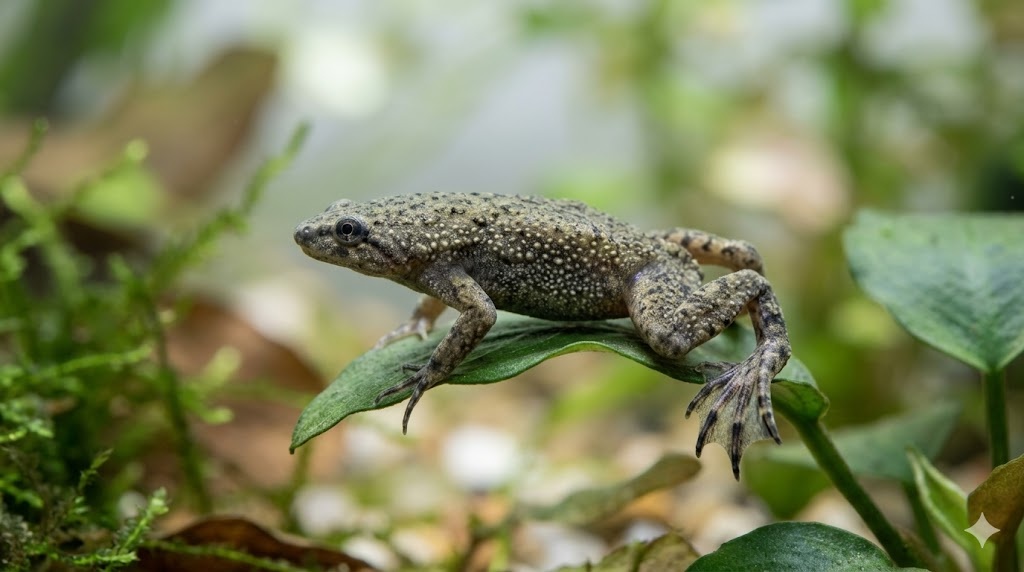
The African Dwarf Frog (Hymenochirus boettgeri and related) is a small fully aquatic frog often kept in tropical aquariums. They are entirely aquatic, social, and live well in groups. Often confused with the larger and predatory African Clawed Frog.
Natural History
Native to equatorial Africa. Fully aquatic - never leave water. Lives in still or slow-moving freshwater.
Appearance
Adults 3-4 cm length. Grey-brown speckled colour. Four webbed feet - all four have webbing (Clawed Frogs have webbing only on hind feet).
Temperament & Handling
Calm, social. Never handle - fully aquatic species; lift only briefly with a soft net if essential.
Enclosure
Minimum: 40 L (10 gallon) for 2-3 frogs.
Provide:
- Calm filtration (gentle flow only).
- Live or silk plants.
- Hides.
- Tight lid (they can jump out at water surface).
Heating, Lighting, Humidity
- Water temperature: 22-26°C. Heater required in most homes.
- Soft lighting.
Diet
Carnivorous. Frozen bloodworms, brine shrimp, sinking carnivore pellets. Target-feed near the bottom; floating food may not reach them.
Health & Lifespan
5 years (some 10+).
Common concerns:
- Chytrid fungus - devastating amphibian disease.
- Bacterial infections.
- Bloat.
Pros & Cons
Pros: sociable, peaceful, small space, attractive in planted tanks. Cons: short-lived; sensitive to water quality.
🐾 Everyday gear for amphibians
Links go to Amazon or a partner brand's own store and may earn us a commission at no extra cost to you. As an Amazon Associate we earn from qualifying purchases. We link gear types, not sponsors' picks: you choose the exact product.
African Dwarf Frog - frequently asked questions
African Dwarf vs Clawed Frog?
Dwarf: small (4 cm max), peaceful, fully webbed feet. Clawed: large (12+ cm), aggressive predator, only hind feet webbed.
Can they live with fish?
Sometimes - small peaceful fish (small tetras). Avoid fast-feeding fish (the frogs starve).
How long do they live?
5 years on average; some over 10.
Do they need land?
No - fully aquatic.
Can I handle them?
No. Permeable skin absorbs oils and chemicals.
🧠 Test yourself: guess the amphibian
Three clues from our quiz bank, each about another of our amphibians. Can you name them?
Clue 1.This stout amphibian of the genus Ceratophrys will try to swallow prey nearly its own size and may wait days for a meal.
It's the Pacman Frog (Horned Frog) - read the full profile →
Clue 2.This amphibian's larvae sometimes become cannibalistic, growing larger heads to prey on their own kind when food is scarce.
It's the Tiger Salamander - read the full profile →
Clue 3.A popular beginner amphibian, this little green-and-black hopper spends much of its time floating in shallow water.
It's the Fire-Bellied Toad - read the full profile →