Desert Rain Frog
The Desert Rain Frog (Breviceps macrops) is a small, round, sand-dwelling amphibian from the fog belt of coastal Namibia and South Africa, best known for the squeaky "war cry" it makes when threatened.
Updated: September 2026
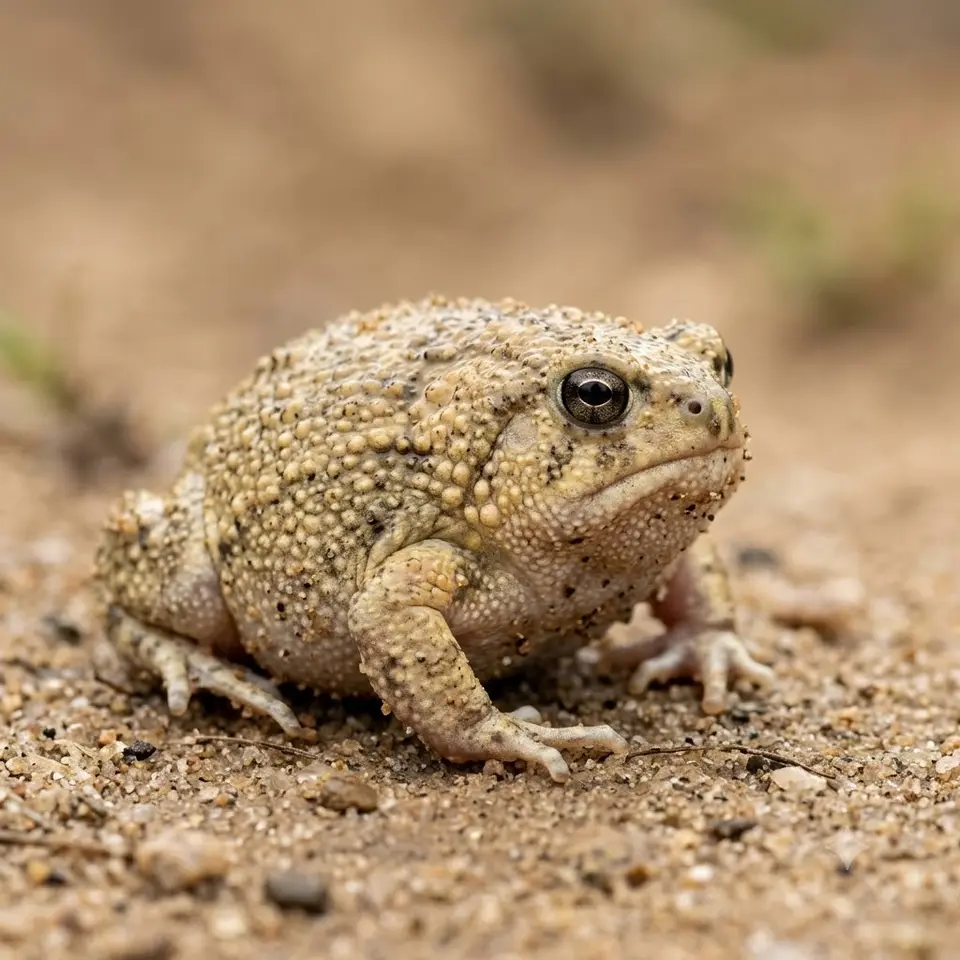 AI illustration
 Wash your hands after handling. The FDA notes that reptiles and amphibians can carry Salmonella and show no signs of illness, so the animal, its enclosure and everything in it can spread the germs: wash your hands with soap and water straight after touching any of them. The agency says children younger than 5, pregnant women, the elderly and people with weakened immune systems should not handle reptiles or amphibians. Source: FDA, Salmonella and pet reptiles and amphibians.
Overview
The Desert Rain Frog (Breviceps macrops) is a small, round, sand-dwelling amphibian from the fog belt of coastal Namibia and South Africa, best known for the squeaky "war cry" it makes when threatened. It is a fossorial specialist that spends nearly all its life buried in damp dune sand, surfacing at night when coastal fog rolls in. Despite viral internet fame, it is one of the hardest amphibians to keep and is almost never captive-bred. For the overwhelming majority of keepers, this is a species to admire, not to own.
Natural History
Breviceps macrops lives in a narrow strip of coastal dunes in Namaqualand, straddling the Namibia-South Africa border. It survives in a near-rainless environment by relying on nightly sea fog for moisture. By day it burrows into cool, slightly damp sand; by night it emerges to hunt small invertebrates. Unlike most frogs, it has no tadpole stage - eggs develop directly into froglets underground. It is considered a species of conservation concern, with habitat loss from mining and development as the main pressures.
Appearance
Adults are tiny, roughly 4-6 cm (1.6-2.4 in) long, with a rounded, almost spherical body, short stubby limbs, and large protruding eyes. Coloration is sandy yellow to pale brown with a translucent belly, providing camouflage against dune sand. The skin is granular, and the face has a slightly grumpy, downturned look that fuels its internet popularity.
Temperament & Handling
This is strictly a look-do-not-touch species. Desert Rain Frogs are shy, stress-prone, and easily injured, and their permeable skin absorbs oils, salts, and residues from human hands. Handling offers no benefit to the animal and real risk. If a frog must be moved, use clean, wet, powder-free gloves or a damp container and keep contact to seconds. The famous defensive squeak is a sign of a stressed animal, not a party trick.
Enclosure
Recreating a coastal dune microclimate is the central challenge. A single adult needs a minimum footprint around 40 x 30 cm (16 x 12 in) with a deep substrate.
Provide:
- At least 15 cm (6 in) of fine, clean sand (silica or washed dune-type sand) for burrowing.
- A moisture gradient: keep the lower sand layers lightly damp while the surface stays drier.
- Minimal decor - a flat piece of cork or a shallow hide, plus a very shallow water area.
- A secure, well-ventilated lid to avoid stagnant, soggy air.
Avoid deep water dishes; these frogs drink and hydrate through their skin from damp sand, not by soaking.
Heating, Lighting, Humidity
- Temperature: cool, roughly 15-22 C (59-72 F). This species does not tolerate heat, and typical "tropical" reptile setups will kill it.
- Humidity: high ambient humidity with regular light misting to mimic fog, but never waterlogged sand.
- Lighting: low, indirect light. No basking bulb is needed; a dim day-night cycle is enough.
Stable cool temperatures are the single biggest husbandry hurdle in most US homes.
Diet
Insectivore. Offer small live prey such as flightless fruit flies, pinhead to small crickets, and small roach nymphs, sized smaller than the frog's head. Feed a few appropriately sized items every 2-3 days. Dust prey with a calcium plus D3 supplement at most feedings to prevent metabolic bone disease. Remove uneaten insects so they do not stress or bite the frog.
Health & Lifespan
4-8 years. Captive longevity for Breviceps macrops is poorly documented because so few are kept successfully, so this figure is only a rough estimate; wild lifespan is thought to be just a few years. Most captive losses come from husbandry error, not disease.
Common concerns:
- Overheating and dehydration from incorrect temperature or humidity.
- Impaction or skin irritation from dirty or oversized substrate.
- Metabolic bone disease from poor supplementation.
- Chronic stress in animals that are handled or wild-collected.
Find an exotics vet experienced with amphibians before acquiring any frog.
Pros & Cons
Pros: small footprint, fascinating natural history, no heat lamp required, striking round appearance. Cons: almost never captive-bred, so specimens are typically wild-caught; extremely difficult to keep; conservation-sensitive; not handleable; poorly understood in captivity.
Everyday gear for amphibians
Links go to Amazon or a partner brand's own store and may earn us a commission at no extra cost to you. As an Amazon Associate we earn from qualifying purchases. An Amazon link leads to a type of gear and you choose the exact product; a card that names a store leads to that partner's own shop.
Desert Rain Frog - frequently asked questions
Can I actually buy a Desert Rain Frog as a pet?
Rarely, and you probably should not. There is essentially no established captive-bred supply, so animals in the trade are usually wild-caught from a range-restricted species of conservation concern. Ethically and practically, this is a species to enjoy through documentaries, not ownership.
Is it toxic or dangerous?
No. It is harmless to people and does not produce medically significant toxins. The risk runs the other way - your skin oils and residues can harm the frog.
Why does it squeak?
The high-pitched cry is a defensive display meant to startle predators. Hearing it from a captive animal usually means it feels threatened and stressed.
What is a better beginner alternative?
For a similar round, burrowing look with far easier care and a solid captive-bred supply, consider a Pacman Frog or an African Bullfrog instead.
Test yourself: guess the amphibian
Three clues from our quiz bank, each about another of our amphibians. Can you name them?
Clue 1.This aquatic salamander never undergoes metamorphosis, keeping its feathery external gills and living its entire life underwater in its larval form.
It's the Axolotl - read the full profile →
Clue 2.A popular beginner amphibian, this little green-and-black hopper spends much of its time floating in shallow water.
It's the Fire-Bellied Toad - read the full profile →
Clue 3.Native to the rivers of central Africa, this little webbed-footed swimmer lacks a tongue and tiny teeth, sweeping food into its mouth with its hands.
It's the African Dwarf Frog - read the full profile →