Golden Mantella
The Golden Mantella (Mantella aurantiaca) is a tiny, brilliantly orange frog from Madagascar whose glowing color is a warning sign that its skin carries mild toxins.
Updated: September 2026
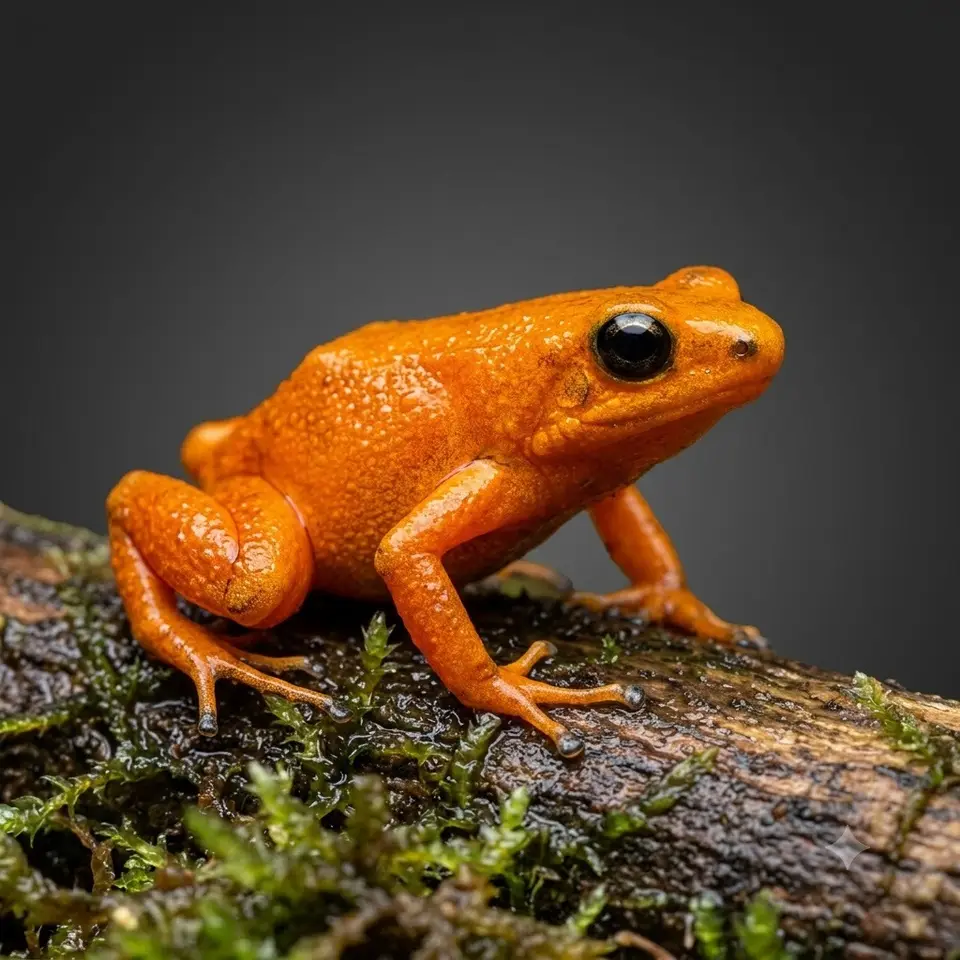 AI illustration
 Wash your hands after handling. The FDA notes that reptiles and amphibians can carry Salmonella and show no signs of illness, so the animal, its enclosure and everything in it can spread the germs: wash your hands with soap and water straight after touching any of them. The agency says children younger than 5, pregnant women, the elderly and people with weakened immune systems should not handle reptiles or amphibians. Source: FDA, Salmonella and pet reptiles and amphibians.
Overview
The Golden Mantella (Mantella aurantiaca) is a tiny, brilliantly orange frog from Madagascar whose glowing color is a warning sign that its skin carries mild toxins. Rarely larger than a thumbnail, it is a diurnal, ground-dwelling species that does best kept in small groups inside a planted, tropical vivarium. Because wild populations are endangered, only captive-bred animals should ever be purchased. It is a look-don't-touch display frog, not a pet to handle.
Natural History
Golden Mantellas come from a small patch of humid forest and pandanus swamp in central-eastern Madagascar, where they live among leaf litter near seasonal breeding pools. Their range is tiny and shrinking from logging, agriculture, and mining, and the IUCN lists them as a threatened species. They are protected under CITES Appendix II, which regulates international trade. Wild-collected animals still surface in the trade, but they carry heavy ethical and conservation baggage, so responsible keepers buy only captive-bred frogs from reputable breeders.
Appearance
Adults are small, roughly 0.8-1 inch (20-25 mm) long, with females slightly larger and rounder than males. The classic color is a solid, vivid orange to golden-red, sometimes with a redder flush on the hind legs. That bright coloring is aposematic - it advertises the frog's skin toxins to predators. The smooth skin and rounded snout give them a jewel-like look that makes them popular display animals despite their small size.
Temperament & Handling
Do not handle Golden Mantellas. Like most amphibians, their skin is permeable and absorbs oils, salts, soaps, and lotions from human hands, and they in turn secrete mild alkaloid toxins. The toxicity comes largely from a diet of wild ants and mites, so captive-bred frogs raised on cultured insects are far less toxic - but the rule stays the same: hands off. If you must move a frog, use a clean container or wet, unpowdered nitrile gloves rinsed in dechlorinated water, and always wash up afterward. They are active, bold little frogs that forage in the open by day, which makes them rewarding to simply watch.
Enclosure
A trio or small group is happier than a single frog; Mantellas are social and tolerate cohabitation well.
Minimum: about 18 x 18 x 18 inches (45 x 45 x 45 cm) for a group of three to five.
Provide:
- A bioactive setup with a drainage layer, then a moisture-holding substrate such as coco fiber and sphagnum moss topped with leaf litter.
- Live plants, cork bark, and hides for cover and humidity.
- A shallow water dish with dechlorinated water, since these frogs are weak swimmers and can drown in deep water.
- A springtail and isopod clean-up crew to control mold and add micro-prey.
Heating, Lighting, Humidity
- Temperature: 68-75 F (20-24 C) by day, a few degrees cooler at night. These are cool-climate frogs and heat is dangerous; sustained temperatures above 78 F (26 C) can be fatal, so no heat lamp is usually needed at normal room temperature.
- Humidity: 70-90%, maintained by daily misting with dechlorinated or reverse-osmosis water.
- Lighting: a low-level UVB (roughly 2-5%) plus a plant grow light supports the frogs and live plants on a 12-hour cycle. Keep the enclosure out of direct sun to avoid overheating.
Diet
Golden Mantellas are insectivores that eat very small, moving prey. Staples include flightless fruit flies (Drosophila), springtails, and pinhead crickets, with the occasional tiny bean beetle or aphid for variety. Feed adults every one to two days and juveniles daily, offering only what they clear in a few minutes. Dust prey with a calcium plus D3 supplement at most feedings and a multivitamin once or twice a week to prevent deficiencies.
Health & Lifespan
8-10 years.
With good husbandry these frogs regularly live 8-10 years, sometimes longer. The most common problems are keeper-driven: overheating, which stresses and kills them quickly; metabolic bone disease from poor calcium and UVB; and dehydration or skin infection from low humidity or dirty water. Chytrid fungus is a serious amphibian disease, so quarantine new arrivals and buy from clean sources. Signs of trouble include lethargy, bloating, weight loss, and reluctance to eat. Find an exotics or amphibian-experienced veterinarian before you need one.
Pros & Cons
Pros:
- Small footprint and no heat lamp needed in most homes.
- Diurnal and active, so they are genuinely fun to watch.
- Can be kept in social groups.
- Striking, ornamental color.
Cons:
- Strictly look-don't-touch; mildly toxic skin.
- Very sensitive to heat and water quality.
- Tiny live prey (fruit flies, springtails) must be cultured or sourced constantly.
- Conservation-sensitive; only captive-bred should be bought.
Everyday gear for amphibians
Links go to Amazon or a partner brand's own store and may earn us a commission at no extra cost to you. As an Amazon Associate we earn from qualifying purchases. An Amazon link leads to a type of gear and you choose the exact product; a card that names a store leads to that partner's own shop.
Golden Mantella - frequently asked questions
Are Golden Mantellas poisonous?
Their skin carries mild alkaloid toxins, signaled by the bright color. Captive-bred frogs fed cultured insects are far less toxic than wild ones, but the toxins can still irritate. Never handle them and always wash your hands after any contact with the enclosure.
Can I keep more than one together?
Yes. Unlike many frogs, Golden Mantellas are social and do well in groups of three to five in an appropriately sized planted vivarium, as long as all frogs are similar in size and well fed.
Do they need a heater?
Usually not. They prefer cool room temperatures of 68-75 F (20-24 C), and heat above about 78 F (26 C) is genuinely dangerous. Focus on keeping them cool and humid rather than warm.
Where should I buy one?
Only from a reputable breeder selling captive-bred animals. Wild Golden Mantellas are endangered and protected under CITES, so buying captive-bred is both the ethical and the healthier choice.
Test yourself: guess the amphibian
Three clues from our quiz bank, each about another of our amphibians. Can you name them?
Clue 1.A common aquarium amphibian only a couple of inches long, it has four webbed feet and is often kept underwater rather than in a terrarium.
It's the African Dwarf Frog - read the full profile →
Clue 2.Famous for its permanent smile and frilly pink gill stalks, this underwater creature is a popular exotic pet and a marvel of regeneration.
It's the Axolotl - read the full profile →
Clue 3.A hardy arboreal amphibian whose waxy skin secretions help it resist drying out, allowing it to bask more than most frogs.
It's the White's Tree Frog - read the full profile →