Solomon Island Leaf Frog
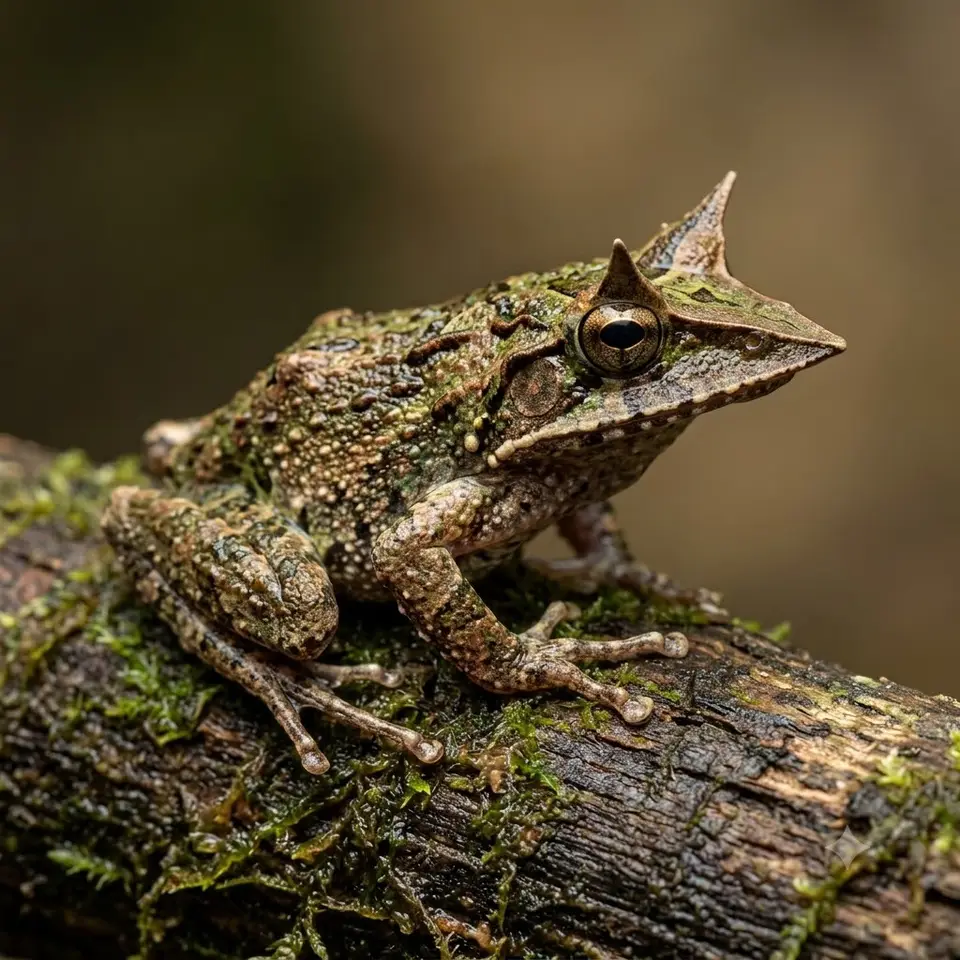
The Solomon Island Leaf Frog (Cornufer guentheri, formerly Ceratobatrachus guentheri) is a leaf-mimicking ambush predator from the Solomon Islands whose triangular head, fleshy "eyelash" points, and skin flaps make it look exactly like a dead leaf on the forest floor.
Updated: July 2026
 AI illustration
 Wash your hands after handling. The FDA notes that reptiles and amphibians can carry Salmonella and show no signs of illness, so the animal, its enclosure and everything in it can spread the germs: wash your hands with soap and water straight after touching any of them. The agency says children younger than 5, pregnant women, the elderly and people with weakened immune systems should not handle reptiles or amphibians. Source: FDA, Salmonella and pet reptiles and amphibians.
Overview
The Solomon Island Leaf Frog (Cornufer guentheri, formerly Ceratobatrachus guentheri) is a leaf-mimicking ambush predator from the Solomon Islands whose triangular head, fleshy "eyelash" points, and skin flaps make it look exactly like a dead leaf on the forest floor. Also sold as the triangle frog or Guenther's triangle frog, it is famous for skipping the tadpole stage entirely - eggs hatch straight into tiny fully formed froglets. It is a striking display animal and, thanks to numerous US and European breeders, is now widely available captive-bred. This is a look-don't-touch species for keepers who value watching over holding.
Natural History
Native to the Solomon Islands archipelago and Bougainville in Papua New Guinea, this frog lives in leaf litter and low vegetation of humid lowland and hill forest. It is a sit-and-wait predator, staying motionless among dead leaves until prey wanders close. Its most unusual trait is direct development: females lay eggs in moist ground or small hollows at the base of trees and skip the free-swimming tadpole phase completely, so froglets emerge as miniatures of the adult. This means no aquatic setup is ever needed. The species also breeds fairly freely in captivity, which is why captive-bred stock is now common in the hobby.
Appearance
Adults reach roughly 6-10 cm (2.5-4 inches), with females larger than males. The body is compressed and angular, the snout sharply pointed, and small horn-like projections sit above each eye. Skin ridges and flaps break up the outline, and coloration ranges across tan, brown, rust, olive, and grey, often with a pale mid-back stripe. The overall effect is convincing dead-leaf camouflage. Males have a visible vocal sac and produce a distinctive bark-like call.
Temperament & Handling
This is a nervous, secretive frog best kept as a display animal. Do not handle it except when strictly necessary, such as a health check or enclosure move. Like all amphibians, its skin is highly permeable and absorbs oils, salts, soaps, and lotions from human hands. If you must move it, wet your hands with dechlorinated water first, or better, herd it gently into a clean cup. It is not venomous and produces no dangerous toxin like a cane toad, but the no-handling rule still applies for the frog's sake. It will also snap at anything small enough to swallow, including smaller frogs, so keep only size-matched animals together and never mix it with other species.
Enclosure
Minimum: 45 x 45 x 45 cm (18 x 18 x 18 inches) for one adult; a similar footprint can hold a size-matched pair or trio.
Provide:
- A deep layer of moist substrate (coco fiber, ABG mix, or a bioactive soil blend).
- A thick top layer of leaf litter for burrowing, camouflage, and security.
- Cork bark, cork rounds, and low plants for cover.
- A shallow, easily exited water dish with dechlorinated or spring water.
- A tight-fitting lid; these frogs can be escape artists.
A bioactive setup with springtails and isopods as cleanup crew works well and holds humidity.
Heating, Lighting, Humidity
- Temperature: 22-27 C (72-80 F), ideally the upper 70s F, with a mild night drop. They tolerate a range, but sustained heat above about 29 C (84 F) is stressful and temperatures near 32 C (90 F) can be fatal; this is a humid-forest species, not a desert reptile.
- Humidity: moderate to high, around 60-80%, maintained with regular misting and a moisture-retentive but well-ventilated setup. They tolerate short dips as long as clean water is always available.
- Lighting: low, ambient light is fine. A low-level UVB bulb is optional and can support long-term health, but is not strictly required if diet is well supplemented.
Diet
Insectivore. Offer appropriately sized live prey: crickets, dubia roaches, black soldier fly larvae, and the occasional earthworm or waxworm as a treat. Feed juveniles every 1-2 days and adults every 2-3 days, adjusting to body condition. Dust prey with a calcium plus D3 supplement at most feedings and a multivitamin roughly once a week. As an ambush predator it feeds best when prey moves past it in cover rather than being chased.
Health & Lifespan
5-10 years.
Because captive-bred animals are now widely available, sourcing is far less of a gamble than it once was - buy captive-bred when you can, as these froglets arrive healthier and better established than wild-caught imports. Any wild-caught animal should still get a fecal exam and quarantine with an exotics vet, since imports often arrive stressed, dehydrated, and carrying internal parasites. Beyond that, watch for:
- Metabolic bone disease from poor calcium or vitamin D supplementation.
- Impaction from loose or oversized substrate being swallowed with prey.
- Skin and bacterial infections from dirty or too-dry conditions.
- Chronic stress and refusal to eat, most common in freshly imported wild-caught specimens.
Pros & Cons
Pros:
- Extraordinary leaf-mimic looks and a distinctive triangular profile.
- Widely available captive-bred from US and European breeders.
- Compact enclosure footprint; no aquatic or tadpole phase to manage.
- Fascinating direct-development biology for observation.
- Not toxic and not aggressive toward people.
Cons:
- Some wild-caught imports still enter the trade, so verify the source.
- Shy and secretive; often hidden in leaf litter.
- Prefers moderate humidity and cooler room temperatures, so warm homes may need management.
- Not a hands-on pet; handling harms the frog.
- Cannibalistic toward smaller animals, so tankmates must be size-matched and same-species only.
Everyday gear for amphibians
Links go to Amazon or a partner brand's own store and may earn us a commission at no extra cost to you. As an Amazon Associate we earn from qualifying purchases. An Amazon link leads to a type of gear and you choose the exact product; a card that names a store leads to that partner's own shop.
Solomon Island Leaf Frog - frequently asked questions
Are they captive-bred or wild-caught?
Both are sold, but captive-bred animals are now widely available from US and European breeders and are the better choice - the species breeds readily in captivity. Captive-bred froglets are hardier and better established. If you do buy a wild-caught import, budget for a vet fecal check and a proper quarantine period.
Can I hold my Solomon Island Leaf Frog?
No, not as a routine. Their permeable skin absorbs whatever is on your hands, and handling stresses them. Enjoy them as a display animal, and only move them with wet, clean hands or a cup when necessary.
Are they toxic or dangerous?
No. Unlike cane toads, they have no potent skin toxin and pose no real risk to people or pets. The no-handling advice is for the frog's protection, not yours.
Do I need a water section or a tadpole tank?
No. They develop directly from egg to froglet with no tadpole stage, so a terrestrial leaf-litter enclosure with a shallow water dish is all you need.
Test yourself: guess the amphibian
Three clues from our quiz bank, each about another of our amphibians. Can you name them?
Clue 1.This aquatic salamander never undergoes metamorphosis, keeping its feathery external gills and living its entire life underwater in its larval form.
It's the Axolotl - read the full profile →
Clue 2.With horn-like skin flaps over its eyes, this burrowing creature mimics a fallen leaf to ambush prey on the forest floor.
It's the Pacman Frog (Horned Frog) - read the full profile →
Clue 3.A hardy arboreal amphibian whose waxy skin secretions help it resist drying out, allowing it to bask more than most frogs.
It's the White's Tree Frog - read the full profile →