Tiger-Leg Monkey Frog
The Tiger-Leg Monkey Frog (Callimedusa tomopterna, formerly Phyllomedusa tomopterna) is a small Amazonian tree frog that hides bold orange-and-black tiger stripes on its flanks and legs.
Updated: September 2026
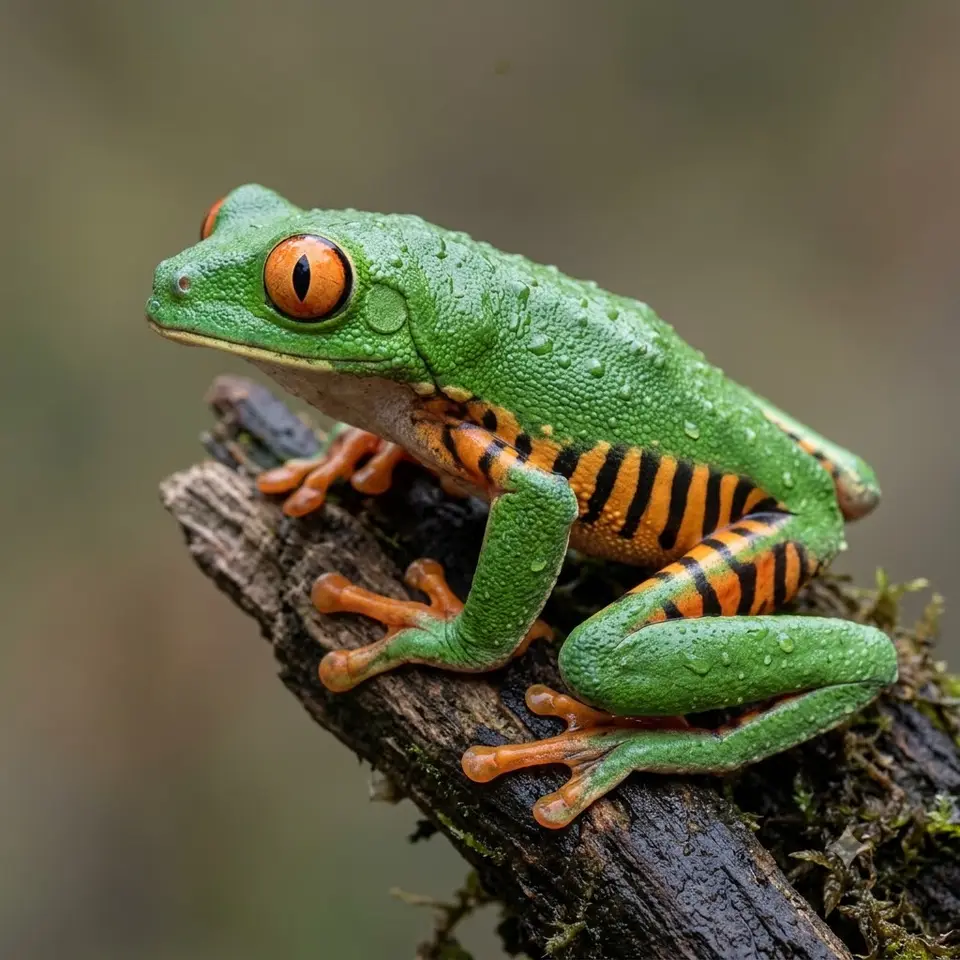 AI illustration
 Wash your hands after handling. The FDA notes that reptiles and amphibians can carry Salmonella and show no signs of illness, so the animal, its enclosure and everything in it can spread the germs: wash your hands with soap and water straight after touching any of them. The agency says children younger than 5, pregnant women, the elderly and people with weakened immune systems should not handle reptiles or amphibians. Source: FDA, Salmonella and pet reptiles and amphibians.
Overview
The Tiger-Leg Monkey Frog (Callimedusa tomopterna, formerly Phyllomedusa tomopterna) is a small Amazonian tree frog that hides bold orange-and-black tiger stripes on its flanks and legs. By day it sleeps folded flat against a leaf, looking like nothing but green; by night it wakes and climbs hand over hand like a tiny primate. It is a stunning display amphibian for keepers who want to watch, not touch.
Natural History
Native to the Amazon basin across Brazil, Peru, Ecuador, Colombia, Bolivia and the Guianas, where it lives in humid lowland rainforest. It belongs to the monkey frog group (Phyllomedusinae), named for their deliberate, grasping walk - they rarely jump unless startled. Wild frogs breed over temporary pools, folding leaves around their eggs above the water. Fully nocturnal: expect a motionless green lump all day and slow, methodical climbing after lights out.
Appearance
Small: adults reach about 2-2.5 in (5-6 cm), females noticeably larger and bulkier than males. The back is smooth leaf-green, the belly pale, and the hidden surfaces of the flanks and thighs carry vivid orange bars broken by black - the "tiger legs" that flash when the frog moves. Large silvery-grey eyes with vertical pupils. Resting frogs tuck every limb in tight, erasing the stripes completely.
Temperament & Handling
Calm, slow and completely non-aggressive, but this is a look-don't-touch pet - and we mean that honestly. Amphibian skin absorbs whatever it contacts, so oils, soap residue and salt from human hands can harm the frog. Monkey frogs also produce mild waxy skin secretions; they are not dangerous like a cane toad, but wash your hands after any contact and never touch your face first. Handle only for health checks or tank moves, with clean wet hands or a cup. Groups of similar size cohabit peacefully.
Enclosure
Vertical space matters more than floor space for this climber.
Minimum: 18 x 18 x 24 in (45 x 45 x 60 cm) for one adult or a pair; taller is better.
Provide:
- Plenty of climbing: cork branches, vines and sturdy live plants (pothos, philodendron) with broad leaves for daytime sleeping.
- Moisture-holding substrate such as coco fibre topped with leaf litter, or a drainage-layer bioactive setup.
- A shallow water dish, refreshed daily with dechlorinated water.
- Good cross-ventilation - stagnant humid air causes skin problems fast.
Heating, Lighting, Humidity
- Temperature: 75-82 F (24-28 C) day; a night drop to 70-72 F (21-22 C) is beneficial.
- Humidity: 60-80%, achieved with a nightly misting cycle; let it dip and air out during the day rather than staying saturated.
- Lighting: a 12-hour day cycle; low-output UVB (2-5%) over a screen top is recommended and supports calcium metabolism. No bright basking lamps.
Diet
Insectivore. Feed appropriately sized crickets, small dubia roaches, and the occasional moth or waxworm as a treat - prey no wider than the frog's head. Adults eat 3-4 items every 2-3 days, juveniles daily. Dust feeders with calcium plus D3 at most feedings and a multivitamin weekly. Feed at night when the frog is active; food left wandering by day is usually ignored.
Health & Lifespan
5-8 years. In captivity with good care, some individuals exceed this.
Common concerns:
- Stress and skin infections from poor ventilation or constant sogginess.
- Metabolic bone disease from missing calcium or UVB.
- Parasites - very common in wild-caught imports; get a vet fecal check on any new frog.
- Dehydration if misting lapses; a sleeping frog cannot reach the water dish.
Sourcing note: many tiger-legs in the US trade are still wild-caught imports, which arrive stressed and often parasitized. Captive-bred frogs cost more and take patience to find, but they are hardier, and buying them takes pressure off wild populations. Ask sellers directly and favor CB. The species can be kept without permits in most of the US, but some states, such as Hawaii, restrict amphibians, so check local rules.
Pros & Cons
Pros:
- Spectacular colors and unique monkey-like walking.
- Small, quiet and peaceful; pairs and groups work.
- Modest enclosure footprint for an arboreal display.
Cons:
- Nocturnal - essentially a green leaf all day.
- Not a handling pet, ever.
- Captive-bred stock can be hard to source.
Everyday gear for amphibians
Links go to Amazon or a partner brand's own store and may earn us a commission at no extra cost to you. As an Amazon Associate we earn from qualifying purchases. An Amazon link leads to a type of gear and you choose the exact product; a card that names a store leads to that partner's own shop.
Tiger-Leg Monkey Frog - frequently asked questions
Why is it called a monkey frog?
Because of how it moves. Instead of hopping, it walks and climbs with slow, deliberate hand-over-hand grips, wrapping its long fingers around branches like a small primate.
Is the Tiger-Leg Monkey Frog poisonous?
Its waxy skin secretions are mild and not a meaningful danger to humans, unlike a cane toad's. Still, wash your hands after contact and keep frogs away from other pets' mouths.
Can I handle it?
Only when necessary - moves and health checks - with clean, wet, chemical-free hands. Regular handling stresses the frog and damages its permeable skin. This is a watching animal.
Tiger-leg vs waxy monkey frog - which is easier?
The tiger-leg. It is smaller, tolerates typical tropical humidity better, and does not need the intense heat and light a waxy monkey frog (Phyllomedusa sauvagii) demands.
Test yourself: guess the amphibian
Three clues from our quiz bank, each about another of our amphibians. Can you name them?
Clue 1.This stocky, burrowing amphibian is one of the largest land-dwelling salamanders, marked with yellowish bars or blotches on dark skin.
It's the Tiger Salamander - read the full profile →
Clue 2.This stout amphibian of the genus Ceratophrys will try to swallow prey nearly its own size and may wait days for a meal.
It's the Pacman Frog (Horned Frog) - read the full profile →
Clue 3.Famous for its permanent smile and frilly pink gill stalks, this underwater creature is a popular exotic pet and a marvel of regeneration.
It's the Axolotl - read the full profile →