Greater Siren
The Greater Siren (Siren lacertina) is a large, fully aquatic salamander from the southeastern United States that keeps its feathery external gills and a single pair of front legs for life, giving it an eel-like look no other North American amphibian shares.
Updated: October 2026
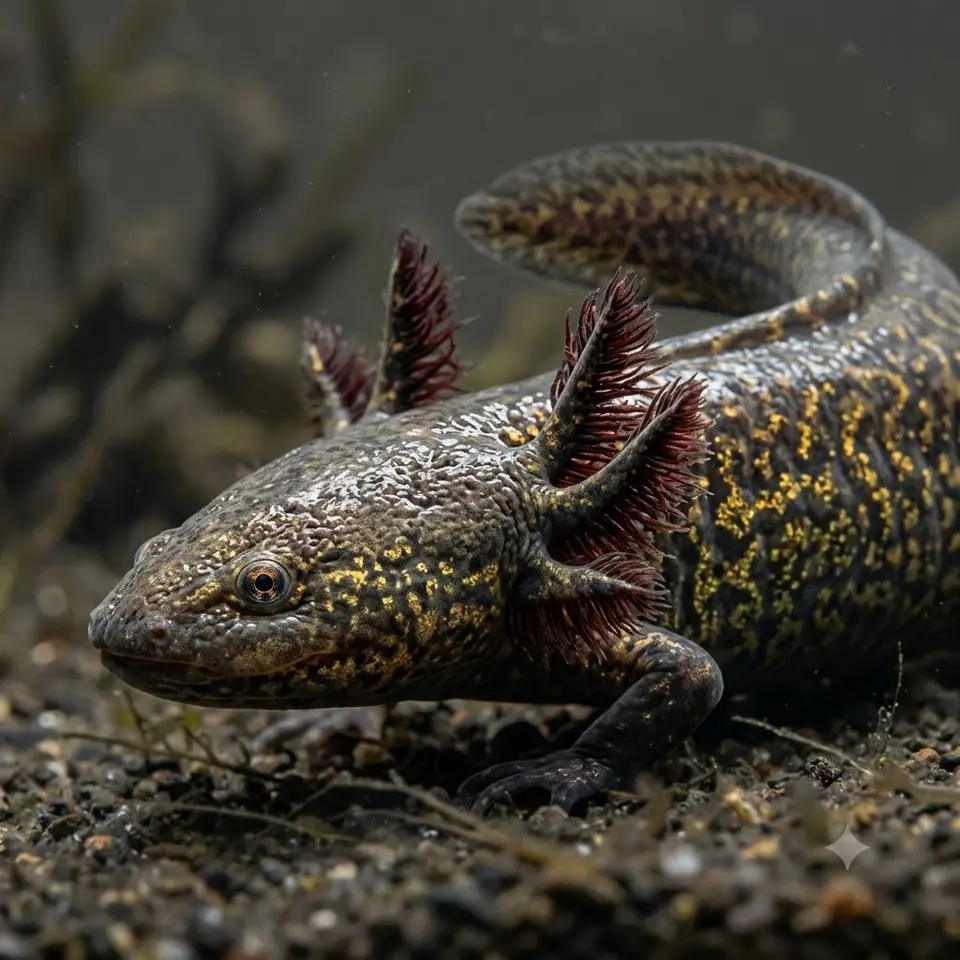 AI illustration
 Wash your hands after handling. The FDA notes that reptiles and amphibians can carry Salmonella and show no signs of illness, so the animal, its enclosure and everything in it can spread the germs: wash your hands with soap and water straight after touching any of them. The agency says children younger than 5, pregnant women, the elderly and people with weakened immune systems should not handle reptiles or amphibians. Source: FDA, Salmonella and pet reptiles and amphibians.
Overview
The Greater Siren (Siren lacertina) is a large, fully aquatic salamander from the southeastern United States that keeps its feathery external gills and a single pair of front legs for life, giving it an eel-like look no other North American amphibian shares. It is a nocturnal, secretive bottom-dweller that can exceed 3 feet (about 90 cm), so it is a serious long-term aquatic commitment rather than a beginner pet. Sirens are rarely captive-bred and are usually wild-caught, which raises real sourcing and legality questions you should settle before buying. This is a look-don't-touch animal that rewards patient observation over interaction.
Natural History
Siren lacertina is native to slow, weedy, warm freshwater across the coastal plain from Virginia down through Florida and into parts of the Gulf states. It lives in swamps, ditches, ponds, and marshes with heavy vegetation and soft muddy bottoms. When its water dries up, a Greater Siren can burrow into the mud and secrete a protective cocoon of dried skin and mucus, waiting out drought for weeks or months. Being paedomorphic, it never fully metamorphoses and stays aquatic its whole life.
Appearance
Adults commonly reach 20 to 38 inches (50 to 97 cm), making this one of the largest salamanders in North America. The body is long and eel-like, olive to gray-green or brown, often with faint spotting, and the belly is lighter. There are no hind legs at all; only a small pair of front legs sits just behind the bushy red-to-brown external gills. There are no true eyelids and the eyes are small, matching a life spent feeling and smelling for food in murky water.
Temperament & Handling
Treat the Greater Siren as a display animal, not a handling pet. Its skin is permeable and coated in protective slime, so dry or unwashed hands can injure it and pass chemicals into its body. Sirens are also strong, slippery, and easily stressed, and a large one can deliver a surprisingly hard bite and even a faint yelp or clicking sound when disturbed. Handle only when you must move it for tank maintenance or a vet visit, using clean wet hands or a soft aquatic net, and keep the animal in water as much as possible.
Enclosure
Think aquarium or stock tank, not vivarium. A single juvenile can start in a 40-gallon breeder, but a full-grown adult needs a 125-gallon tank or a large livestock trough at minimum, with more floor space always better than height. Provide a soft sand or fine gravel bottom, dense planting (live or artificial), and plenty of caves, PVC pipe, and driftwood so the animal feels covered. A tight, heavy, fully secured lid is non-negotiable, because sirens are powerful and will push out through any gap. Strong filtration plus regular water changes are essential, since a big amphibian in warm water produces a heavy waste load.
Heating, Lighting, Humidity
Because the siren is fully aquatic, the parameters that matter are water-based, not air humidity. Keep water temperature around 68 to 78 degrees F (20 to 26 degrees C); most homes need no heater, and sudden swings are more dangerous than a steady cool reading. Always dechlorinate tap water and keep ammonia and nitrite at zero. Lighting should be dim and indirect on a normal day-night cycle; bright light stresses this nocturnal burrower, so floating plants or shade cover help it settle.
Diet
The Greater Siren is a carnivore that leans opportunistic and will also nibble some algae and plant matter. Feed a varied menu of earthworms, blackworms, bloodworms, aquatic snails, crayfish, shrimp, and appropriately sized feeder fish or thawed fish pieces. Adults eat a few times a week; juveniles more often. Feed after dark when the animal is active, remove uneaten food to protect water quality, and avoid a steady diet of fatty feeder fish, which leads to obesity.
Health & Lifespan
15-25 years. With good water and stable temperatures, a Greater Siren is a genuine multi-decade animal, and some individuals live longer, so plan accordingly. The most common problems are keeper-made: skin and gill infections from poor water quality, ammonia burns from an uncycled tank, injuries from escape attempts or sharp decor, and obesity or bloat from overfeeding. Cloudy skin, ragged or shrinking gills, refusal to eat, and unusual floating all warrant a same-week visit to a vet who treats exotics and amphibians. Quarantine any new animal and never mix in wild-caught tankmates that could carry parasites.
Pros & Cons
Pros:
- Unusual, prehistoric-looking aquatic salamander with real display appeal.
- Very long-lived for a home aquatic pet.
- Hardy once water quality is stable; no complex land setup needed.
Cons:
- Gets big and needs a large, well-filtered tank.
- Almost always wild-caught, raising sourcing ethics and possible legal limits.
- Not a handling animal, and it can bite; strictly look-don't-touch.
Everyday gear for aquatic amphibians
Links go to Amazon or a partner brand's own store and may earn us a commission at no extra cost to you. As an Amazon Associate we earn from qualifying purchases. An Amazon link leads to a type of gear and you choose the exact product; a card that names a store leads to that partner's own shop.
Greater Siren - frequently asked questions
Is the Greater Siren captive-bred or wild-caught?
Almost all in the trade are wild-caught, since captive breeding is uncommon. Ask the seller directly, favor any documented captive-bred stock, and never collect one yourself without checking your state's rules, because sirens are protected or regulated in several parts of their range.
Can I keep one with fish or other tankmates?
Not safely. A siren will eat anything small enough to swallow and can injure larger tankmates, so single-animal housing is the honest default.
Is it toxic or dangerous to people?
No, Greater Sirens are not toxic to humans, unlike some tropical amphibians you may read about. The real risk runs the other way: your skin oils, soaps, and lotions can harm the animal, which is why bare-handed handling is discouraged.
Why does it have no back legs?
That is normal anatomy, not an injury. Sirens naturally have only front limbs plus permanent external gills because they never fully metamorphose, staying aquatic for life.
Is it legal to import or ship one in the US?
The genus Siren is on the US federal injurious-wildlife list for salamanders (50 CFR 16.14), a measure against the Bsal chytrid fungus: importing them into the United States is banned, and so is shipping them between the continental states and Hawaii, Puerto Rico or the territories. The US Fish and Wildlife Service says the listing does not affect owning one and does not ban moving a pet between states within the continental US, but other federal, state or local laws may apply - check your state's rules before you buy.
Test yourself: guess the amphibian
Three clues from our quiz bank, each about another of our amphibians. Can you name them?
Clue 1.A hardy arboreal amphibian whose waxy skin secretions help it resist drying out, allowing it to bask more than most frogs.
It's the White's Tree Frog - read the full profile →
Clue 2.A popular beginner amphibian, this little green-and-black hopper spends much of its time floating in shallow water.
It's the Fire-Bellied Toad - read the full profile →
Clue 3.Native to the rivers of central Africa, this little webbed-footed swimmer lacks a tongue and tiny teeth, sweeping food into its mouth with its hands.
It's the African Dwarf Frog - read the full profile →