Marbled Salamander
The Marbled Salamander (Ambystoma opacum) is a stocky, secretive mole salamander from the eastern United States, boldly patterned with silvery-white or gray crossbands across a jet-black body.
Updated: October 2026
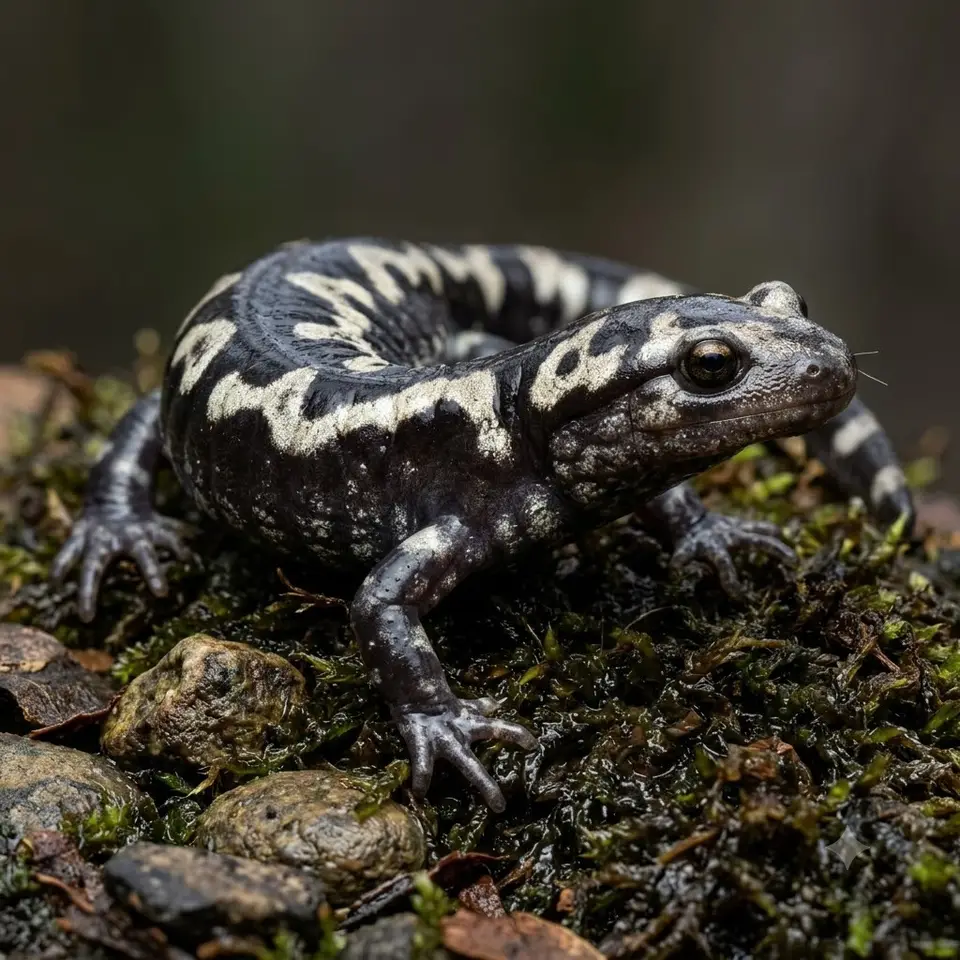 AI illustration
 Wash your hands after handling. The FDA notes that reptiles and amphibians can carry Salmonella and show no signs of illness, so the animal, its enclosure and everything in it can spread the germs: wash your hands with soap and water straight after touching any of them. The agency says children younger than 5, pregnant women, the elderly and people with weakened immune systems should not handle reptiles or amphibians. Source: FDA, Salmonella and pet reptiles and amphibians.
Overview
The Marbled Salamander (Ambystoma opacum) is a stocky, secretive mole salamander from the eastern United States, boldly patterned with silvery-white or gray crossbands across a jet-black body. It is a terrestrial, burrowing species that spends most of its life hidden underground, emerging mainly at night and in damp weather. This is a display animal rather than a pet you interact with, and it rewards keepers who enjoy a cool, quiet, naturalistic setup. Because captive breeding is uncommon, sourcing ethics matter more here than with most amphibians.
Natural History
Marbled Salamanders belong to the mole salamander family (Ambystomatidae) and range across the eastern and central United States, from New England south to the Gulf and west toward Texas. They live in forests near seasonal wetlands, sheltering under logs, leaf litter, and in the burrows of other animals. Unusually for the genus, they breed in autumn: females lay eggs in a dry pond depression and guard them until rain fills the basin and triggers hatching. This fall-breeding, egg-brooding behavior sets them apart from spring-breeding relatives.
Appearance
Adults reach about 3.5-5 inches (9-12.5 cm) in total length, making them one of the smaller Ambystoma species but heavy-bodied for their size. The base color is glossy black, overlaid with bold crossbands that wrap the back and sides. Males typically show brighter silvery-white bands, while females tend toward gray, which helps with sexing mature animals. The head is broad and blunt, the legs short and sturdy, and the whole body looks built for pushing through soil and leaf litter.
Temperament & Handling
This is a look-don't-touch animal, and that should be the plan before you buy one. Amphibian skin is thin and permeable, absorbing oils, salts, lotions, and residues from human hands, and handling stresses a species that naturally hides from everything. Like other mole salamanders, marbled salamanders can secrete a sticky, noxious substance from glands along the back and tail as a defense. It is not dangerous to a healthy adult human, but you should never touch your eyes or mouth afterward and should wash thoroughly. If you must move the animal for cleaning, use clean wet hands or a container, keep it brief, and put it back promptly.
Enclosure
A single adult does well in a 10-gallon (roughly 50 x 25 x 30 cm) terrestrial tank, and more floor space is always better than height since these are ground dwellers, not climbers. Provide several inches of moist, chemical-free substrate such as coconut fiber or a soil-and-leaf-litter mix that holds a burrow. Add cork bark, flat rocks, and hides so the animal can stay covered, plus a shallow water dish of dechlorinated water for soaking. Keep the substrate damp but never waterlogged, and use a secure lid, as they can push into surprisingly small gaps.
Heating, Lighting, Humidity
Marbled Salamanders are cool-climate animals and heat is the most common way keepers kill them. Aim for 60-70 degrees F (15-21 degrees C), and never let the enclosure climb much past the low 70s F (about 23 degrees C); temperatures in the upper 70s F and beyond can be fatal. No basking bulb or heat lamp is needed, and a warm room may require moving the tank to a cooler spot. They do not require UVB, and dim ambient room light on a natural day-night cycle is plenty. Keep humidity high through a moist substrate and light misting rather than a soggy tank.
Diet
This species is an insectivore that hunts small, slow-moving invertebrates. Offer appropriately sized crickets, earthworms, waxworms, small roaches, and isopods, all no wider than the space between the animal's eyes. Feed adults every 2-3 days and juveniles a bit more often, adjusting to keep a healthy, not bloated, body. Dust prey with a calcium and vitamin D3 supplement a couple of times a week. Remove uneaten insects, since loose crickets can nip a resting salamander.
Health & Lifespan
8-10 years. With cool, clean, stable conditions many individuals live a decade or more in captivity. The most frequent problems are heat stress, poor water quality from chlorine or dirty dishes, impaction from loose or oversized substrate, and skin infections tied to dirty, stagnant conditions. Metabolic bone disease can appear without adequate calcium. Watch for lethargy, bloating, discolored skin patches, or refusal to eat, and locate an exotics veterinarian who treats amphibians before you need one.
Pros & Cons
Pros: hardy in cool conditions, striking marbled pattern, small footprint, no heat or UVB gear required, long-lived. Cons: hidden most of the time, not handleable, sensitive to heat, and often wild-caught rather than captive-bred.
Everyday gear for amphibians
Links go to Amazon or a partner brand's own store and may earn us a commission at no extra cost to you. As an Amazon Associate we earn from qualifying purchases. An Amazon link leads to a type of gear and you choose the exact product; a card that names a store leads to that partner's own shop.
Marbled Salamander - frequently asked questions
Can I handle my marbled salamander?
Generally no. Their permeable skin absorbs residues from your hands and handling stresses them, so limit contact to brief moves with clean, wet hands or a container.
Are they toxic?
They secrete a mild noxious substance as defense. It will not seriously harm a healthy adult, but wash your hands and avoid touching your face after any contact.
Should I buy captive-bred or wild-caught?
Captive-bred is strongly preferred, though it is uncommon for this species. Ask sellers about origin, avoid wild-collected animals where possible, and check federal and state laws, since the genus Ambystoma is on the federal injurious-wildlife list and some states protect native salamanders.
Do they need a heat lamp?
No. They are cool-climate animals that thrive at 60-70 degrees F (15-21 degrees C), and added heat is far more likely to harm than help.
Test yourself: guess the amphibian
Three clues from our quiz bank, each about another of our amphibians. Can you name them?
Clue 1.This aquatic salamander never undergoes metamorphosis, keeping its feathery external gills and living its entire life underwater in its larval form.
It's the Axolotl - read the full profile →
Clue 2.When threatened, this small green amphibian arches its back to flash a vivid red-and-black warning pattern on its underside.
It's the Fire-Bellied Toad - read the full profile →
Clue 3.A common aquarium amphibian only a couple of inches long, it has four webbed feet and is often kept underwater rather than in a terrarium.
It's the African Dwarf Frog - read the full profile →