Snakeskin Guppy
The Snakeskin Guppy is a fancy variety of Poecilia reticulata defined by a chain-link rosette pattern that wraps the whole body, turning a two-inch livebearer into a piece of swimming filigree.
Updated: July 2026
Species guide: Guppy · All guppy strains
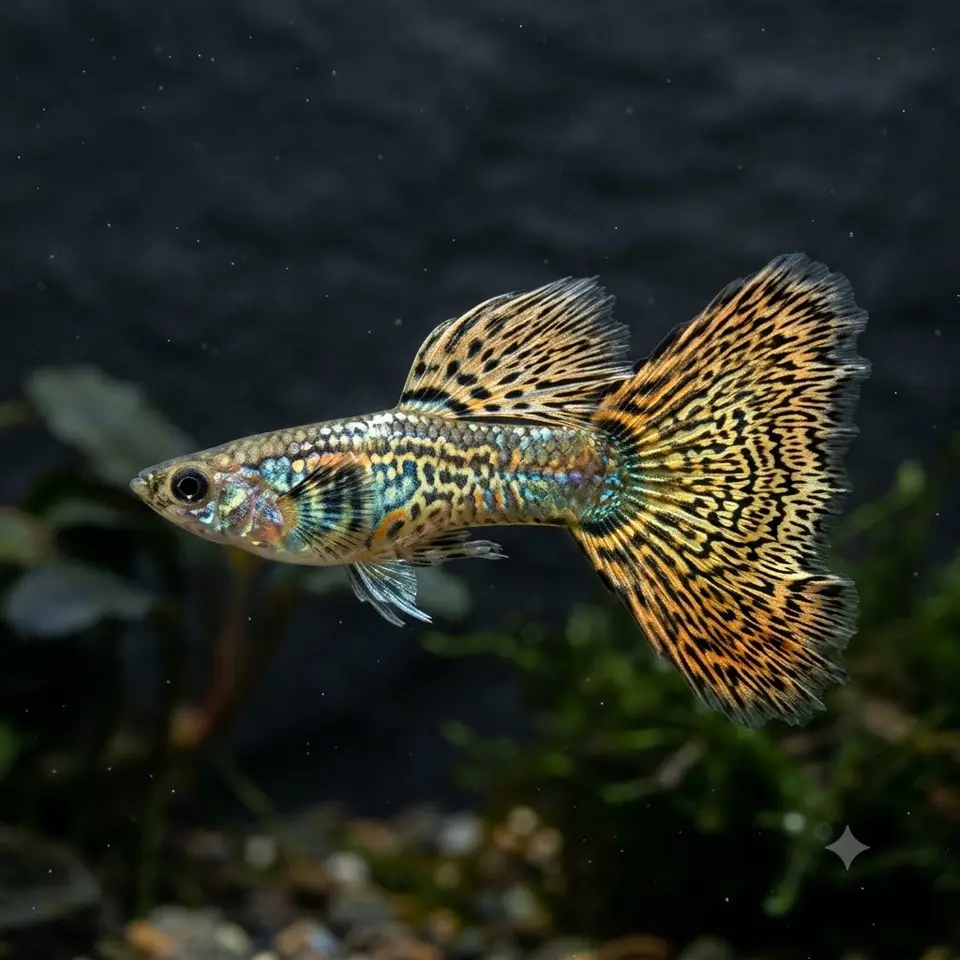 AI illustration
 Overview
The Snakeskin Guppy is a fancy variety of Poecilia reticulata defined by a chain-link rosette pattern that wraps the whole body, turning a two-inch livebearer into a piece of swimming filigree. Care is standard easy guppy care - the variety is about the pattern gene, not a different fish. What you pay for is pattern coverage and consistency, so knowing what a good snakeskin looks like matters more here than in almost any other guppy class.
Natural History
Wild guppies from Trinidad and northeastern South America carry scattered rosette and filigree markings as camouflage genes, and breeders isolated those into the full-body snakeskin pattern over decades of line breeding from the mid-1900s on. The variety is now a recognized class with the IFGA (International Fancy Guppy Association) in the US, judged on how completely and evenly the chain-link pattern covers the body. The key gene is usually Y-linked, which is why the pattern passes reliably from father to son and why females of most lines look plain.
Appearance
Males run about 1.25-1.5 in (3-4 cm), females 2-2.5 in (5-6 cm). The defining trait is a continuous rosette or chain-link mesh - like reptile scales - that should cover at least the rear two-thirds of the male's body, ideally flank to tail with no bare patches. Base colors include gold, bronze, green, blue, and red, and show-line males typically carry broad delta tails with a matching lace pattern. The easy confusion is with the Cobra: cobras combine rosettes with bold vertical body bars, while a true snakeskin is all mesh, no bars. Pattern intensity shifts with mood - a stressed or subordinate male washes out, then darkens back up when he settles.
Temperament & Tankmates
Standard guppy temperament: peaceful, busy, and constantly displaying. Keep males with females at a 1:2 ratio or run a males-only group to avoid endless fry. Good tankmates are other peaceful small fish - corydoras, neons, otocinclus, snails. Skip fin nippers like tiger barbs and skip bettas; a big lace delta tail is an irresistible target, and torn fins ruin exactly what you bought the fish for.
Tank Size & Setup
A 10 gallon (40 L) tank handles a trio; 20 gallons (75 L) suits a colony. Plant it moderately - java moss and hornwort give fry cover and give males a backdrop that makes the mesh pattern pop. Gentle filtration (sponge or baffled hang-on-back), a tight lid because guppies jump, and dark substrate to deepen the body color.
Water Parameters
72-82 F (22-28 C), pH 7.0-8.0, and moderately hard water (GH 8-12) - guppies genuinely do better with minerals in the water, and soft-water keepers should add a remineralizer. Weekly 25 percent water changes; show lines are noticeably less forgiving of old, dirty water than feeder-grade guppies.
Diet
Quality small-pellet or crushed flake as the staple, with live or frozen baby brine shrimp and daphnia several times a week - carotenoid-rich food visibly deepens the gold and bronze base colors under the mesh. Add spirulina for fiber, feed small amounts once or twice daily, and fast one day a week.
Health & Lifespan
2-3 years. The pattern gene itself causes no health problems, but snakeskins share the general fancy-guppy weaknesses of heavy line breeding: imported stock often arrives with camallanus worms (red threads at the vent) or columnaris, so quarantine every new fish for three to four weeks. The broad show tail is prone to fin rot and tears in poor water or rough company; clean water and calm tankmates are the whole prevention plan. Locally bred fish from a US breeder or club auction are typically far hardier than farm imports.
Pros & Cons
Pros:
- One of the most intricate patterns in the guppy hobby
- Same easy care as any guppy - true beginner fish
- Pattern breeds predictably to sons (Y-linked)
- Recognized IFGA show class with real breeding depth
Cons:
- Cheap imports often have broken, patchy patterns
- Big delta tails invite nipping and fin rot
- Females look plain in most lines
- Show lines less hardy than plain guppies
Everyday gear for aquariums
Links go to Amazon or a partner brand's own store and may earn us a commission at no extra cost to you. As an Amazon Associate we earn from qualifying purchases. An Amazon link leads to a type of gear and you choose the exact product; a card that names a store leads to that partner's own shop.
Snakeskin Guppy - frequently asked questions
What is the difference between a snakeskin and a cobra guppy?
A snakeskin has an unbroken chain-link mesh over the body; a cobra mixes rosettes with bold vertical bars. Sellers use the names loosely, so judge the fish, not the label.
Do female snakeskins show the pattern?
Usually not, because the main gene rides the Y chromosome. Some lines carry X-linked pattern too, giving females faint mesh, but plain-looking females from a good male still carry his value as breeders do not need her to show it.
Will snakeskin guppies breed true?
Sons reliably inherit the father's pattern, so a trio from one line produces recognizable snakeskin males within a generation. Mixed-tank females may carry other strains, so buy the trio from one breeder if you want consistency.
What should I look for when buying?
Pick a male whose mesh runs continuously from mid-body into the tail with no blank gaps, a tail pattern that matches the body, and active, gluttonous behavior. Skip any tank with clamped fins or hollow-bellied fish.
Test yourself: guess the fish
Three clues from our quiz bank, each about another of our fish. Can you name them?
Clue 1.Males of this small, vividly colored labyrinth fish are so territorial that two cannot share a tank without fighting, giving rise to a fierce nickname.
It's the Betta (Siamese Fighting Fish) - read the full profile →
Clue 2.Fancy varieties of this fish include bubble-eye and telescope-eye types bred for unusual looks.
It's the Goldfish - read the full profile →
Clue 3.Popular with aquarists who ship dormant eggs by mail, the males of this fish are far flashier than females.
It's the Killifish - read the full profile →