Tuxedo Guppy
The Tuxedo Guppy wears its name on its body - a pale silver or gold front half and a solid dark rear half, split by a clean vertical line and usually finished with a brightly colored delta tail.
Last reviewed: July 2026
Species guide: Guppy · All guppy strains
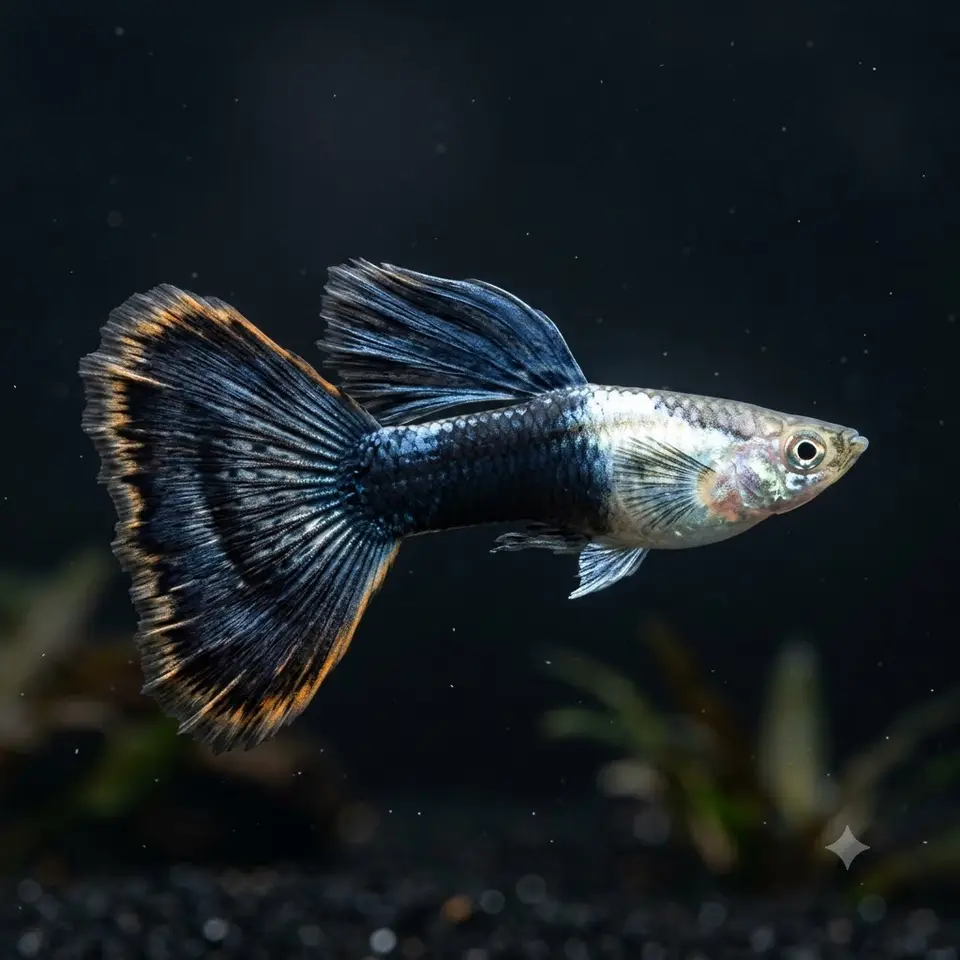 AI illustration
 Overview
The Tuxedo Guppy wears its name on its body - a pale silver or gold front half and a solid dark rear half, split by a clean vertical line and usually finished with a brightly colored delta tail. It is one of the most recognizable fancy guppy patterns, sitting behind famous show strains like the German Yellow Tuxedo and Neon Blue Tuxedo. Care is standard guppy care, which makes this one of the easiest ways to keep a genuinely show-grade looking fish in a small tank.
Natural History
The guppy (Poecilia reticulata) is a hardy livebearer from Trinidad and northeastern South America, but the tuxedo pattern exists only in aquariums. It is a domesticated half-black trait refined by breeders since the mid-1900s, most famously in German and Japanese show lines. The genes behind the dark rear half are largely sex-linked, carried on the X and Y chromosomes, which is why males display the pattern boldly while females from the same strain often show only a faint smoky version. Serious breeding lines have been selected for decades for a crisp dividing line and dense, even pigment.
Appearance
Males run about 1.5 in (4 cm), females 2-2.5 in (5-6 cm). The defining feature is the two-tone body: the front half stays pale - silver, white, or gold - while the rear half is covered in deep black or dark metallic blue. The tail and dorsal fin carry the accent color, commonly yellow, red, or electric blue, usually as a wide delta fan. That body split is what separates a tuxedo from other fancy patterns: cobras wear a full-body snakeskin rosette, moscows are one solid metallic color head to tail, and grass or mosaic guppies carry patterned tails on a plain body. When buying, look for a sharp, straight demarcation line, black without gray smudging bleeding forward, and a tail color that matches the strain - fuzzy edges usually mean mixed pet-store stock rather than a maintained line.
Temperament & Tankmates
Peaceful, active, and constantly displaying - males flare and chase all day without doing real harm. Keep one male per two or three females so no single female gets harassed, or run an all-male group if you do not want fry. Good tankmates are other peaceful small fish: corydoras, otocinclus, small rasboras, and calm tetras. Avoid tiger barbs, bettas, and other fin nippers - that wide show tail is an irresistible target and a shredded caudal ruins the look and invites fin rot.
Tank Size & Setup
A 10 gallon (38 L) tank comfortably houses a trio; 20 gallons (75 L) suits a colony. Plant it densely - guppies are prolific livebearers and fry survive in java moss and floating plants, so decide early whether you want the numbers to grow. Use gentle filtration; a strong outflow exhausts big-tailed males and can tatter fins over time. A lid matters, as guppies jump.
Water Parameters
72-82 F (22-28 C), pH 7.0-8.0, moderately hard to hard water. Guppies genuinely prefer mineral-rich water and sulk in very soft, acidic setups. Fancy show strains are less forgiving than feeder guppies, so stability and a weekly 25 percent water change do more for them than chasing exact numbers.
Diet
Omnivores with tiny stomachs. Feed a quality small-pellet or crushed flake staple once or twice daily in amounts cleared within a minute, and rotate in frozen or live baby brine shrimp and daphnia - protein variety noticeably deepens the black pigment and tail color. Add some vegetable content (spirulina flake, blanched greens) weekly.
Health & Lifespan
2-3 years. Heavily line-bred tuxedo strains trade some of the wild guppy's toughness for looks: imported stock often carries internal parasites (watch for wasting and stringy white feces), and columnaris (cotton-wool disease) moves fast in stressed fish. Quarantine every new purchase for two to three weeks. The oversized delta tail is the variety-specific weak point: it tears on sharp decor, rots quickly after nipping, and drags in strong current, so keep water clean, flow gentle, and hardscape smooth. Females birth roughly monthly, and back-to-back pregnancies shorten their lives; giving females breaks in a male-free tank helps.
Pros & Cons
Pros:
- Striking two-tone show look in a beginner-level fish
- Standard easy guppy care, small tank friendly
- Sex-linked pattern breeds true from good strains
- Peaceful and endlessly active
Cons:
- Show strains are less hardy than plain guppies
- Big tails snag, tatter, and attract nippers
- Prolific breeding can overwhelm a tank
- Pet-store tuxedos rarely breed true
Everyday gear for aquariums
Links go to Amazon or a partner brand's own store and may earn us a commission at no extra cost to you. As an Amazon Associate we earn from qualifying purchases. An Amazon link leads to a type of gear and you choose the exact product; a card that names a store leads to that partner's own shop.
Tuxedo Guppy - frequently asked questions
Is a tuxedo guppy the same as a half-black guppy?
Essentially yes - "half-black" describes the genetics and "tuxedo" is the hobby name for the finished look. Strains are usually labeled by tail color plus the pattern, like Half-Black Yellow or German Yellow Tuxedo.
Will the fry look like their parents?
From a true breeding strain, most males will show the tuxedo pattern because the key genes are sex-linked. Mixed pet-store stock throws unpredictable fry - fun, but not tuxedos on demand.
Can I keep only male tuxedo guppies to avoid fry?
Yes, all-male groups work and display beautifully. Keep at least four to six so chasing spreads out, and skip fin-nipping tankmates.
What should I check before buying?
A crisp, straight color line, dense black with no gray bleed, an intact evenly colored tail, and active fish with full bellies. Buy from a breeder or a dealer who names the strain if you want the pattern to hold in future generations.
Test yourself: guess the fish
Three clues from our quiz bank, each about another of our fish. Can you name them?
Clue 1.This dazzling Amazonian schooling fish wears a full-length red stripe beneath its blue band, distinguishing it from a similar smaller cousin.
It's the Cardinal Tetra - read the full profile →
Clue 2.Keepers love this diverse group for bold personalities but warn that many dig substrate and fiercely defend a chosen territory.
It's the Cichlid (Overview) - read the full profile →
Clue 3.Popular with aquarists who ship dormant eggs by mail, the males of this fish are far flashier than females.
It's the Killifish - read the full profile →