Black Orchid Betta
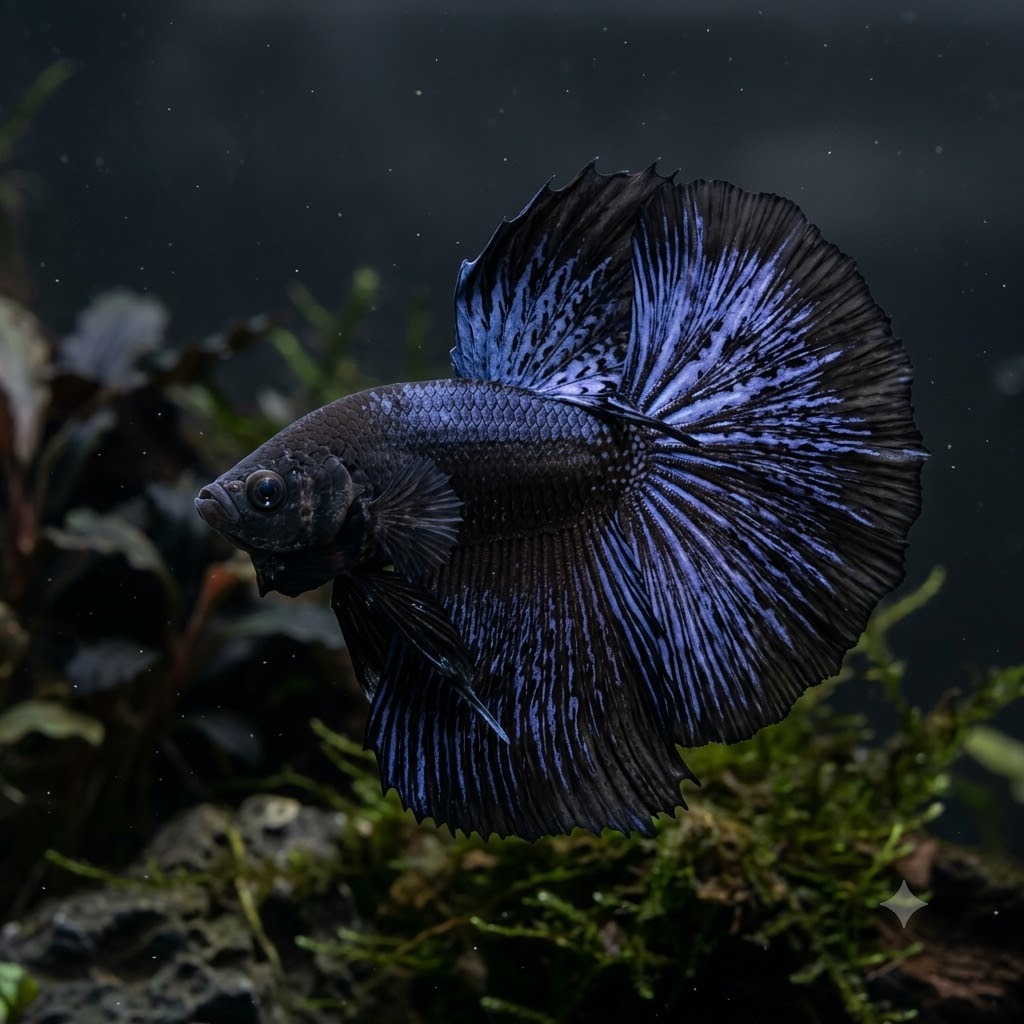
The Black Orchid Betta is a near-black fish shot through with iridescent blue and green rays in the fins, most famously on a crowntail frame where the spiky rays catch light against the dark body.
🗓️ Last reviewed: July 2026
Overview
The Black Orchid Betta is a near-black fish shot through with iridescent blue and green rays in the fins, most famously on a crowntail frame where the spiky rays catch light against the dark body. It is a color and pattern name rather than a fin type, and it sits in one of the harder corners of betta breeding: black pigment in Betta splendens is genuinely difficult to produce and even harder to keep fertile. Care itself is standard - heated water, a lid, 5 gallons or more, one male per tank - but buyers should know that "black orchid" is a marketing label used loosely and that many fish sold under it are dark steel blue rather than truly black.
Natural History
Wild bettas are drab brown-green fish from the shallow waters of Southeast Asia. Black is a domestic development, and hobbyists have chased it for decades through several distinct genetic routes - the melano black, the black lace, and metallic dark forms. Black Orchid emerged in the 2000s as a named look combining a dark, sooty body with iridescent turquoise streaking through the fins, popularized on crowntails and later produced on halfmoons and plakats as well. It is a breeder project with no wild counterpart.
Appearance
Body 2-2.5 in (5-6.5 cm). The base is a deep charcoal to near-black, sometimes with a faint bluish sheen over the flanks, and the fins carry iridescent blue-green rays that stand out most strongly under direct light. On crowntail black orchids the reduced webbing between extended rays makes the iridescence look like a fan of glowing spokes. Halfmoon versions read as darker overall, with the iridescence spread through the webbing. Truly black bettas of the melano type have a matte, light-absorbing quality that nothing else in the hobby matches, while the more common dark-steel fish look black in a shop tank and distinctly blue at home under bright light. Females are darker than most betta females and often show the same fin streaking in miniature.
Temperament & Tankmates
No different from any other betta: territorial, curious, and reactive to movement outside the glass. Crowntail-framed black orchids are moderate swimmers - their rays are long but the reduced webbing means less drag than a full halfmoon. One male per tank, always. In 10 gallons (38 L) or larger, workable tankmates are snails, dwarf corydoras (pygmy, salt-and-pepper, dwarf), and small peaceful schoolers like ember tetras or harlequin rasboras; standard corydoras and kuhli loaches need a group of five or six and 20 gallons (75 L). Avoid fin nippers, since crowntail rays are exactly the sort of target that invites them, and avoid other anabantoids.
Tank Size & Setup
5 gallons (19 L) minimum, 10 gallons (38 L) preferred. Tight lid, no exceptions - bettas jump. A heater, gentle filtration, live or silk plants, a cave, and a surface resting leaf. Lighting deserves a thought with this variety specifically: a dark fish in a dim tank simply disappears, while a good light angled across the fins is what makes the iridescent rays visible at all. A light-colored substrate makes the silhouette read better, though it works against the moody look many keepers want.
Water Parameters
76-82 F (24-28 C), heated year round. pH 6.5-7.5, soft to moderately hard water, ammonia and nitrite at zero, nitrate under 20 ppm, and 25-30 percent weekly water changes. Tannins from Indian almond leaves suit bettas well but tint the water, which mutes the contrast between a black body and its blue rays - a fair trade many keepers still make.
Diet
Carnivore. Quality betta pellets as the staple in two small daily meals, with frozen or live bloodworms, brine shrimp, and daphnia two or three times a week, and one fasting day. Color foods rich in carotenoids do nothing useful here - there is no red or yellow to enhance - so prioritize protein quality and variety over color-boosting claims on the label.
Health & Lifespan
3-5 years. General health matches other bettas of the same fin type: fin rot, ich, velvet, and stress-related tail biting in long-finned fish, plus internal parasites in freshly imported stock, so quarantine. Two variety-specific points matter. First, the breeding problem: females of the true melano black type are famously infertile, their eggs failing to develop, which is why breeders pair melano males with black lace or steel blue females rather than black to black. If you plan a breeding project, ask the seller which black genetics the line uses. Second, labeling: many fish sold as black orchid are dark blue or steel, and the difference only becomes obvious at home under a strong light. Buying tips - view the fish under bright light before deciding, check that the fin rays are intact and unclamped, and be skeptical of photos, since black fish are the hardest subject to shoot honestly.
Pros & Cons
Pros:
- Dramatic dark fish with iridescent fin rays, unlike anything else in the hobby
- Crowntail version has less drag than heavy halfmoon finnage
- Standard betta care requirements
- Females are unusually attractive for the species
Cons:
- True black is rare; many labeled fish are dark blue
- Melano black females are effectively infertile, limiting breeding
- Needs good lighting or the fish is invisible in the tank
- Crowntail rays are a magnet for fin nippers and rot
Black Orchid Betta - frequently asked questions
Is Black Orchid a fin type?
No. It is a color and pattern name, most often applied to crowntails but also produced on halfmoons and plakats. Choose the fin type for the care profile, then the coloring.
Why does my black betta look blue?
Because most fish sold as black are actually very dark steel blue, and iridescence only shows under strong light. True melano blacks are matte and light-absorbing, and they are much less common in shops.
Can I breed black orchids?
With care. Melano-type females rarely produce viable eggs, so the standard workaround is to breed a black male to a black lace or steel blue female and select the darkest offspring over generations.
Do black bettas fade with age?
They can lighten somewhat, and cold or dirty water dulls any betta. Sudden pattern change usually means marble genetics somewhere in the line rather than a health problem.
🧠 Test yourself: guess the fish
Three clues from our quiz bank, each about another of our fish. Can you name them?
Clue 1.Unlike most aquarium fish, this beginner-friendly group gives birth to free-swimming young instead of laying eggs.
It's the Molly / Platy / Swordtail (Livebearers) - read the full profile →
Clue 2.Nicknamed the 'king of the aquarium,' this round, flat Amazonian cichlid feeds its fry on mucus from its own skin.
It's the Discus - read the full profile →
Clue 3.A laterally compressed cichlid with vertical dark stripes, it forms monogamous pairs and guards its eggs on a flat leaf or surface.
It's the Angelfish - read the full profile →