Blue Neon Guppy
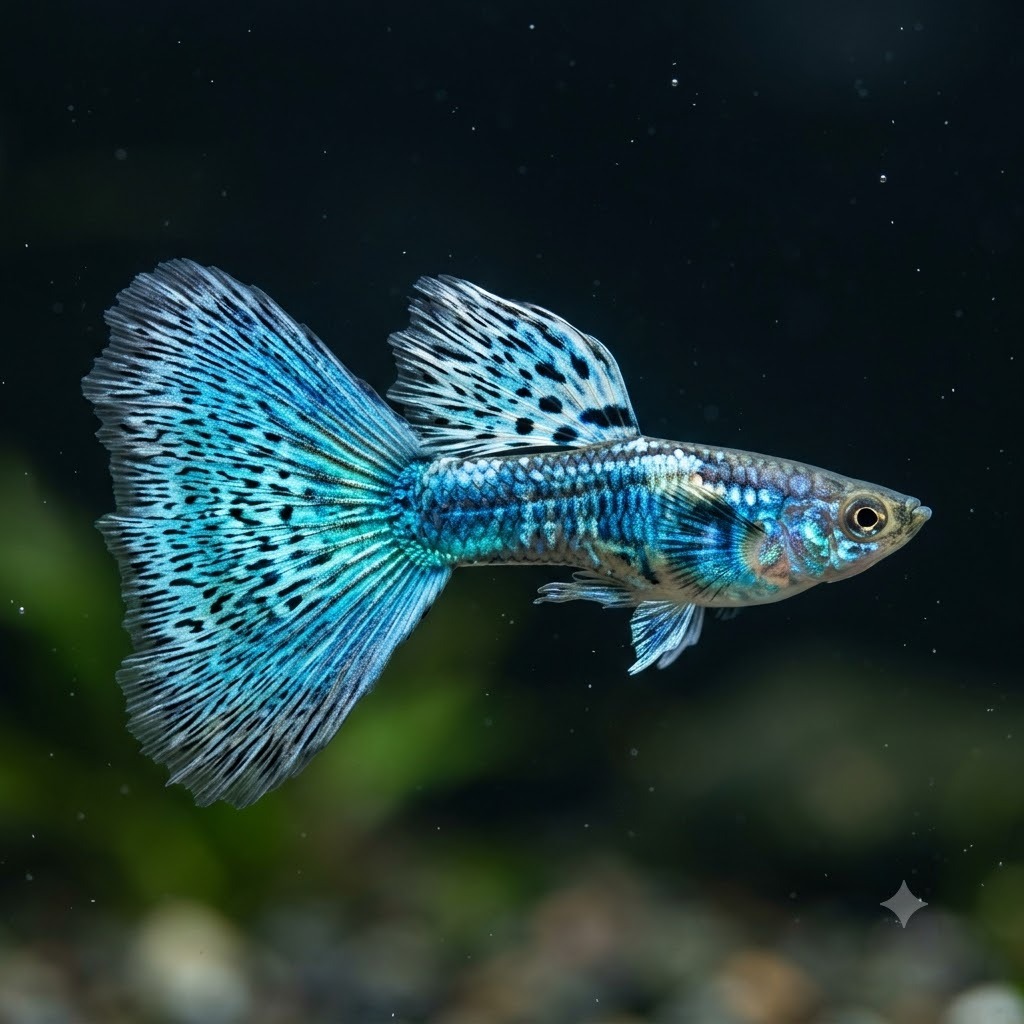
The Blue Neon Guppy, also sold as Neon Blue, is a European-bred strain built around one goal: an intense, electric blue running through the body and a broad blue delta tail, with as little contamination from other colors as possible.
🗓️ Last reviewed: July 2026
Overview
The Blue Neon Guppy, also sold as Neon Blue, is a European-bred strain built around one goal: an intense, electric blue running through the body and a broad blue delta tail, with as little contamination from other colors as possible. It is one of the harder looks to produce, because blue in guppies is structural rather than pigmented - the color comes from light bouncing off reflective cells, not from anything the fish eats. That has two consequences buyers should know: photos of this strain are frequently flattering to the point of dishonesty, and blue lines are among the more delicate fancy guppies.
Natural History
Wild guppies carry small structural blue flecks on the flanks. European breeders - the strain is usually credited to German lines, though the record is hobby lore rather than documentation - worked those flecks up into full-body blue over many generations, producing the fish marketed as Blue Neon. Related blue projects - blue grass, half-black blue, blue moscow - come from parallel efforts, and lines are often crossed among them. The name has nothing to do with neon tetras, which are unrelated fish, and everything to do with the intensity breeders were chasing. Like all fancy guppies, it is a domestic strain with no wild population behind it.
Appearance
Males 1.2-1.4 in (3-3.5 cm) of body plus a large caudal; females 2-2.4 in (5-6 cm), usually silvery with a blue tail wash. The ideal is a saturated sky-to-sapphire blue covering the rear body and the whole delta tail, with the dorsal matching, and no yellow or red bleeding into the fin edges. In practice, quality is a spectrum: strong lines glow, weaker ones read as pale lavender or grey-blue with washed edges. Because the color is structural, it flares and fades as the fish turns and it varies dramatically with light - the same male can look brilliant under a good LED and almost colorless in a dim tank. Some lines are combined with a half-black body to intensify the contrast.
Temperament & Tankmates
Peaceful, always moving, and mostly in the upper half of the water column. The wide delta tail makes males slow, so keep fin nippers such as tiger barbs and serpae tetras out, and skip anything fast enough to strip food before the guppies get there. Corydoras, otocinclus, small rasboras, snails, and shrimp in a planted tank are safe company. Keep 1 male to 2-3 females to spread out courtship, or run an all-male display, which suits this strain particularly well since the group effect is what sells the color. Mixed groups produce fry constantly and adults eat most of them without heavy planting.
Tank Size & Setup
10 gallons (38 L) minimum for a trio, 20 gallon long (76 L) for a small colony. Plant well - guppy grass, hornwort, java moss - keep flow gentle with a sponge filter, use smooth decor, and fit a lid, because startled guppies jump. Lighting is the single biggest visual decision with this strain: a strong, slightly angled light over a dark substrate and background is what makes structural blue look electric, and a dim tank wastes the fish entirely.
Water Parameters
72-82 F (22-28 C), pH 7.0-7.8, moderately hard to hard water (GH 8-12 or higher). Guppies want minerals, and soft acidic water produces clamped fins, faded color, and short lives. Weekly 25 percent water changes with ammonia and nitrite at zero and nitrate kept low. For a big-finned strain like this, clean water is the main defense against fin rot.
Diet
Omnivore with a tiny mouth. Quality micro pellets or crushed flake as the staple, plus live or frozen baby brine shrimp and daphnia several times a week and some spirulina or blanched greens. Two small meals a day. Note that color-enhancing foods will not brighten the blue, since it is structural - what they will do, if they are heavy in carotenoids, is push any red or yellow in the line, which works against the clean blue look. Feed for condition rather than color here.
Health & Lifespan
2-3 years. Blue strains have a reputation among breeders for being finicky, and it is deserved: they are tightly line-bred, fry survival can be uneven, and adults are less tolerant of cold, soft, or dirty water than the plain feeder guppies sold as live food. Anyone expecting the classic "guppies are indestructible" experience should adjust expectations for any show strain, and for this one in particular. The large delta tail is the usual weak point, with fin rot and bacterial infection beginning at the edges when nitrate climbs, and torn fins from nippy tankmates opening the door. Imported farm stock commonly arrives with camallanus worms and columnaris, so quarantine for three to four weeks. Buying tips - view the fish under a light similar to your own tank rather than trusting product photos, look for even color out to the fin edge and no red bleed, and prefer a local breeder, whose stock is usually stronger and more honestly represented than mass imports.
Pros & Cons
Pros:
- Intense structural blue that few other freshwater fish match
- Big delta tail makes a striking all-male display group
- Standard guppy care requirements underneath
- Peaceful and suited to modest planted tanks
Cons:
- Color depends entirely on lighting and is easy to over-photograph
- Blue lines are among the more delicate fancy strains
- Large tail invites fin rot and nipping damage
- Quality varies widely; many shop fish are pale grey-blue
Blue Neon Guppy - frequently asked questions
Does this fish have anything to do with neon tetras?
No. The name refers to the brightness breeders were aiming for. Blue Neon is a guppy strain, Poecilia reticulata, and neon tetras are a separate species from South America.
Why does my blue guppy look grey?
Because guppy blue is structural, created by reflective cells rather than pigment. It needs decent, directional light to appear. Improve the lighting and use a dark background before assuming the fish is poor quality.
Can I feed color food to make the blue stronger?
No. Carotenoid-based color foods act on reds, oranges, and yellows. They cannot enhance structural blue, and in a blue line they may bring out unwanted warm tones.
Are blue neons a good beginner fish?
Only in an already cycled, heated, hard-water tank. They are more demanding than plain guppies, and a new tank that has not finished cycling will kill them faster than it kills feeder stock.
🧠 Test yourself: guess the fish
Three clues from our quiz bank, each about another of our fish. Can you name them?
Clue 1.This vast family of often colorful, territorial fish includes the angelfish, oscar, and the discus, plus the species swarming Africa's Rift lakes.
It's the Cichlid (Overview) - read the full profile →
Clue 2.Contrary to popular myth, this hardy pet has a memory spanning months and should never be kept in a tiny bowl.
It's the Goldfish - read the full profile →
Clue 3.Originally from South America, this little livebearer was spread worldwide to eat mosquito larvae.
It's the Guppy - read the full profile →