Cobra Guppy
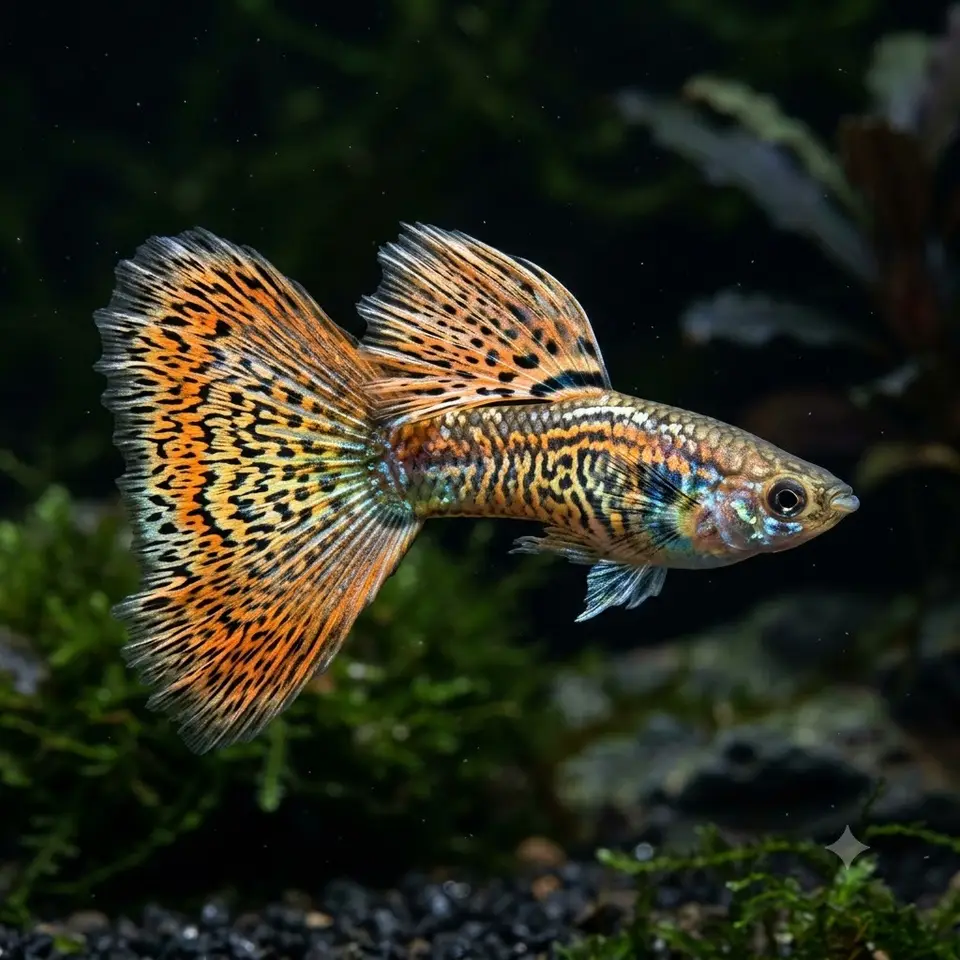
The Cobra Guppy is a fancy guppy variety defined by its snakeskin-style pattern - vertical dark bars and chain-link rosettes over a metallic base that covers the male's whole body, not just the tail.
Last reviewed: July 2026
Species guide: Guppy · All guppy strains
 AI illustration
 Overview
The Cobra Guppy is a fancy guppy variety defined by its snakeskin-style pattern - vertical dark bars and chain-link rosettes over a metallic base that covers the male's whole body, not just the tail. It is one of the easiest "show pattern" guppies to keep well, because the wow factor comes from color genetics rather than exaggerated finnage. If you want a fish that looks line-bred and expensive but still behaves like a regular hardy guppy, this is the variety to start with.
Natural History
Wild guppies (Poecilia reticulata) come from streams and ditches of northeastern South America and nearby islands, where males already carry chaotic spots and iridescence. The snakeskin pattern appeared in domestic lines mid-20th century, and breeders selected the boldest barred and rosetted versions into what the US hobby now calls Cobra. Everything about it is a captive creation - the pattern genes ride mostly on the Y chromosome, so fathers pass the look directly to sons, which is why good Cobra lines stay recognizable generation after generation.
Appearance
A show-quality Cobra male carries the full package: vertical black or dark-green bars along the flanks, connected rosette or chain markings between them, and the same pattern continuing into the dorsal and caudal fins. Base colors are usually green, gold, red, or silver with strong metallic sheen. Males run about 1.5 in (4 cm); females reach 2-2.5 in (5-6 cm) but show little to no pattern - they look like plain gray guppies with at best a patterned tail. Cobra differs from plain Snakeskin mainly in the strong vertical barring; Lace types show a finer, web-like mesh instead. Tails are typically delta or fantail shaped, large but not as extreme as some halfmoon lines.
Temperament & Tankmates
Peaceful, busy, and always visible - standard guppy behavior. Males display at each other constantly but rarely do damage. Good tankmates are small peaceful species: neon and ember tetras, corydoras, otocinclus, rasboras, snails, and shrimp (adults). Avoid fin nippers like tiger barbs and serpae tetras, and skip bettas - a patterned, big-tailed male guppy is exactly what a betta attacks. Keep males in groups or at a 1 male to 2-3 female ratio so no single female gets harassed.
Tank Size & Setup
A 10 gallon (40 L) tank handles a trio; 20 gallons (75 L) is better once fry start arriving, and they will. Plant it moderately - guppies like open swimming space up top with cover below, and floating plants give fry somewhere to survive. Gentle to moderate filtration; a strong current exhausts big-tailed males. A tight lid matters, as guppies jump. Smooth decor protects the caudal fin from snags.
Water Parameters
72-82°F (22-28°C), pH 7.0-8.2, and moderately hard to hard water - guppies genuinely prefer minerals, and soft acidic water shortens their lives. Weekly 25 percent water changes and stable parameters matter more than exact numbers. Line-bred Cobras tolerate less swing than feeder-grade guppies, so drip-acclimate new fish.
Diet
Quality small flake or micro pellets as the staple, with frozen or live brine shrimp, daphnia, and a spirulina component a few times a week. Feed small amounts once or twice daily - what they finish in about a minute. Varied protein plus vegetable matter keeps the metallic pattern colors saturated; a flake-only diet washes them out.
Health & Lifespan
2-3 years. The Cobra pattern itself carries no health baggage, but the variety shares the general problem of intensively line-bred guppies: narrow gene pools and fragile imports. Farm-bred stock from Asia often arrives carrying columnaris, camallanus worms, or protozoan infections, so quarantine every new purchase for 3-4 weeks. Watch for clamped fins, wasting despite eating, and ragged tail edges (fin rot, usually a water quality signal). Females are prone to the usual livebearer birth complications late in life. Buying from a local breeder instead of a chain-store tank sidesteps most of this.
Pros & Cons
Pros:
- Striking full-body pattern without fragile extreme finnage
- Hardy, active, and beginner-appropriate
- Pattern breeds true through male lines
- Small tank requirement and easy feeding
- Fry are easy to raise and rehome
Cons:
- Females show almost none of the pattern
- Imported stock frequently arrives sick
- Relentless breeding fills tanks fast
- Short lifespan compared to most pets
- Cannot mix with bettas or nippy species
Everyday gear for aquariums
Links go to Amazon or a partner brand's own store and may earn us a commission at no extra cost to you. As an Amazon Associate we earn from qualifying purchases. An Amazon link leads to a type of gear and you choose the exact product; a card that names a store leads to that partner's own shop.
Cobra Guppy - frequently asked questions
What is the difference between a Cobra and a Snakeskin guppy?
They overlap, and some breeders use the names interchangeably. In US usage, Cobra means the snakeskin pattern plus strong vertical barring on the body; Snakeskin refers to the rosette-and-chain pattern generally, and Lace is the finest mesh version.
Will Cobra fry look like the father?
Male fry mostly will - the core pattern genes are Y-linked, so sons inherit the look directly. Quality still varies, and breeders raise a batch and keep only the best-marked males.
Do female Cobra guppies show the pattern?
Barely. Most look like plain gray-bodied guppies, sometimes with a patterned tail. That is normal for the variety, not a sign of poor stock.
Are Cobra Guppies harder to keep than regular guppies?
Care is identical. The only practical difference is that heavily line-bred fish are a bit less forgiving of poor water and unquarantined tankmates, so buy healthy stock and keep up water changes.
Test yourself: guess the fish
Three clues from our quiz bank, each about another of our fish. Can you name them?
Clue 1.This tall, laterally compressed blackwater fish needs warm, soft, acidic water and is famously sensitive for keepers.
It's the Discus - read the full profile →
Clue 2.This category of hardy tropical fish includes the swordtail and platy and breeds readily in home tanks.
It's the Molly / Platy / Swordtail (Livebearers) - read the full profile →
Clue 3.This tiny, hardy aquarium fish gives birth to live young rather than laying eggs, earning it the nickname 'rainbow fish.'
It's the Guppy - read the full profile →