Dumbo Ear Guppy
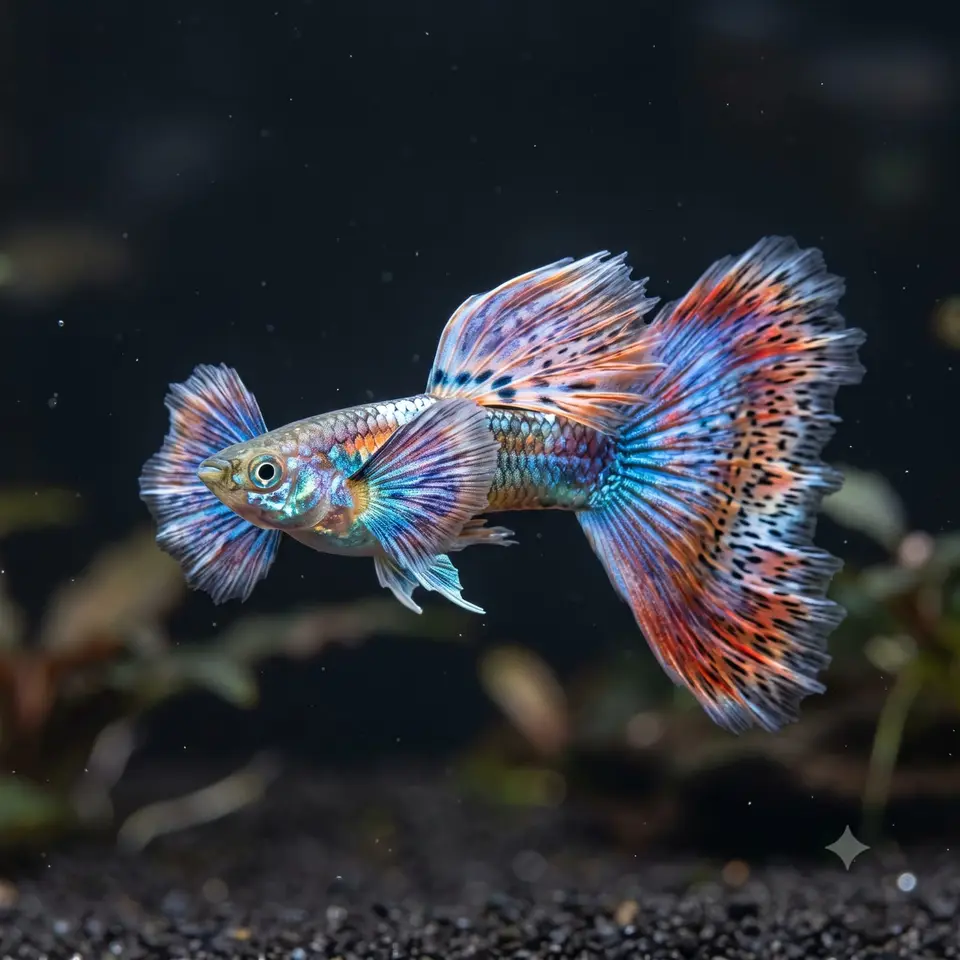
The Dumbo Ear Guppy is a fancy guppy variety defined by oversized, elephant-ear pectoral fins that flap visibly with every stroke, layered onto the same hardy livebearer beginners have kept for a century.
Updated: September 2026
Species guide: Guppy · All guppy strains
 AI illustration
 Overview
The Dumbo Ear Guppy is a fancy guppy variety defined by oversized, elephant-ear pectoral fins that flap visibly with every stroke, layered onto the same hardy livebearer beginners have kept for a century. The trait pairs with almost any tail type and color line, so a "dumbo" tank can look wildly varied while care stays standard guppy-simple. The only real adjustments are gentler flow and closer fin-health watching, because those big pectorals are the first thing to tear or rot.
Natural History
Every guppy variety traces back to wild Poecilia reticulata from northeastern South America - a small, adaptable livebearer. The dumbo (also sold as "elephant ear" or "big ear") trait emerged from Asian commercial farms, with Thai breeders popularizing it in the 1990s-2000s. It is a pectoral-fin mutation, not a tail type, so breeders freely stack it onto mosaic, halfmoon, and solid-color lines; Dumbo Red Mosaic is the classic combination you will see in most US shops.
Appearance
Males run 1-1.5 in (2.5-4 cm), females 2-2.5 in (5-6 cm). What defines the variety is the pectoral fins: enlarged to several times normal size, rounded like elephant ears, and constantly fanning. They are often white or black in contrast to the body, which makes the flapping motion pop. Males carry the showy version plus a large tail (commonly halfmoon or delta spreads); females show the trait more modestly. Unlike tail-type varieties, a dumbo is judged mostly on pectoral size, symmetry, and contrast - a good specimen has two matched "ears," not one big and one stubby.
Temperament & Tankmates
Standard peaceful guppy temperament: active, social, zero aggression beyond mild male display. The variety-specific caveat is that big pectorals plus a big tail make males slower and more tempting to nippers - skip tiger barbs, serpae tetras, and bettas. Good tankmates: corydoras, otocinclus, small rasboras, neon tetras, snails, and other peaceful livebearers. Keep 2-3 females per male so no single female gets chased ragged, or run a males-only display group.
Tank Size & Setup
10 gallons (38 L) minimum for a small group, 20 gallons (75 L) if you let them breed - and as livebearers, they will. Plant it well (guppy fry survive in java moss thickets), use smooth decor that cannot snag trailing fins, and keep a lid on. The dumbo-specific point is flow: those sail-like pectorals act as brakes, so baffle the filter output. A male fighting strong current all day burns energy and shreds fins.
Water Parameters
72-82°F (22-28°C), pH 7.0-7.8, moderately hard water - guppies genuinely prefer minerals, and fancy imported lines fail fastest in soft, acidic tanks. Do 25-30% weekly water changes; clean water matters more for this variety than most because torn pectoral edges infect quickly in dirty tanks. Stable and slightly hard beats chasing perfect numbers.
Diet
Quality small flake or micro pellets as the staple, cut with frozen or live treats (baby brine shrimp, daphnia) and some vegetable content - spirulina flake works. Feed small amounts once or twice daily. Well-fed adults also eat fewer of their own fry, if that matters to your plans.
Health & Lifespan
2-3 years. Guppy-standard lifespan, but the enlarged pectorals add specific risks: fin rot and tears show up on the "ears" first, and a dumbo clamping its pectorals flat is an early stress signal worth acting on. Mass-produced imported lines can carry weak genetics and arrive with parasites, so quarantine new fish for 2-4 weeks. Watch for the usual guppy issues too - ich, columnaris, Tetrahymena ("guppy disease", common in crowded import tanks), and wasting from internal parasites.
Pros & Cons
Pros:
- Unique flapping-fin look no other guppy variety has
- Same easy, hardy care as any guppy
- Peaceful and community-safe
- Breeds readily if you want a project
- Widely available in the US at modest prices
Cons:
- Big pectorals tear and rot more easily than standard fins
- Needs gentle flow - strong filters exhaust males
- Magnet for fin-nipping tankmates
- Import-farm lines vary in genetic quality
- Short lifespan, like all guppies
Everyday gear for aquariums
Links go to Amazon or a partner brand's own store and may earn us a commission at no extra cost to you. As an Amazon Associate we earn from qualifying purchases. An Amazon link leads to a type of gear and you choose the exact product; a card that names a store leads to that partner's own shop.
Dumbo Ear Guppy - frequently asked questions
Is a Dumbo Ear Guppy harder to keep than a regular guppy?
Barely. Same water, food, and tank size - just baffle the flow, keep water clean so fin edges stay healthy, and avoid nippy tankmates.
Do dumbo guppies breed true?
Mostly, when you pair dumbo to dumbo - the trait passes reliably, though ear size and symmetry vary between offspring. Crossing to a standard guppy dilutes it fast, so keep lines separate if you are breeding for the look.
What should I look for when buying?
Two matched, evenly sized pectorals held open and fanning, active swimming, and no ragged or clamped fins. Skip any tank with dead or listless fish, and quarantine new arrivals before they join the display.
Can I keep dumbo guppies with bettas?
Not recommended. Bettas often read a flashy male guppy as a rival, and those oversized pectorals and tail make him too slow to escape a determined attacker.
Test yourself: guess the fish
Three clues from our quiz bank, each about another of our fish. Can you name them?
Clue 1.Aquarists prize this small loricariid because, unlike its giant relatives, it tops out around five inches and won't outgrow a community tank.
It's the Bristlenose Pleco - read the full profile →
Clue 2.A peaceful aquarium staple, this little fish loses its bright shimmer at night and regains it by day.
It's the Neon Tetra - read the full profile →
Clue 3.Easy to breed and colorful, the males of this small species sport flashy fan-shaped tails to court drab females.
It's the Guppy - read the full profile →