Grass Guppy
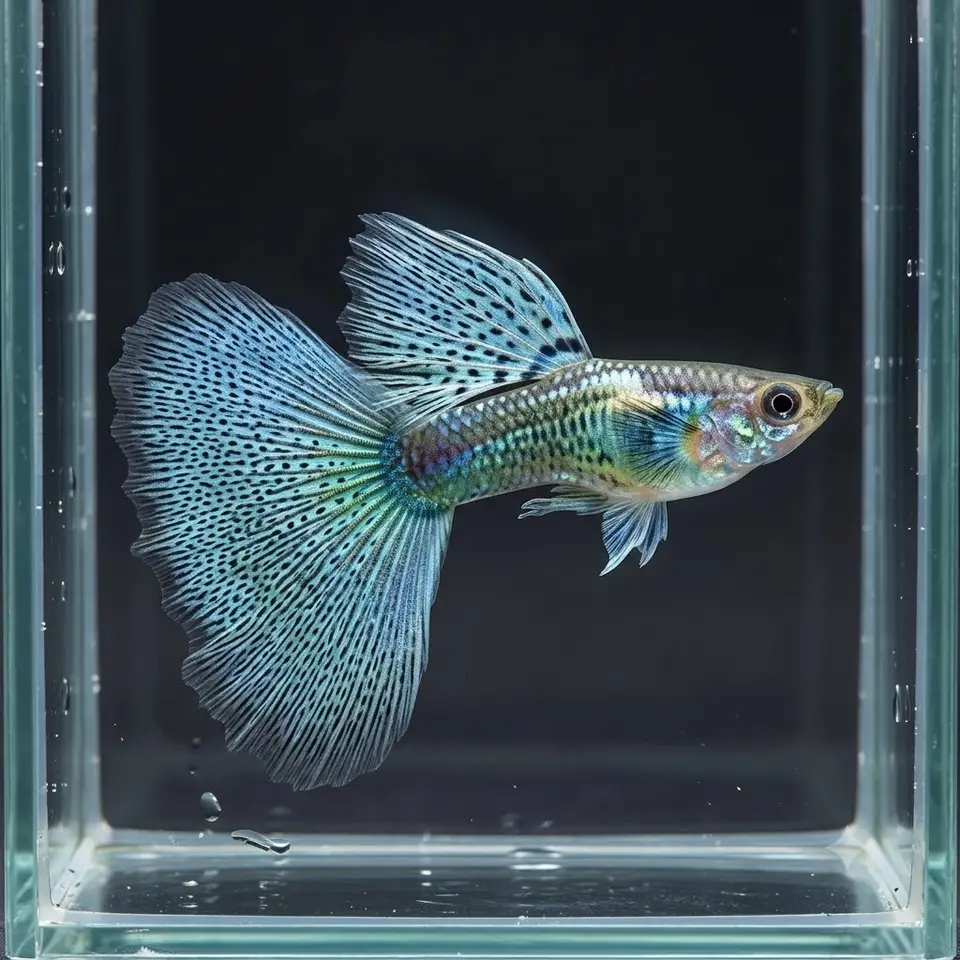
The Grass Guppy is a fancy guppy variety defined by a fine peppering of tiny dots scattered across the tail like grass seed, one of the three classic show-pattern classes alongside Mosaic and Snakeskin.
Updated: July 2026
Species guide: Guppy · All guppy strains
 AI illustration
 Overview
The Grass Guppy is a fancy guppy variety defined by a fine peppering of tiny dots scattered across the tail like grass seed, one of the three classic show-pattern classes alongside Mosaic and Snakeskin. It is a standard Poecilia reticulata under the hood, so care is easy, but the pattern is prized enough that quality stock is worth seeking out. Males carry the color and pattern; females stay plain and larger. Popular color backgrounds include red grass, blue grass, and yellow (gold) grass.
Natural History
The guppy is a livebearer native to fresh and brackish waters of northeastern South America and the Caribbean, long since spread worldwide as both a mosquito-control fish and an aquarium staple. The Grass pattern is not a wild trait but a product of decades of selective breeding by hobbyists, who split fancy tail patterns into named classes for show judging. "Grass" refers strictly to the pattern of small, evenly distributed dots, not to a separate species or a body shape.
Appearance
Adult males reach about 1.5 in (4 cm), females up to 2.5 in (6 cm) and drabber. The signature is the caudal fin: dense, fine, uniform speckling that reads like sprayed grass seed, usually over a red, blue, purple, or yellow base. The dorsal fin often echoes the pattern. Tail shape is typically a broad delta or veiltail. This is what separates Grass from its cousins: Mosaic guppies show larger, irregular, interconnected blotches, while Snakeskin (cobra) guppies show a wavy chain or net pattern running across the body and fins. Grass is generally the most consistent to breed true because the fine speckling is less prone to breaking up between generations.
Temperament & Tankmates
Peaceful, active, and constantly on the move. They suit a community of other calm, small fish: neon and ember tetras, corydoras, otocinclus, and small rasboras. Avoid known fin-nippers like tiger barbs and serpae tetras, which will shred the long delta tail, and avoid aggressive or much larger fish. Keep more females than males (roughly 2-3 females per male) to spread out mating attention, or keep a male-only group to enjoy the color without endless fry.
Tank Size & Setup
A trio or small group starts comfortably in 10 gallons (38 L); 20 gallons (76 L) gives room for a fuller community and buffers water quality. Provide gentle to moderate flow, since a big delta tail tires a fish out in strong current, and plant heavily (live or silk) to give fry cover and adults places to rest. Skip sharp decor and rough plastic plants that can tear the finnage.
Water Parameters
Temperature 74-82 F (23-28 C), pH 7.0-7.8, and moderately hard water. Guppies actively prefer harder, slightly alkaline water and dislike soft, acidic tanks. Keep ammonia and nitrite at zero, nitrate low with weekly partial water changes, and prioritize stability over chasing perfect numbers.
Diet
Omnivores with small appetites. Feed a quality micro-pellet or crushed flake as the staple, rotated with frozen or live brine shrimp, daphnia, and microworms for color and condition. Feed small amounts once or twice daily, only what is eaten in a minute or two, since overfeeding fouls the water fast in a small tank.
Health & Lifespan
2-3 years. Line-bred fancy guppies are less hardy than feeder or wild strains because generations of selection for finnage and pattern have narrowed the gene pool. The large delta tail is the main variety-specific liability: it snags on rough decor, tires in strong flow, and is a prime target for fin rot in poor water or for nipping tankmates. Watch for bacterial fin rot (frayed, receding edges), the parasite "guppy disease" (Tetrahymena), and columnaris, all of which hit mass-imported stock hardest. Clean, stable water and quarantine of new arrivals prevent most problems.
Pros & Cons
Pros:
- Striking, consistent tail pattern that breeds fairly true
- Easy, beginner-friendly base care
- Peaceful community fish
- Small footprint, thrives in modest tanks
Cons:
- Short lifespan, often 2-3 years
- Long tail is fragile and nip-prone
- Imported fancy stock can arrive weak or diseased
- Breeds prolifically unless managed
Everyday gear for aquariums
Links go to Amazon or a partner brand's own store and may earn us a commission at no extra cost to you. As an Amazon Associate we earn from qualifying purchases. An Amazon link leads to a type of gear and you choose the exact product; a card that names a store leads to that partner's own shop.
Grass Guppy - frequently asked questions
How is a Grass guppy different from a Mosaic or Snakeskin?
It is a pattern class, not a species. Grass means fine, evenly scattered dots on the tail; Mosaic means larger irregular blotches; Snakeskin means a wavy chain or net pattern. All are the same fish, Poecilia reticulata.
Do females show the grass pattern?
Not really. As with most fancy guppies, males carry the color and speckling while females stay plain silvery-gray. Buy males to see the variety at its best.
What should I look for when buying?
Choose fish with crisp, even dot distribution, a straight spine, clamped-free fins, and active behavior. Prefer a local breeder over mass-imported chain-store stock, which is more likely to carry disease and inbreeding weakness.
Will they breed on their own?
Yes, readily and often. A mixed-sex group produces fry every few weeks. Keep a male-only group, or add fry-eating tankmates and dense plants, if you do not want a population boom.
Test yourself: guess the fish
Three clues from our quiz bank, each about another of our fish. Can you name them?
Clue 1.Domesticated from a dull carp over a thousand years ago in China, this orange fish is one of the oldest kept pets.
It's the Goldfish - read the full profile →
Clue 2.This dazzling Amazonian schooling fish wears a full-length red stripe beneath its blue band, distinguishing it from a similar smaller cousin.
It's the Cardinal Tetra - read the full profile →
Clue 3.Aquarists prize this small loricariid because, unlike its giant relatives, it tops out around five inches and won't outgrow a community tank.
It's the Bristlenose Pleco - read the full profile →