Half-Black Guppy
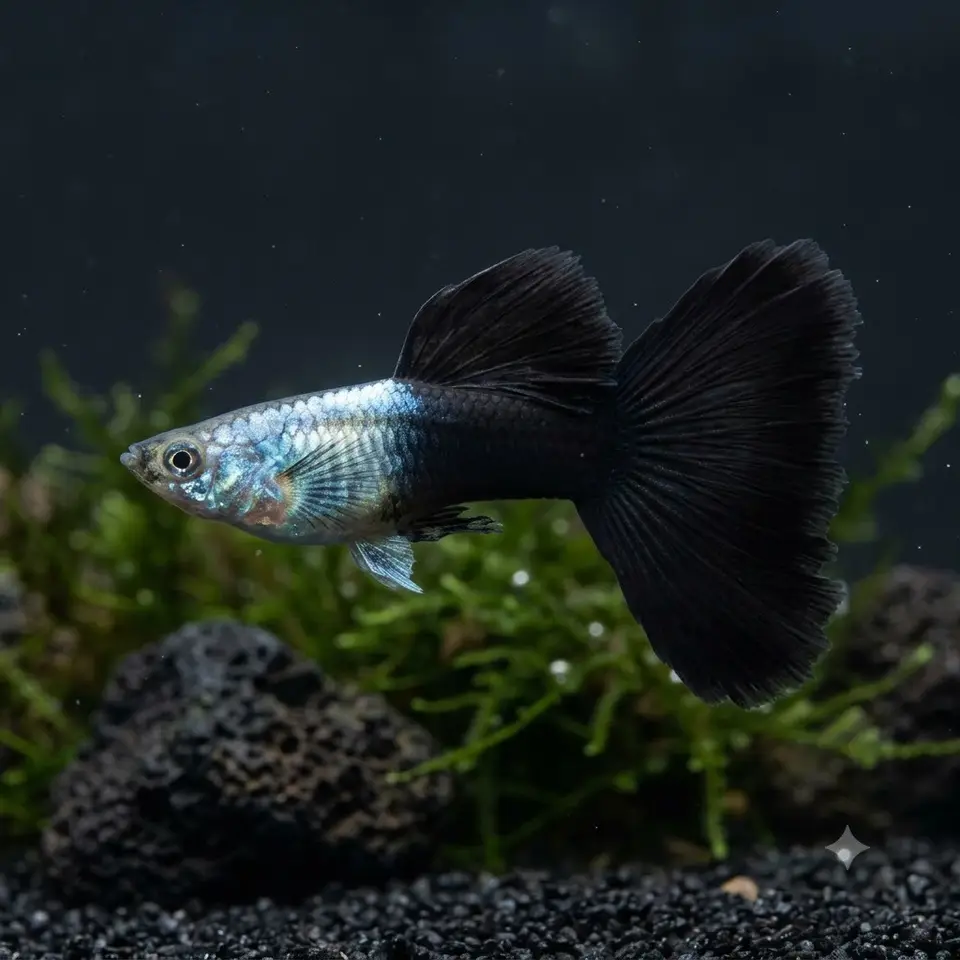
The Half-Black Guppy wears the fancy-guppy world's tuxedo - a dense black rear half of the body that ends in a clean vertical line and makes whatever tail color follows it look twice as bright.
Updated: September 2026
Species guide: Guppy · All guppy strains
 AI illustration
 Overview
The Half-Black Guppy wears the fancy-guppy world's tuxedo - a dense black rear half of the body that ends in a clean vertical line and makes whatever tail color follows it look twice as bright. It is a color pattern rather than a fin type, produced by well-documented sex-linked genes, and it anchors a whole family of show classes from Half-Black Red to Half-Black Pastel. Care is standard hardy-guppy care, which makes this one of the easiest ways to own a fish that looks genuinely bred for the show bench.
Natural History
Every fancy guppy descends from wild Poecilia reticulata of Trinidad and northern South America - tiny, adaptable livebearers that breeders have been reshaping for a century. The half-black body pattern traces to the genes breeders call nigrocaudatus, carried largely on the X and Y chromosomes and fixed in fancy lines by the mid-1900s. The IFGA (International Fancy Guppy Association) now judges half-blacks in their own named classes - Half-Black Red, Blue, Green, Purple, Yellow, Pastel and AOC - making this one of the most formalized patterns in the hobby.
Appearance
Males reach about 1.5-2 in (4-5 cm) with tail, females 2-2.5 in (5-6 cm). The defining mark is the rear half of the body, roughly from below the dorsal fin to the tail root, in solid black to blue-black with a crisp boundary; the front half stays silver or pastel. Show lines pair that black saddle with a wide delta tail in one clean color - the contrast is the whole point. Females show only a dusky rear half, enough to identify carriers. Half-black differs from a Full Black (Moscow) guppy, where the dark pigment covers the entire body and fins.
Temperament & Tankmates
Standard peaceful, busy guppy energy in the upper half of the tank. They mix well with tetras, rasboras, corydoras and otocinclus. Avoid fin-nippers like tiger barbs - the broad tail on show half-blacks is a target. Males display constantly, so keep 1 male to 2-3 females, or an all-male group, to spread out the harassment.
Tank Size & Setup
10 gallons (38 L) minimum for a trio; 20 gallons (75 L) if you let them breed, because they will. Use gentle filtration - a sponge filter or baffled hang-on-back - since big delta tails and strong current do not mix. Add live or silk plants for fry cover, a light substrate that sets off the black saddle, and a lid; guppies jump.
Water Parameters
72-82 F (22-28 C), pH 7.0-7.8, moderately hard to hard water (GH 8-12 or higher). Guppies sulk in soft acidic water - fins go ragged and bodies clamp. Clean, stable water matters more for a long-finned show strain than it ever did for feeder-grade stock.
Diet
Quality small flakes or micro pellets as the staple, plus frozen or live baby brine shrimp and daphnia a few times a week. Carotenoid-rich food deepens the red and orange tail classes, and spirulina in the rotation keeps the black dense. Feed small amounts 1-2 times daily.
Health & Lifespan
2-3 years.
Standard guppy rules apply - warm clean water, no crowding - but half-blacks add two variety-specific caveats. First, the deepest black comes from tight line-breeding, so top show stock often carries weaker immunity and smaller broods than ordinary guppies. Second, the wide delta tails on show fish tear easily and invite fin rot in dirty water. One practical quirk: the black body hides early ich and velvet on the rear half, so inspect the pale front half and the fins closely at every feeding.
Pros & Cons
Pros:
- Striking, high-contrast pattern that reads across the room
- Well-documented genetics - the pattern breeds true once fixed
- Standard beginner-friendly guppy care
- Recognized IFGA show classes if you want to compete
Cons:
- Show lines are inbred and less robust than plain guppies
- Large tails attract nippers and fin rot
- Prolific breeding will overrun a tank without a plan
- Pet-store stock often has muddy, incomplete black
Everyday gear for aquariums
Links go to Amazon or a partner brand's own store and may earn us a commission at no extra cost to you. As an Amazon Associate we earn from qualifying purchases. An Amazon link leads to a type of gear and you choose the exact product; a card that names a store leads to that partner's own shop.
Half-Black Guppy - frequently asked questions
Is a Half-Black the same as a Tuxedo Guppy?
Mostly yes - "tuxedo" is the pet-trade name for the same rear-half-black pattern. Show breeders reserve "half-black" for lines where the black is dense, sharply bounded and covers a true half of the body; store tuxedos are often faded or patchy versions of it.
Will the black breed true?
Yes, once fixed. The key half-black genes ride on the sex chromosomes, so a male from a true line passes the pattern to most of his sons. Cross into unrelated stock and the black saddle usually still shows, but it loses density and its crisp edge within a generation or two.
Why is my fish's black half turning gray?
Stress, cold water and age all wash the black out, and cheap stock never had dense pigment to begin with. Warm stable water, good food and low stress restore the depth if the genetics are there.
What should I look for when buying?
A crisp vertical line at mid-body, black that is truly black rather than smoky, a solid matching tail color and clean fin edges. For breeding, buy a matched trio from a single breeder line instead of mixing store fish.
Test yourself: guess the fish
Three clues from our quiz bank, each about another of our fish. Can you name them?
Clue 1.This peaceful armored aquarium fish gulps air from the surface and breathes part of it through its gut.
It's the Corydoras Catfish - read the full profile →
Clue 2.This tiny, hardy aquarium fish gives birth to live young rather than laying eggs, earning it the nickname 'rainbow fish.'
It's the Guppy - read the full profile →
Clue 3.This stout algae-eating catfish has bony armor plates and males that grow fleshy tentacle-like growths on the snout.
It's the Bristlenose Pleco - read the full profile →