Leopard Guppy
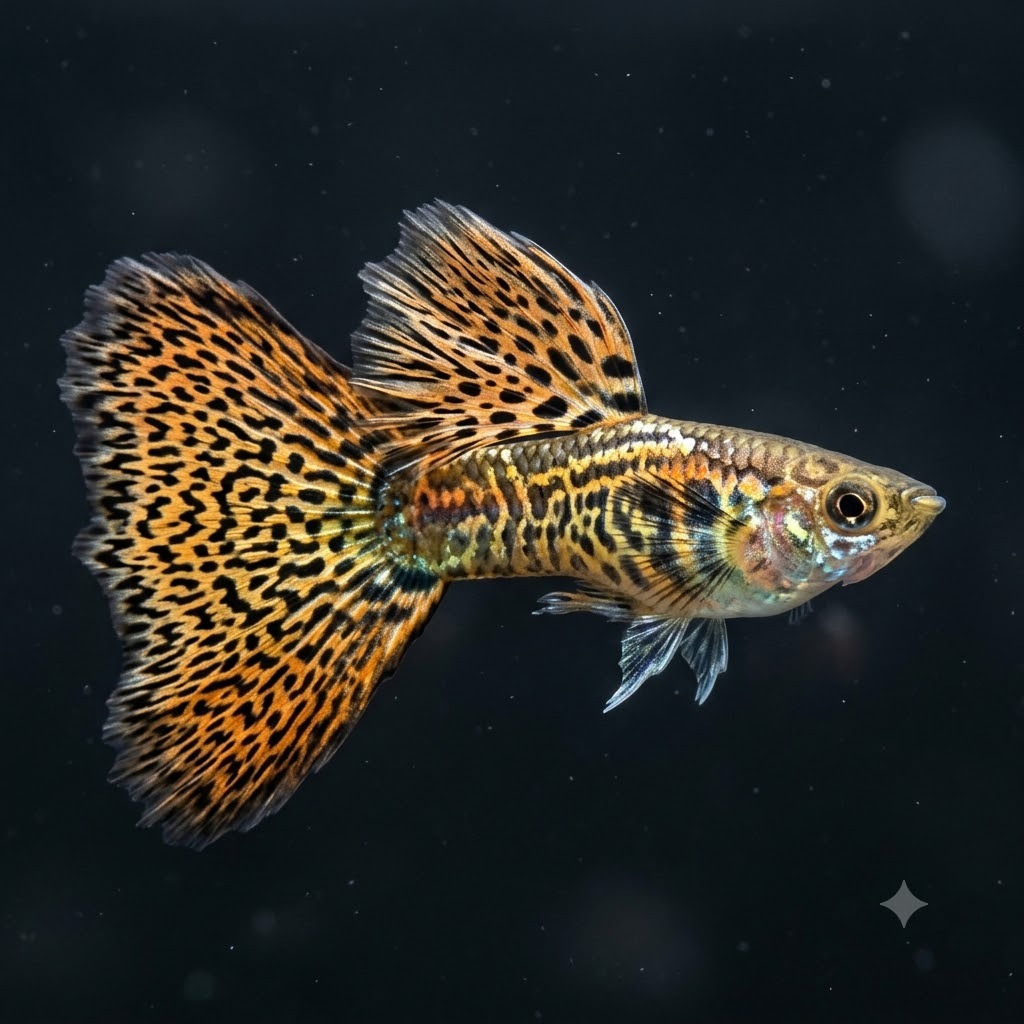
The Leopard Guppy is a tail-pattern strain: round, separate, rosette-like spots scattered across the caudal fin, usually on a red, orange, or yellow ground.
🗓️ Last reviewed: July 2026
Overview
The Leopard Guppy is a tail-pattern strain: round, separate, rosette-like spots scattered across the caudal fin, usually on a red, orange, or yellow ground. It sits in the same family of pattern classes as Grass and Mosaic, and telling the three apart in a shop tank is a genuine skill. Underneath the pattern it is a standard Poecilia reticulata - peaceful, small, prolific, easy to feed - with the usual fancy-guppy trade-off: line-bred stock is prettier and less robust than plain feeder guppies, and it punishes dirty water faster.
Natural History
Wild guppies live in streams and coastal ditches across northern South America and nearby Caribbean islands, where male tails carry small random blotches. Selective breeding over the last century sorted those blotches into named pattern strains, and Leopard is one of them - fixed by European and Asian breeders as the line where tail markings are round, distinct, and separated rather than linked or finely speckled. Worth knowing before you enter a show: not every organization treats leopard as its own judging class, and many judge it inside the broader mosaic or pattern categories, so the name is more reliable as a strain description than as a competition class. Every leopard line in the hobby is deliberate line-breeding work; no wild population looks like this.
Appearance
Males run 1.2-1.4 in (3-3.5 cm) of body plus tail; females reach 2-2.4 in (5-6 cm) and show little pattern. The caudal fin carries round to oval spots, each one separate from its neighbors, often with a darker ring around a lighter center, spread evenly over a solid base color. The dorsal usually repeats the spotting. Compare the neighbors carefully: Grass shows fine, dust-like specks; Mosaic shows large irregular blotches connected into a web; Cobra and Snakeskin are body patterns rather than tail patterns. Most leopards are bred onto a wide delta tail, and body color varies from pale to metallic depending on the line. Many guppy color and pattern genes sit on the Y chromosome, so a good male often passes his tail to his sons - but not all of them do, since some color loci sit on the X chromosome or on autosomes, and lines differ in how cleanly they transmit.
Temperament & Tankmates
Peaceful, active, and mostly in the upper half of the tank. The variety-specific caution is the tail: a large spotted delta is heavy and slow, so avoid fin nippers such as tiger barbs and serpae tetras, and avoid fast feeders that will strip the food before a big-finned male arrives. Good company: corydoras, otocinclus, small rasboras, snails, and shrimp in a planted tank. Keep 1 male per 2-3 females to spread out the constant courtship, or run an all-male group for a display tank without fry. In mixed groups expect broods every four to six weeks, most of them eaten by the adults unless there is dense plant cover.
Tank Size & Setup
10 gallons (38 L) minimum for a trio, 20 gallon long (76 L) for a small breeding colony. Plant it well - guppy grass, hornwort, or java moss doubles as fry cover - and keep flow gentle so heavy-tailed males are not swimming into a current all day. A sponge filter is ideal: mild and fry-safe. Smooth decor only, since delicate finnage tears on sharp edges, and a lid, because startled guppies do jump.
Water Parameters
72-82 F (22-28 C), pH 7.0-7.8, moderately hard to hard water (GH 8-12 or higher). Guppies genuinely want minerals; very soft, acidic water shortens their lives and ruins fin condition. Weekly 25 percent water changes are the single most effective thing you can do for a fancy strain, since nitrate creep shows up first as ragged fin edges. Stability matters more than exact numbers.
Diet
Omnivore with a tiny mouth. A quality micro pellet or crushed flake as the staple, plus frozen or live baby brine shrimp and daphnia a few times a week, and some spirulina or blanched greens. Two small meals a day beat one large one. Carotenoid-rich foods deepen the base color that the spots sit on, which is what makes the pattern read from across the room.
Health & Lifespan
2-3 years. Be honest about hardiness: fancy guppies are not the indestructible fish their reputation suggests. Generations of line-breeding for pattern trade away vigor, so a show-bred leopard is meaningfully more fragile than the plain feeder guppies sold as live food, and it will not tolerate an uncycled tank, cold water, or a skipped water change the same way. The big tail is the usual clinical weak point - fin rot and bacterial infection start at the edges whenever water quality slips. Imported farm stock frequently carries camallanus worms and columnaris, so quarantine every new fish for three to four weeks and watch for red threads at the vent and white patches on the body. Buying tips - favor a local breeder over mass imports, look for round, clearly separated spots that hold their shape to the fin edge, and ask whether the line breeds true.
Pros & Cons
Pros:
- Crisp rosette spotting that reads clearly even at a distance
- Much of the pattern rides father to son, making it a satisfying first breeding project
- Standard easy guppy care underneath the show genetics
- Peaceful and suited to small planted tanks
Cons:
- Line-bred stock is less hardy than ordinary guppies
- Large tail invites fin rot and nipping damage
- Sold loosely - many shop "leopards" are really mosaics or grass
- Constant fry production in mixed-sex groups
Leopard Guppy - frequently asked questions
How do I tell a Leopard from a Grass or Mosaic guppy?
Look at the tail markings. Round, separate spots with space between them = Leopard. Fine, dust-like specks = Grass. Large irregular blotches joined into a web = Mosaic.
Will my leopard male's fry look like him?
Often yes for the sons, since much guppy color is Y-linked and rides from father to son. It is not a guarantee - some color genes sit on the X chromosome or on autosomes, so a line can throw off-type males. Daughters carry little visible pattern. Body color and tail size come from both parents, which is why breeders track the female line too.
Are leopard guppies harder to keep than regular guppies?
Slightly. The care list is identical, but line-bred fancy strains have less margin for error - cold water, soft water, and nitrate buildup hit them faster than they hit feeder-grade fish.
Why do my spots look blurry compared with the photos?
Partly lighting, partly genetics. Spot definition varies a lot between lines, and young males have not finished developing their pattern. Good food and clean water sharpen what is there but will not create definition the fish does not have.
🧠 Test yourself: guess the fish
Three clues from our quiz bank, each about another of our fish. Can you name them?
Clue 1.A peaceful aquarium staple, this little fish loses its bright shimmer at night and regains it by day.
It's the Neon Tetra - read the full profile →
Clue 2.Unlike most aquarium fish, this beginner-friendly group gives birth to free-swimming young instead of laying eggs.
It's the Molly / Platy / Swordtail (Livebearers) - read the full profile →
Clue 3.A laterally compressed cichlid with vertical dark stripes, it forms monogamous pairs and guards its eggs on a flat leaf or surface.
It's the Angelfish - read the full profile →