Mosaic Guppy
The Mosaic Guppy is a fancy guppy variety defined by an irregular, stained-glass web of connected blotches across the tail - one of the classic show pattern classes, and a rewarding first "serious" strain for hobbyist breeders.
Updated: July 2026
Species guide: Guppy · All guppy strains
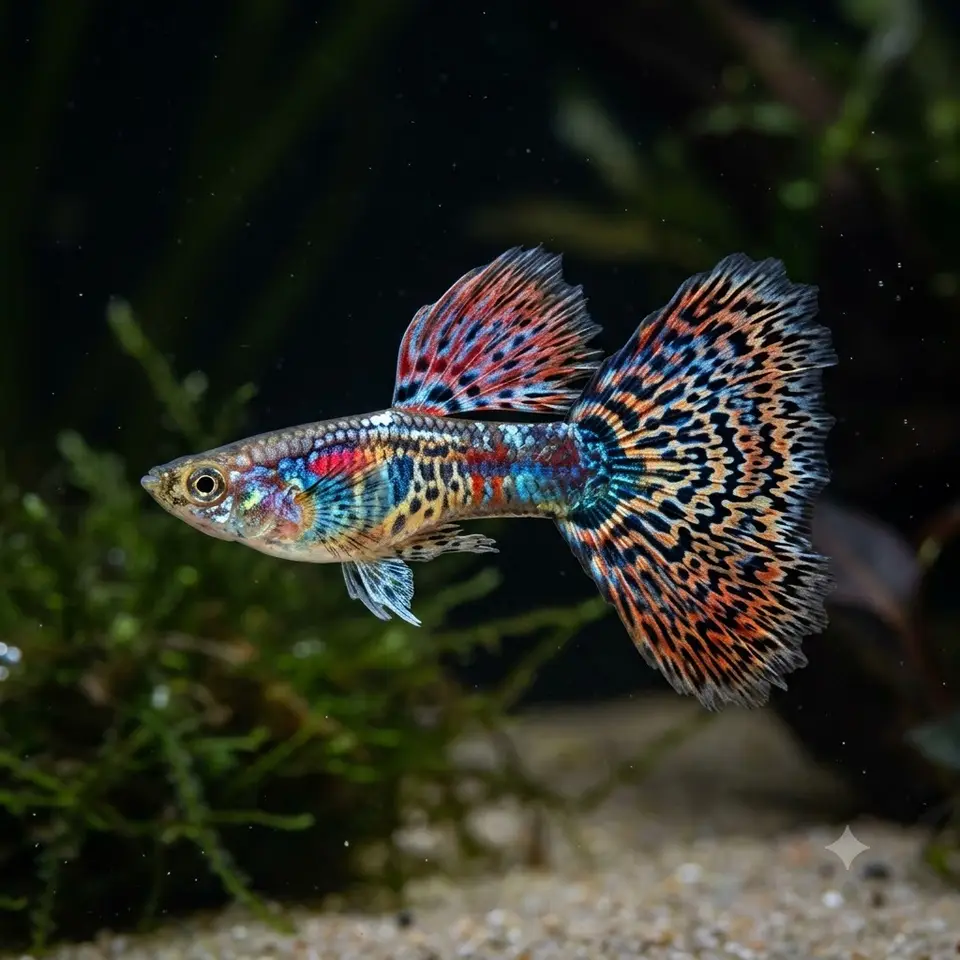 AI illustration
 Overview
The Mosaic Guppy is a fancy guppy variety defined by an irregular, stained-glass web of connected blotches across the tail - one of the classic show pattern classes, and a rewarding first "serious" strain for hobbyist breeders. Underneath the pattern it is still a standard Poecilia reticulata: hardy, peaceful, prolific, and happy in a small planted tank. The variety-specific part is the big patterned tail - it needs calm tankmates, clean water, and a little breeding know-how to keep the pattern sharp across generations.
Natural History
Wild guppies come from streams and brackish edges of northern South America and nearby Caribbean islands, where males carry random splashes of color. A century of selective breeding turned those splashes into fixed show categories, and Mosaic is one of the oldest: breeders in Japan and Europe formalized it as a distinct tail-pattern class, judged alongside Grass, Cobra, Tuxedo, and Solid. Every Mosaic line today is the product of deliberate line-breeding, not a natural population.
Appearance
Mosaic means the tail pattern, not a color. The caudal fin (and usually the dorsal) carries large, irregular dark markings connected to each other like grout lines between tiles - a flowing, linked web over a contrasting base, most often red markings over blue, or blue-black over red. Compare the neighbors: Grass guppies show fine, evenly scattered, separate dots; Leopard guppies show round rosette spots; Cobra/Snakeskin is a body pattern, not a tail pattern. Good Mosaics have bold, clearly connected markings that reach the tail edge without dissolving into specks. Most are bred onto a wide delta tail, and many lines pair the tail with a tuxedo (dark rear half) body. Males run 1.2-1.4 in (3-3.5 cm) plus tail; females reach 2-2.4 in (5-6 cm) and show only faint pattern. The pattern genes are largely Y-linked, so a male passes his mosaic to his sons almost intact - which is exactly what makes the variety fun to breed.
Temperament & Tankmates
Peaceful, busy, and glued to the upper half of the tank. The variety-specific caveat is the tail: a delta-finned Mosaic male is a slow swimmer towing a flag, so never house him with fin nippers (tiger barbs, serpae tetras) or anything fast enough to outcompete him at feeding. Safe company: corydoras, otocinclus, small rasboras, snails, shrimp. Keep 1 male per 2-3 females so no single female is harassed, or run an all-male display group - with no females present, males mostly just posture. Expect fry constantly in mixed groups; adults will eat most of them unless you provide dense plant cover.
Tank Size & Setup
10 gallons (38 L) minimum for a trio; a 20 gallon long (76 L) suits a small breeding colony. Plant it well - hornwort, guppy grass, or java moss doubles as fry cover - and keep flow gentle, because heavy current exhausts big-tailed males. A sponge filter is ideal: fry-safe and mild. Smooth decor only; trailing fins tear on sharp edges. A lid helps, as startled guppies can jump.
Water Parameters
72-82°F (22-28°C), pH 7.0-7.8, and moderately hard to hard water (GH 8-12 or above) - guppies genuinely prefer minerals, and very soft water shortens their lives. Weekly 25% water changes are the single best fin-health measure for this variety: fancy finnage is the first thing to erode when nitrates creep up. Stability matters more than hitting exact numbers.
Diet
Omnivores with tiny mouths. Feed a quality micro pellet or crushed flake as the staple, plus frozen or live baby brine shrimp and daphnia a few times a week, and some spirulina or blanched greens. Small meals once or twice daily beat one big one. Carotenoid-rich foods (astaxanthin, brine shrimp) visibly deepen the red in red Mosaic lines.
Health & Lifespan
2-3 years. Show-bred Mosaics are somewhat more delicate than pet-store mutts: generations of line-breeding for pattern trade away a little vigor. The big tail is the main clinical issue - fin rot and bacterial infections start there whenever water quality slips, and torn fins from nippers or rough decor open the door. Imported farm stock commonly carries camallanus worms and columnaris, so quarantine every new fish for 3-4 weeks. Buying tips: favor a local breeder over mass imports, pick males with crisp connected tail markings and no fin edge fraying, and ask whether the line breeds true - a good Mosaic male should throw mosaic sons.
Pros & Cons
Pros:
- Striking, show-recognized tail pattern
- Pattern passes reliably father to son - great starter breeding project
- Standard easy guppy care underneath
- Peaceful and small-tank friendly
Cons:
- Large tail invites fin rot and nipping damage
- Line-bred stock less hardy than plain guppies
- Imported fish often arrive with parasites
- Relentless breeding in mixed-sex groups
Everyday gear for aquariums
Links go to Amazon or a partner brand's own store and may earn us a commission at no extra cost to you. As an Amazon Associate we earn from qualifying purchases. An Amazon link leads to a type of gear and you choose the exact product; a card that names a store leads to that partner's own shop.
Mosaic Guppy - frequently asked questions
What actually makes a guppy a Mosaic?
The tail pattern: large irregular markings connected into a continuous web across the caudal fin, over a contrasting base color. Any color combo qualifies if the markings link up - isolated dots would make it a Grass or Leopard instead.
Will my Mosaic male's fry look like him?
Mostly, yes - the pattern is largely Y-linked, so sons inherit it directly from the father. The mother's line still shapes body color and tail size, which is why serious breeders track both parents.
Mosaic or Grass - how do I tell in the store?
Look at the tail markings: connected, flowing blotches with visible "grout lines" = Mosaic; fine, evenly spaced, separate specks like scattered seed = Grass.
Are Mosaics harder to keep than ordinary guppies?
Slightly. Care is identical, but the bigger tail and line-bred genetics mean they punish dirty water and nippy tankmates faster. Clean, hard, stable water and calm company close the gap.
Test yourself: guess the fish
Three clues from our quiz bank, each about another of our fish. Can you name them?
Clue 1.Often confused with a deeper-red cousin, this small fish has red only on its back half, not its whole belly.
It's the Neon Tetra - read the full profile →
Clue 2.This peaceful armored aquarium fish gulps air from the surface and breathes part of it through its gut.
It's the Corydoras Catfish - read the full profile →
Clue 3.This vast family of often colorful, territorial fish includes the angelfish, oscar, and the discus, plus the species swarming Africa's Rift lakes.
It's the Cichlid (Overview) - read the full profile →