Platinum Guppy
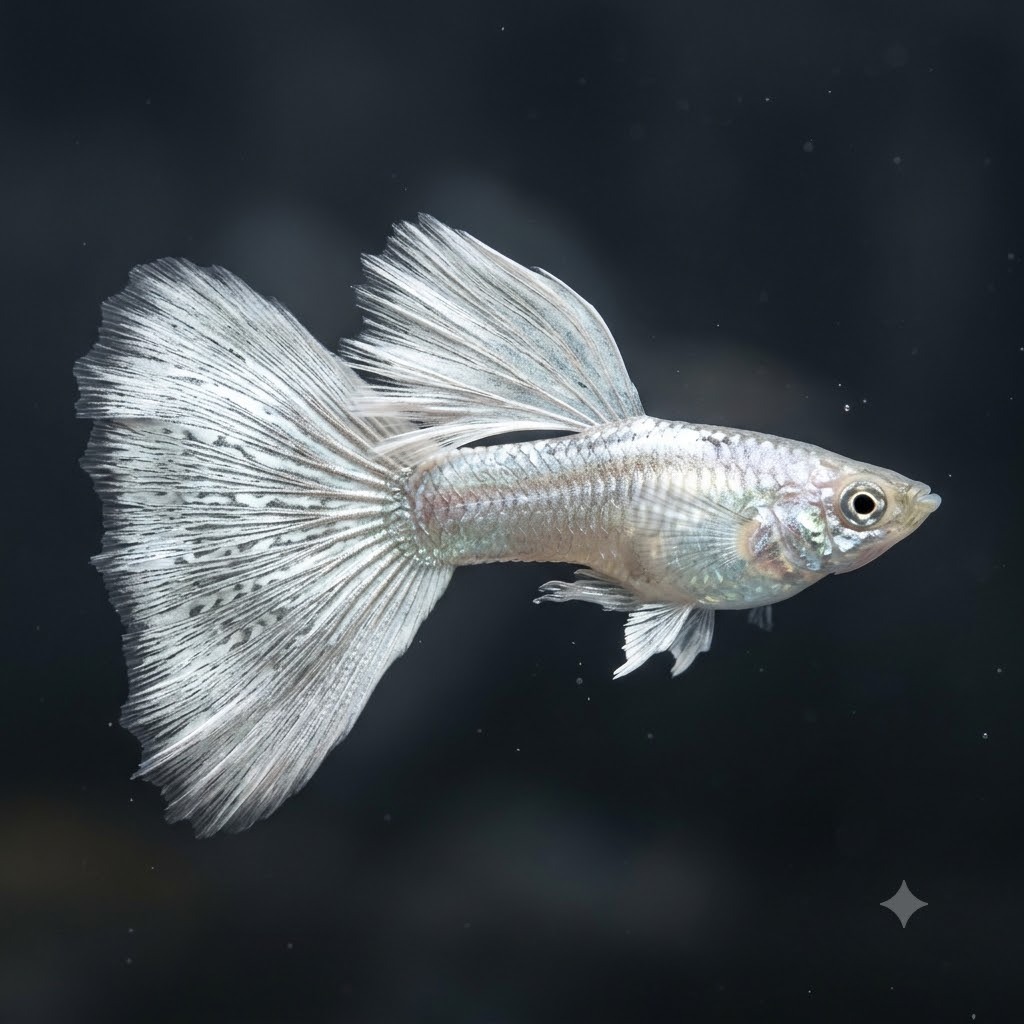
The Platinum Guppy is a body trait rather than a tail pattern: a thick metallic white-to-silver sheen laid over the head and body, so the fish looks dipped in liquid metal from the front half back.
🗓️ Last reviewed: July 2026
Overview
The Platinum Guppy is a body trait rather than a tail pattern: a thick metallic white-to-silver sheen laid over the head and body, so the fish looks dipped in liquid metal from the front half back. Because it is a body feature, it is sold in combination with almost every tail type and color - platinum red, platinum white, platinum tuxedo, platinum mosaic - and that is the main source of confusion when buying. Care is ordinary guppy care in hard, warm, clean water. The honest note is the usual one for show strains: these are line-bred fish with less resilience than plain guppies, and the metallic sheen looks very different under shop lighting than at home.
Natural History
Wild guppies carry iridophores - light-reflecting cells that create small metallic flecks on the flanks. Breeders selected for more and more of that reflective layer until it covered the entire forebody, producing what the hobby calls platinum. The trait was fixed and popularized largely by Asian and European breeders in recent decades, and it now functions as a module that gets crossed into other strains. Like every fancy guppy trait, it is a domestic development with no wild equivalent.
Appearance
Males 1.2-1.4 in (3-3.5 cm) of body plus tail; females 2-2.4 in (5-6 cm) and often showing the metallic body themselves, which is unusual and one of the strain's attractions. The signature is a bright, opaque metallic layer covering the head, shoulders, and much of the flank, ranging from white-silver to a warm gold-tinged platinum depending on the line. The rear body and tail then carry whatever color the strain adds: red, blue, yellow, white, or a pattern class such as mosaic. The reflectivity is structural, so the sheen shifts with the viewing angle and the light source - the same fish can look brilliant white under a strong LED and dull grey under a dim bulb. Better lines have even coverage without patchy gaps behind the gill plate.
Temperament & Tankmates
Peaceful, active, and surface-oriented like all guppies. Where the strain has been bred onto a large delta tail, the male is a slow swimmer and needs calm company: corydoras, otocinclus, small rasboras, snails, and shrimp in a planted tank. Fin nippers such as tiger barbs and serpae tetras are out. Keep 1 male per 2-3 females to distribute courtship pressure, or keep an all-male group, which shows off the metallic bodies as a shoal and produces no fry. In mixed groups, broods arrive every few weeks and adults eat most of them without dense cover.
Tank Size & Setup
10 gallons (38 L) minimum for a trio, 20 gallon long (76 L) for a colony. Dense planting for fry cover, gentle flow, a sponge filter, smooth decor, and a lid. Lighting deserves real thought with this strain: strong, well-positioned light is what makes a platinum body look like metal, while a dim tank turns it flat and grey. A dark substrate and background sharpen the contrast considerably.
Water Parameters
72-82 F (22-28 C), pH 7.0-7.8, moderately hard to hard water (GH 8-12 or higher). Guppies need minerals; soft acidic water leads to clamped fins, faded fish, and short lives. Weekly 25 percent water changes with ammonia and nitrite at zero and nitrate kept low. Stability is more important than hitting exact figures.
Diet
Omnivore with a tiny mouth. Micro pellets or crushed flake as the staple, live or frozen baby brine shrimp and daphnia several times a week, and spirulina or blanched greens. Two small meals a day. Carotenoid-rich foods support the red or orange in platinum-red lines; the metallic sheen itself is structural and does not respond to diet, so color-boosting claims are irrelevant to the platinum part of the fish.
Health & Lifespan
2-3 years. Health is typical for a fancy strain, which is to say not as bulletproof as guppies' general reputation. Line-bred stock is more sensitive than feeder guppies to cold water, soft water, uncycled tanks, and skipped maintenance, and lines that combine platinum with very heavy finnage stack a slow swimmer on top of that. The oversized tails in those lines are where fin rot starts when nitrate climbs. Imported farm fish frequently carry camallanus worms and columnaris, so quarantine every new arrival for three to four weeks and watch for red threads at the vent and white saddle patches. Buying tips - judge the metallic coverage under a light similar to your own tank, look for an even sheen without bare patches behind the gills, and ask exactly which strain the platinum has been crossed with, since the name alone tells you nothing about the tail.
Pros & Cons
Pros:
- Striking metallic forebody unlike ordinary iridescent guppies
- Females usually show some of the sheen too, so the whole group looks good
- Combines with many tail types and colors
- Standard easy guppy care underneath
Cons:
- Sheen depends heavily on lighting and looks dull in dim tanks
- The name describes the body only, so shop fish vary wildly
- Line-bred stock is less hardy than plain guppies
- Big-tailed sub-lines add fin rot and nipping risk
Platinum Guppy - frequently asked questions
Is platinum a tail type or a color class?
Neither - it is a body trait. Platinum describes a thick metallic layer over the head and forebody, and it gets combined with whatever tail type and color the breeder is working with.
Why does my platinum guppy look grey at home?
Because the sheen is structural, produced by reflective cells rather than pigment, so it depends entirely on light. Shops use strong directional lighting. Better tank lighting and a dark background will bring it back.
Do platinum guppies pass the trait to their fry?
Established lines pass it reliably, and unlike most guppy color, which is Y-linked and therefore male-only, the platinum sheen commonly shows in females too - though how strongly varies by line. Expect variation in coverage quality, and select breeders with clean, gap-free sheen.
Are they good beginner guppies?
They are fine for a beginner who already runs a cycled, heated, hard-water tank. They are not the fish to learn cycling on - fancy strains are less forgiving than the plain guppies sold as feeders.
🧠 Test yourself: guess the fish
Three clues from our quiz bank, each about another of our fish. Can you name them?
Clue 1.Often confused with a deeper-red cousin, this small fish has red only on its back half, not its whole belly.
It's the Neon Tetra - read the full profile →
Clue 2.Nicknamed the 'king of the aquarium,' this round, flat Amazonian cichlid feeds its fry on mucus from its own skin.
It's the Discus - read the full profile →
Clue 3.A popular tank-cleaning bottom dweller from South American rivers, it rasps biofilm with a suckermouth and enjoys driftwood to graze.
It's the Bristlenose Pleco - read the full profile →