Rosy Barb
The rosy barb (Pethia conchonius) is a hardy, active schooling fish from South Asia, prized by beginners for its resilience and by experienced keepers for the deep rosy-red flush that males develop in good conditions.
Updated: November 2026
 AI illustration
Overview
The rosy barb (Pethia conchonius) is a hardy, active schooling fish from South Asia, prized by beginners for its resilience and by experienced keepers for the deep rosy-red flush that males develop in good conditions. Adults reach about 6-8 cm, making them one of the larger, more robust small barbs commonly kept in the aquarium hobby. Rosy barbs are lively, almost constantly on the move, and thrive when kept in groups. Their tolerance of cooler water sets them apart from most tropical community fish and makes them a good choice for unheated or lightly heated rooms.
Natural History
The rosy barb (Pethia conchonius) was described by Hamilton in 1822 and comes from Afghanistan, Pakistan, India, Nepal and Bangladesh, and it has also been reported from Myanmar (FishBase, P. conchonius). Its genus name Pethia is the general Sinhala name for small fish of the carp family (FishBase, P. conchonius). Adults live in lakes and fast-flowing hill streams and eat worms, crustaceans, insects and plant matter (FishBase, P. conchonius). FishBase calls it one of the hardiest barbs and notes that it breeds prolifically and tolerates low water temperatures (FishBase, P. conchonius). It has been introduced around the world and is now very popular with aquarists (FishBase, P. conchonius). FishBase records eight introductions; it became established in Puerto Rico between 1950 and 1974, in Mexico in 1967 and in Colombia and Singapore, but not in Australia in 1970 (FishBase introductions, P. conchonius).
Appearance
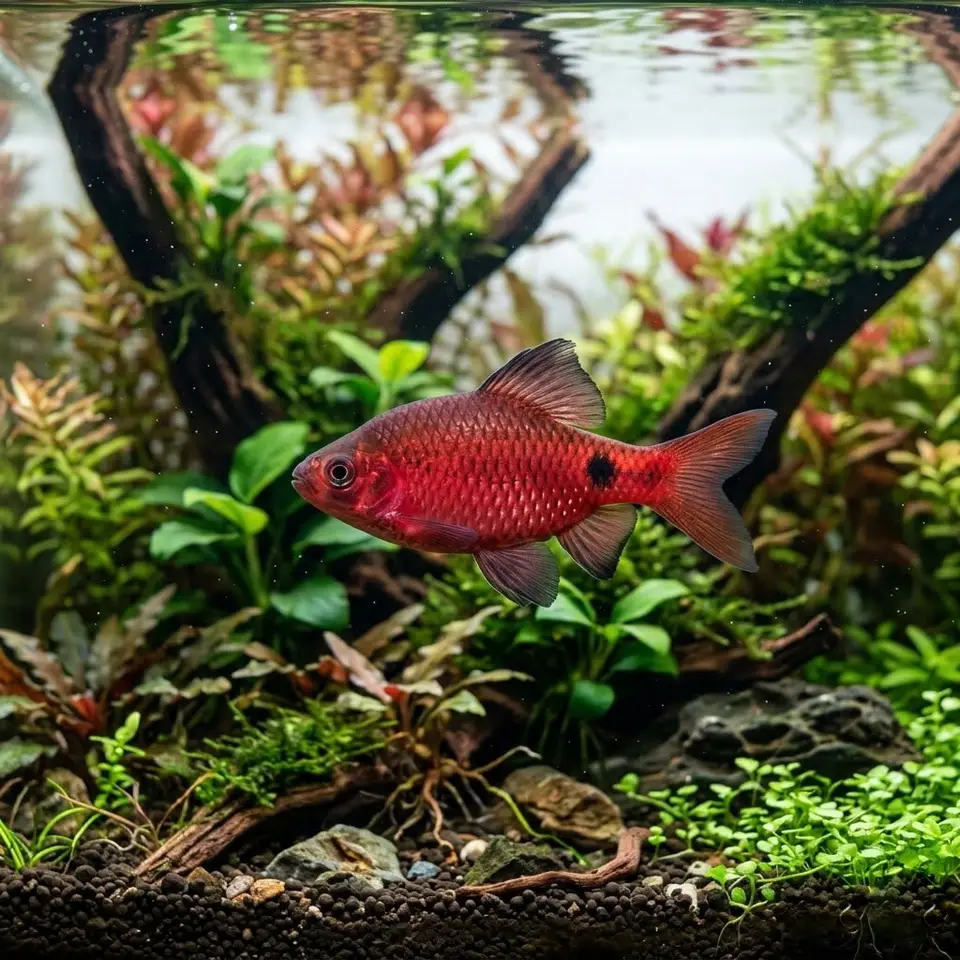
The rosy barb has a deep, slightly flattened body built for constant swimming. Wild-type fish are silvery-gold with a dark spot near the tail. Mature males are the showpiece: during good condition and especially at breeding time they flush an intense rosy-red to coppery pink, with dusky black-tipped fins. This colour intensifies with maturity, a varied diet and the presence of females, and fades under stress or poor conditions, so the redness of the males is a useful indicator of how well the fish are being kept. Females stay more subdued - golden to silvery with a fuller belly. Selectively bred varieties include neon-gold, long-finned and deeper red strains, though the long-finned forms are slower and more prone to fin damage. Both sexes reach roughly 6-8 cm as adults.
Tank Size & Setup
Rosy barbs are active swimmers and need horizontal room to cruise. A group of six or more should have a minimum tank size of 110 litres, with longer tanks strongly preferred over tall ones. Length matters more than volume for this species, since they spend the day patrolling back and forth. Provide a mix of open swimming space and planted or decorated edges where they can retreat. Robust, hardy plants suit them well, though very active barbs may nibble softer species. A darker substrate and a background of planting help the males feel secure and show off their deepest colour. A gentle to moderate current and good oxygenation mimic their stream habitat. A secure lid is wise, as startled barbs can jump.
Water Parameters
- Temperature: 18-24°C - they tolerate cooler water better than most tropicals and can suffer if kept too warm long-term.
- pH: 6.0-7.5.
- Hardness: soft to moderately hard.
- Ammonia 0, nitrite 0, nitrate kept low with regular water changes.
Rosy barbs are forgiving of minor fluctuations, but stable, clean water brings out their best colour.
Diet
Omnivore. Rosy barbs eat readily and are not fussy, which is part of what makes them so easy to keep. Offer a quality flake or small pellet as a staple, supplemented with frequent live or frozen foods such as bloodworms, daphnia and brine shrimp, plus occasional blanched vegetables or algae-based foods like spinach and courgette. Including some plant matter in the diet helps satisfy their tendency to graze and reduces nibbling on aquarium plants. A varied diet intensifies the males' red colouration and keeps the whole group in strong condition. Feed small amounts once or twice daily and avoid overfeeding, as these greedy fish will eat more than is good for them and can become bloated in tanks where food is over-supplied.
Health & Lifespan
Average lifespan is 4-6 years. Rosy barbs are among the hardier aquarium fish, but they are still vulnerable to the usual freshwater ailments.
Common concerns:
- Ich (white spot) - often triggered by chilling or stress.
- Fin rot - linked to poor water quality.
- Fin nipping stress - crowded or under-schooled barbs may harass one another or tankmates.
- Obesity from overfeeding.
Keeping them in a proper group of six or more and maintaining clean, well-oxygenated water prevents most problems.
Pros & Cons
Pros: hardy and beginner-friendly, striking red males, active and entertaining, tolerant of cooler rooms. Cons: can nip fins of slow or long-finned tankmates; needs a group of six or more; active swimmers require length rather than a small tank.
Everyday gear for aquariums
Links go to Amazon or a partner brand's own store and may earn us a commission at no extra cost to you. As an Amazon Associate we earn from qualifying purchases. An Amazon link leads to a type of gear and you choose the exact product; a card that names a store leads to that partner's own shop.
Rosy Barb - frequently asked questions
How big do rosy barbs get?
Around 6-8 cm as adults, larger than many small barbs.
Do they need to be kept in groups?
Yes. Keep a minimum of six. Small groups become nippy and stressed.
Are they good for beginners?
Very much so - they are hardy, adaptable and forgiving of minor mistakes.
Do they nip other fish?
They can, especially slow-moving or long-finned tankmates. A proper-sized school reduces this.
What temperature do they need?
18-24°C. They tolerate cooler water and should not be kept too warm.
Sources
Sources this profile draws on, as linked in the text:
- FishBase, P. conchonius(fishbase.se)
- FishBase introductions, P. conchonius(fishbase.se)
This page is general information, not veterinary advice. For questions about your pet's health, please talk to your vet.
Test yourself: guess the fish
Three clues from our quiz bank, each about another of our fish. Can you name them?
Clue 1.A peaceful nano-fish best kept in large shoals, it glows electric blue and crimson under subdued aquarium lighting.
It's the Cardinal Tetra - read the full profile →
Clue 2.Prized for vivid stripes and patterns, this disc-shaped fish is one of the most colorful freshwater species kept.
It's the Discus - read the full profile →
Clue 3.Sporting two pairs of whiskers, this bottom-dweller is happiest kept in groups as it constantly sifts the substrate for food.
It's the Corydoras Catfish - read the full profile →