Taisho Sanke Koi
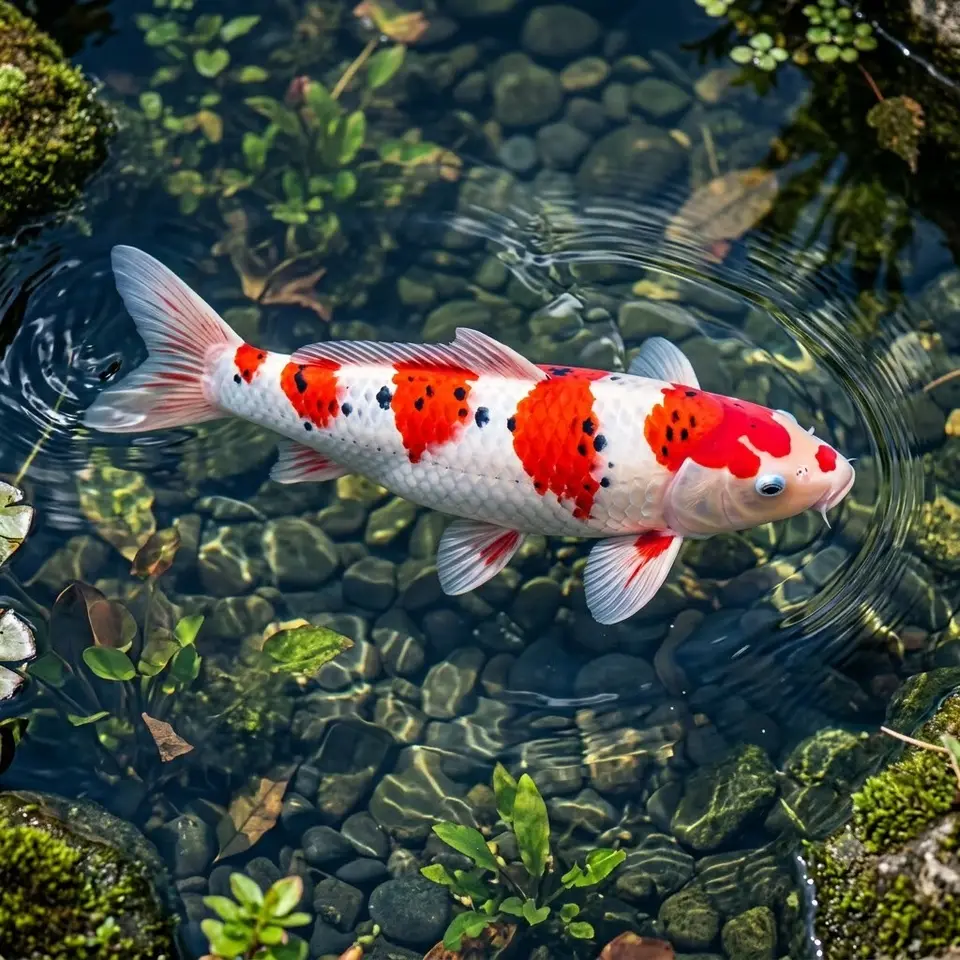
Taisho Sanke - 'Sanke' to friends - is Kohaku wearing ink: the same white base and red pattern with black (sumi) accents scattered like brushstrokes above the lateral line.
Last reviewed: July 2026
 AI illustration
 Overview
Taisho Sanke - 'Sanke' to friends - is Kohaku wearing ink: the same white base and red pattern with black (sumi) accents scattered like brushstrokes above the lateral line. One of the 'Big Three' (Gosanke) varieties with Kohaku and Showa, it adds a third colour's complexity to the judging art.
Natural History
Fixed in the Taisho era (1910s) Japan; the name literally dates the variety. With Kohaku and Showa it forms Gosanke, koi's royal family.
Appearance
White base, Kohaku-style red pattern, plus discrete black spots (never on the head in the ideal) - small, lacquer-deep and balanced. To 60-90 cm.
Tank Size & Setup
Standard koi pond requirements: thousands of liters, depth, filtration, netting. Sanke display best against light pond bottoms where sumi reads sharply.
Water Parameters
Seasonal cold-water range as all koi; black sumi famously deepens in harder, mineral-rich water and can fade soft.
Diet
Seasonal koi feeding; colour-enhancing foods (spirulina, carotenoids) support red without muddying white.
Health & Lifespan
Average lifespan is 25-40 years. The koi standard: decades of life, pond-health-driven wellness, reputable-source buying.
Pros & Cons
Pros
- Gosanke royalty with three-colour depth
- Sumi develops fascinatingly over years
- Same friendly koi personality
- A collector's canvas
Cons
- Standard koi pond costs
- Sumi quality is a genetic lottery
- Judging subtleties take study
- Black can fade in soft water
Everyday gear for aquariums
Links go to Amazon or a partner brand's own store and may earn us a commission at no extra cost to you. As an Amazon Associate we earn from qualifying purchases. An Amazon link leads to a type of gear and you choose the exact product; a card that names a store leads to that partner's own shop.
Taisho Sanke Koi - frequently asked questions
Sanke vs Showa at a glance?
Sanke = white fish with red and small black accents (no black on head); Showa = black fish wrapped in red and white (black on head, wrapping the body). Head and wrap tell you instantly.
Why did my Sanke's black spots change?
Sumi is alive - it sinks, surfaces and finishes over years with age, water and diet. Watching it develop is half the variety's fascination.
Is Sanke good for beginners?
Absolutely - same hardiness as all koi; the three-colour appreciation simply grows with you.
Test yourself: guess the fish
Three clues from our quiz bank, each about another of our fish. Can you name them?
Clue 1.Keepers love this diverse group for bold personalities but warn that many dig substrate and fiercely defend a chosen territory.
It's the Cichlid (Overview) - read the full profile →
Clue 2.This stout algae-eating catfish has bony armor plates and males that grow fleshy tentacle-like growths on the snout.
It's the Bristlenose Pleco - read the full profile →
Clue 3.A laterally compressed cichlid with vertical dark stripes, it forms monogamous pairs and guards its eggs on a flat leaf or surface.
It's the Angelfish - read the full profile →