Rosetail Betta
The Rosetail Betta is a Halfmoon pushed past its limit - excessive branching in the tail rays makes the fin edge ruffle and overlap like rose petals, creating one of the most dramatic silhouettes in the hobby.
Updated: October 2026
Species guide: Betta (Siamese Fighting Fish) · All betta varieties
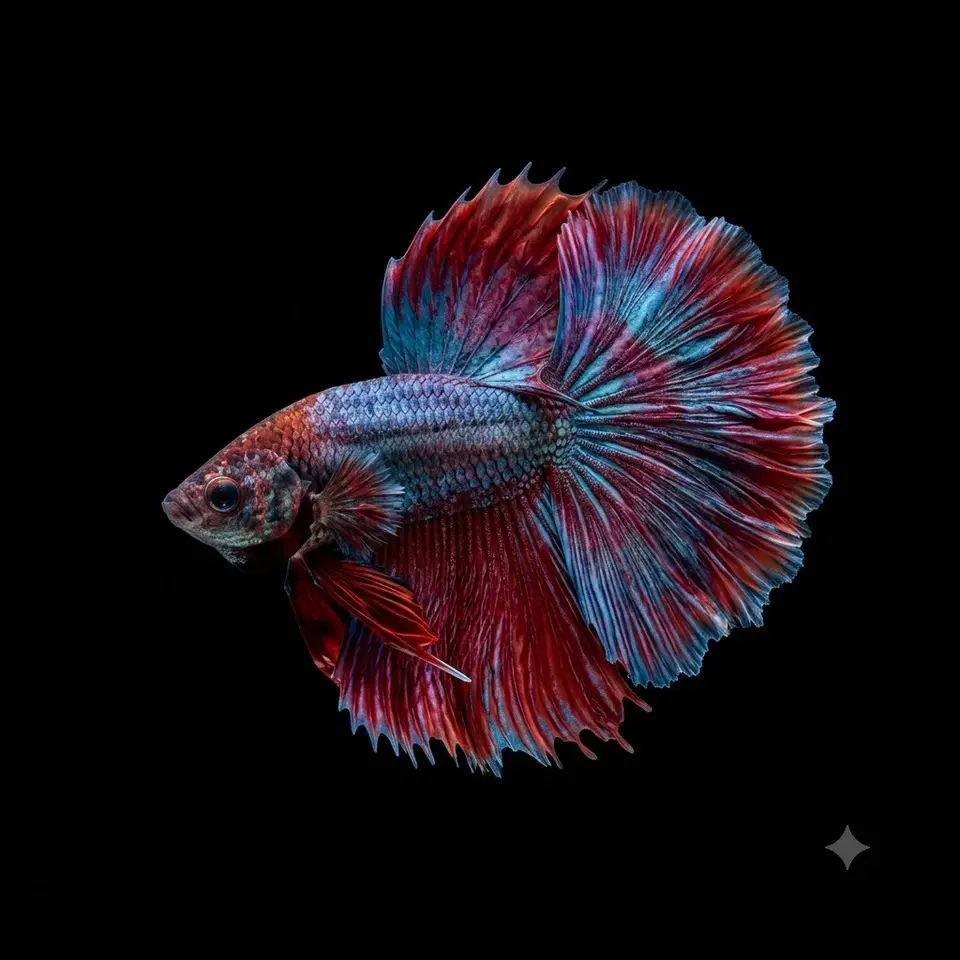 AI illustration
 Overview
The Rosetail Betta is a Halfmoon pushed past its limit - excessive branching in the tail rays makes the fin edge ruffle and overlap like rose petals, creating one of the most dramatic silhouettes in the hobby. That beauty is bought on credit: the same genetics that produce the ruffles produce weak rays, tail biting, and swimming fatigue. This is a showpiece variety for keepers willing to run a near-perfect, low-flow tank, not a starter betta.
Natural History
Every Rosetail is a domestic Betta splendens, descended from wild bettas of Thailand and Cambodia that live in warm, slow, shallow water and breathe air with a labyrinth organ. The variety appeared in the 1980s-90s as breeders chasing ever-fuller Halfmoon tails selected for extra ray branching. Where a standard Halfmoon ray splits into 4, 8 or even 16 branches, Rosetail lines branch excessively, so the fin membrane outgrows its own supports and folds. Push the trait further still and you get the Feathertail, with an even more shredded, lace-like edge. The look is entirely man-made - nothing like it survives in the wild.
Appearance
A typical male runs 2.5-3 in (6-7.5 cm) including finnage. The defining feature is the caudal fin: a 180-degree-plus spread whose edge is ruffled, overlapping, and rose-like rather than the clean D of a true Halfmoon. Dorsal and anal fins are usually oversized to match. Rosetails come in nearly every betta color - solids, butterflies, koi, metallics. Tell it apart at a glance: Halfmoon = crisp straight edge; Rosetail = ruffled petals; Feathertail = frayed feather edge. Buyers should also know the downside written into the line: some fish carry the "X-factor" (visibly kinked, weak rays), and heavily ruffled fish often can't fully open the tail at all. Females show the branching only mildly and look close to regular Halfmoon females.
Temperament & Tankmates
Standard betta rules, amplified. Males are strictly one per tank - never two males, never a male with a female outside supervised breeding. The heavy tail actually softens aggression in practice because the fish tires quickly, which makes him more vulnerable, not safer: fin-nippers like tiger barbs or serpae tetras will shred a Rosetail in a day. Best kept alone in 5-10 gallons. In a larger, densely planted tank, calm bottom-dwellers such as kuhli loaches or a few corydoras, plus snails, are the safest company. Skip guppies (males may be attacked for their flashy tails) and anything fast enough to outcompete him at feeding.
Tank Size & Setup
5 gallons (19 L) minimum, 10 gallons (38 L) better, long footprint over tall - a heavy-finned fish struggles to climb to the surface for air. Non-negotiables: a gentle sponge filter or heavily baffled flow (strong current pins these fish to the glass), a tight lid with an air gap for labyrinth breathing, and only silk or live plants: test any decor with pantyhose; if it snags nylon, it will tear fin membrane. Add broad-leaved plants or a betta hammock near the surface so he can rest without swimming.
Water Parameters
78-80°F (25.5-26.5°C) on a heater, always - room temperature is not enough. pH 6.5-7.5, soft to moderately hard water, ammonia and nitrite 0, nitrate under 20 ppm. Rosetails need cleaner water than average bettas because torn fins infect easily; do 25-30% weekly changes on a cycled tank and don't skip them.
Diet
A carnivore: quality betta pellets (2-4 pellets, twice daily) as the base, with frozen or live bloodworms, brine shrimp, and daphnia a few times a week. Fast one day weekly - bettas bloat easily, and constipation is a common cause of buoyancy trouble. Good protein also supports fin regrowth after the inevitable tears.
Health & Lifespan
2-4 years. Expect the shorter end of the betta range - the extreme branching correlates with weaker fish overall. Variety-specific problems to watch: tail biting (many Rosetails chew off their own heavy tails from stress or irritation. It looks alarming but usually heals), fin tears and fin rot in the torn tissue, fin collapse where the tail folds and drags with age, and swim-bladder complaints from the sheer drag of the finnage. Clean warm water and low flow prevent most of it. Buying tips: choose a young fish that swims level and flares fully, with straight rays and no kinks; avoid fish already resting on the bottom or with clamped, collapsing tails, and be wary of listings that are actually Feathertails sold as Rosetails.
Pros & Cons
Pros:
- The most dramatic tail in the betta hobby
- Small tank footprint: thrives alone in 5-10 gallons
- Full range of betta colors and patterns
- Interactive, personable, learns to recognize you
Cons:
- Weak rays and fin collapse are bred into the variety
- Prone to tail biting and fin rot
- Needs near-zero flow and snag-free decor
- Often shorter-lived than standard bettas
- Show-quality fish cost $25-60+
Everyday gear for aquariums
Links go to Amazon or a partner brand's own store and may earn us a commission at no extra cost to you. As an Amazon Associate we earn from qualifying purchases. An Amazon link leads to a type of gear and you choose the exact product; a card that names a store leads to that partner's own shop.
Rosetail Betta - frequently asked questions
What is the difference between a Rosetail and a Halfmoon?
Both spread the tail 180 degrees, but a Halfmoon has a clean, straight edge while a Rosetail's excess ray branching makes the edge ruffle and overlap like petals. A Rosetail is essentially a Halfmoon with too much of a good thing.
Why is my Rosetail biting his own tail?
Tail biting is common in heavy-finned bettas - stress, boredom, or simple irritation at dragging the weight around. Improve water quality, add resting spots and enrichment, and the fin usually regrows, though rarely as full as before.
Do Rosetails live as long as other bettas?
Usually a bit less. The genetics behind extreme branching tend to produce less robust fish, so 2-3 years is typical even with excellent care, against 3-5 for a well-kept plakat.
Can a Rosetail live in a community tank?
Only a calm one (kuhli loaches, corydoras, snails) in 10+ gallons with dense planting. Never with fin-nippers or other bettas; his tail makes him the slowest fish in any tank.
Test yourself: guess the fish
Three clues from our quiz bank, each about another of our fish. Can you name them?
Clue 1.This peaceful armored aquarium fish gulps air from the surface and breathes part of it through its gut.
It's the Corydoras Catfish - read the full profile →
Clue 2.Native to the rice paddies of Southeast Asia, this fish has a special organ that lets it gulp air directly from the surface to survive low-oxygen water.
It's the Betta (Siamese Fighting Fish) - read the full profile →
Clue 3.This tiny schooling fish glows with an iridescent blue stripe and a red streak along its rear half.
It's the Neon Tetra - read the full profile →