Moscow Guppy
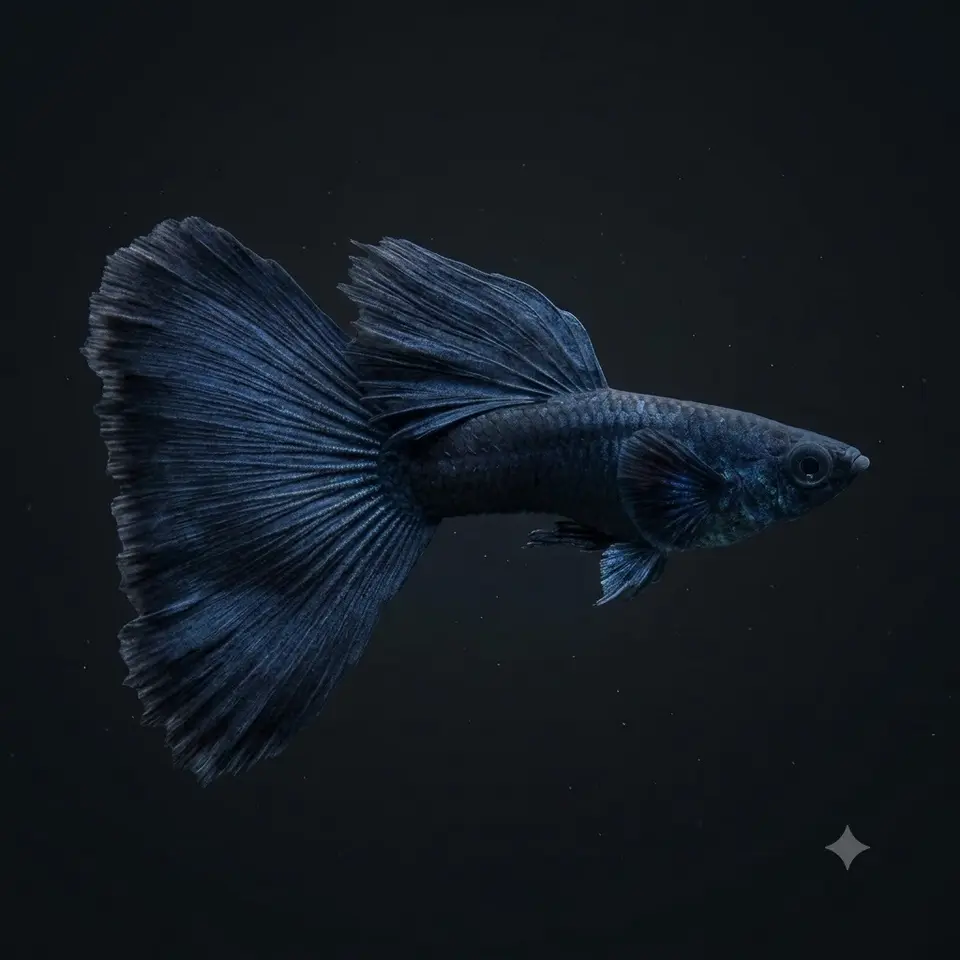
The Moscow Guppy is a fancy guppy strain defined by a single trait no other variety fully matches: solid metallic color from the tip of the nose to the end of the tail, with no gray wild-type front half.
Updated: October 2026
Species guide: Guppy · All guppy strains
 AI illustration
 Overview
The Moscow Guppy is a fancy guppy strain defined by a single trait no other variety fully matches: solid metallic color from the tip of the nose to the end of the tail, with no gray wild-type front half. Moscows come in deep blue, green, purple and near-black, and males can visibly shift the intensity of that color with mood and dominance. Care is standard guppy care with a few line-bred caveats - stable, slightly hard water and gentle tankmates matter more here than with pet-store stock.
Natural History
All fancy guppies descend from the wild Poecilia reticulata of northern South America and Trinidad, a small, adaptable livebearer. The Moscow strain was developed by Russian hobbyist breeders in and around Moscow in the 1980s, then spread through European and American show circles in the 1990s. The defining "Moscow" trait is carried on the Y chromosome, so it passes reliably from father to son - which is why serious lines stay consistent and why outcrossed males quickly lose the look.
Appearance
Males run about 1.2-1.4 in (3-3.5 cm) in body, females larger and plainer at 2-2.4 in (5-6 cm). What defines the variety is full-body coverage: metallic color over the head, face and body, flowing into a broad delta tail of the same shade. Compare that to a Tuxedo (Half-Black) guppy, where only the rear half is dark, or to most fancy strains, where the front half stays gray. Moscow Blue is the classic form; Moscow Green, Purple and Black (the base of many "Midnight" lines) are also established. The famous party trick is mood shifting - a dominant male can deepen from steel to near-black in minutes, then pale again when stressed or chilled. A washed-out Moscow is telling you something about water or pecking order.
Temperament & Tankmates
Peaceful, active, endlessly displaying - standard guppy behavior. Keep 2-3 females per male or a males-only group to spread out harassment. The risk runs the other way: that big soft delta tail invites nipping, so skip tiger barbs, serpae tetras and bettas. Good company includes corydoras, otocinclus, small rasboras, neon tetras and snails. Avoid housing with common pet-store guppies if you care about the line: females mixed with non-Moscow males will give you mixed fry.
Tank Size & Setup
A 10 gallon (38 L) tank suits a trio; 20 gallons (75 L) is better for a colony, because livebearers multiply. Provide gentle filtration (a sponge filter or baffled hang-on-back), since heavy flow exhausts long-finned males. Live plants (java moss, guppy grass, hornwort) give fry cover and males resting spots. Smooth decor only; ragged edges shred delta tails. A tight lid helps - guppies jump.
Water Parameters
72-82°F (22-28°C), pH 7.0-8.0, moderately hard water (GH 8-12). Guppies genuinely prefer hard, alkaline conditions; soft acidic water shortens their lives. Line-bred Moscows are less forgiving than feeder-grade guppies, so prioritize stability: weekly 25% water changes, zero ammonia and nitrite, nitrates under 20 ppm. Cold drafts and temperature swings are the fastest way to a pale, clamped, disease-prone Moscow.
Diet
Omnivores with big appetites in tiny bodies. Feed a quality small-pellet or flake staple once or twice daily, only what disappears in a minute. Frozen or live baby brine shrimp and daphnia two to three times a week noticeably deepen the metallic color - diet shows in this strain more than most. Add a little spirulina or blanched greens for fiber. Fry take crushed flake and baby brine from day one.
Health & Lifespan
2-3 years. That is typical fancy-guppy territory - intensively line-bred fish trade some vigor for looks. The heavy delta tail is the variety's weak point: fin rot follows nipping or poor water, and males can tire in strong current. Watch for the usual guppy issues (ich, columnaris and wasting disease in newly imported stock), and quarantine every new fish for 3-4 weeks. Sustained pale color is an early stress flag unique in its usefulness; a healthy dominant Moscow should look saturated most of the day.
Pros & Cons
Pros:
- Unique full-body metallic color no other strain matches
- Fascinating mood-based color shifting
- Y-linked trait breeds true in male lines
- Standard easy guppy care and tank size
- Prolific and rewarding for beginner breeders
Cons:
- Line-bred stock less hardy than plain guppies
- Large delta tail invites nipping and rot
- Quality fish cost far more than pet-store guppies
- Color fades with stress, cold or poor water
- Rarely found locally; usually shipped from breeders
Everyday gear for aquariums
Links go to Amazon or a partner brand's own store and may earn us a commission at no extra cost to you. As an Amazon Associate we earn from qualifying purchases. An Amazon link leads to a type of gear and you choose the exact product; a card that names a store leads to that partner's own shop.
Moscow Guppy - frequently asked questions
How do I know a Moscow is genuine?
Look at the head. A true Moscow male carries color over the face and crown with no gray front half. Gray from the gills forward means a Tuxedo or a mixed fish, whatever the label says.
Why did my Moscow turn pale?
Short-term paling is normal mood shifting - males lighten when startled, chilled or outranked. A fish that stays washed out for days is stressed: test the water, check the temperature and watch for bullying.
Will Moscow fry look like the parents?
Sons will, if the father is a true Moscow and the mother is from the same line - the trait rides the Y chromosome. Mixing in unrelated females muddies body shape and finnage within a generation or two.
Where should I buy one?
From a dedicated breeder, online guppy auction or aquarium club rather than a chain store. Expect roughly $15-40 per pair for good Moscow Blue lines, and ask how long the seller's line has bred true.
Test yourself: guess the fish
Three clues from our quiz bank, each about another of our fish. Can you name them?
Clue 1.This category of hardy tropical fish includes the swordtail and platy and breeds readily in home tanks.
It's the Molly / Platy / Swordtail (Livebearers) - read the full profile →
Clue 2.A peaceful nano-fish best kept in large shoals, it glows electric blue and crimson under subdued aquarium lighting.
It's the Cardinal Tetra - read the full profile →
Clue 3.Fancy varieties of this fish include bubble-eye and telescope-eye types bred for unusual looks.
It's the Goldfish - read the full profile →