Mustard Gas Betta
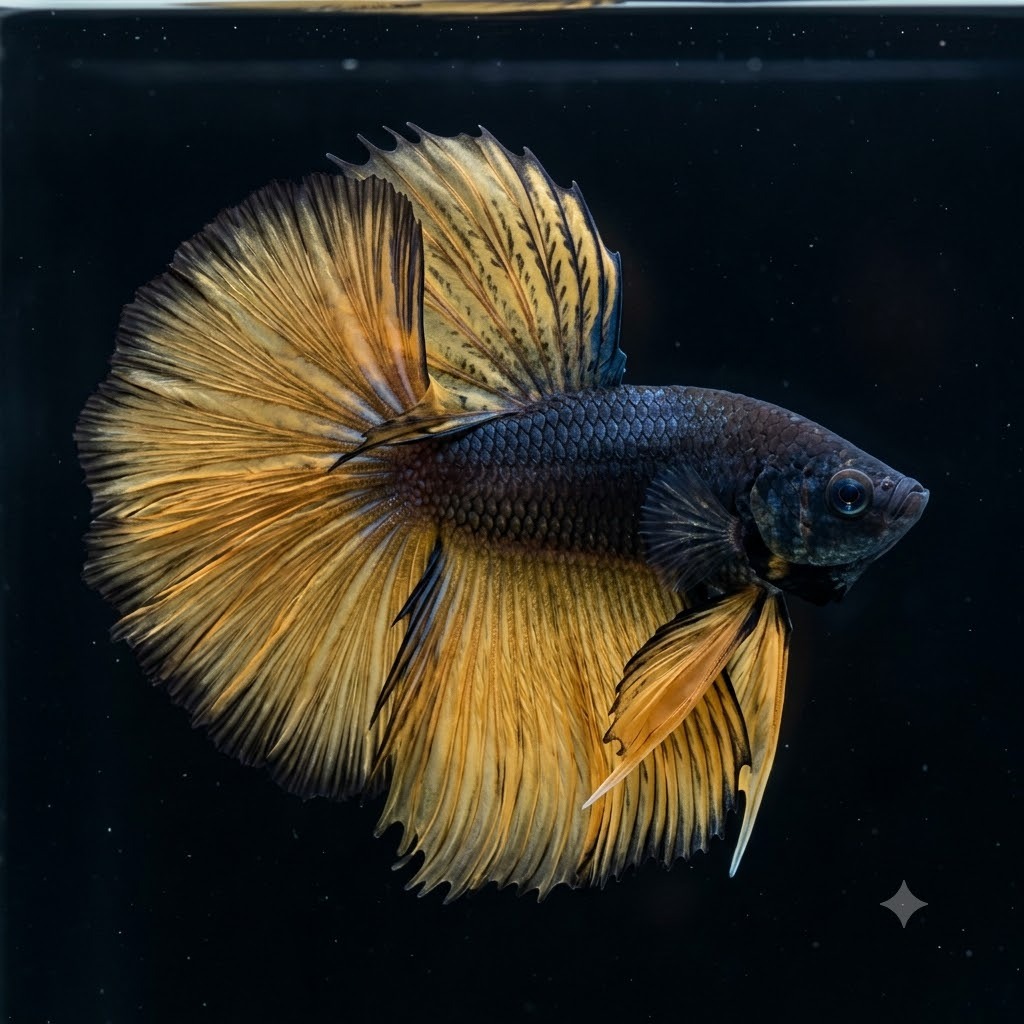
The Mustard Gas Betta is a bicolor: a dark blue, steel, or green body paired with fins that run yellow through mustard to burnt orange, with the body color bleeding a short way into the base of each fin.
🗓️ Last reviewed: July 2026
Overview
The Mustard Gas Betta is a bicolor: a dark blue, steel, or green body paired with fins that run yellow through mustard to burnt orange, with the body color bleeding a short way into the base of each fin. The name is a hobby trade name coined in the late 1990s, referring to the sulphurous mustard-yellow tone of the fins rather than to anything about the fish itself. It is a color class, not a fin type, so mustard gas fish come as plakats, halfmoons, and crowntails. Care is standard betta care - heated water, a lid, 5 gallons or more, one male per tank - and the honest caveat is quality control: the label gets applied loosely, and true clean-contrast fish are much less common than the name suggests.
Natural History
There is no wild mustard gas betta. The look was developed by hobbyist breeders working with domestic Betta splendens in the late 1990s, stacking blue and yellow color layers until the contrast held together, and the name stuck as the line circulated through the American and European betta scenes. Thai breeders took the pattern up and it is now produced worldwide. In show terms the fish falls under the bicolor class, where judges want a body of one color and fins clearly of another. Like most modern betta varieties, it is a selective breeding project, not a natural population.
Appearance
2-2.5 in (5-6.5 cm) in body length, with the fins depending on the underlying type. The signature is contrast: a deep blue, teal, steel, or green body against yellow to orange fins, with a darker wash where the body color pushes into the fin base and fades. Anal and caudal fins usually carry the strongest yellow, while the ventrals are often the darkest part of the fin set. Better fish show a clean break between body and fins and even fin color out to the edge; weaker ones have muddy fins where blue bleeds most of the way through the yellow, or bodies that look washed out rather than saturated. Females exist in the same coloring and are noticeably less dramatic, since fin area is where the effect lives.
Temperament & Tankmates
An ordinary betta in behavior, which means territorial and interactive. Plakat mustard gas males are quick and pushy; halfmoons are slower and easier to keep with other fish, though their finnage tempts nippers. Keep one male to a tank and never house two together. In 10 gallons (38 L) or larger the usual company works: nerite or mystery snails, dwarf corydoras (pygmy, salt-and-pepper, dwarf), ember tetras, harlequin rasboras - standard corydoras and kuhli loaches need a group of five or six and 20 gallons (75 L). Avoid tiger barbs and serpae tetras entirely, and expect shrimp to be treated as food unless there is dense cover.
Tank Size & Setup
5 gallons (19 L) minimum, 10 gallons (38 L) better for a fish you want to watch. A tight lid is mandatory - bettas jump, and this is the single most preventable way to lose one. Include a heater, gentle filtration, live or silk plants, a cave, and a broad leaf near the surface for resting. A dark background and dark substrate make the yellow fins read far stronger than a bright, bare tank does.
Water Parameters
76-82 F (24-28 C) with a heater running year round. pH 6.5-7.5, soft to moderately hard water, ammonia and nitrite at zero, nitrate under 20 ppm, and 25-30 percent weekly water changes. Cool, dirty water dulls fin color in bicolor fish faster than in solid-colored ones, so the contrast this variety is bought for is partly a water quality reward.
Diet
Carnivore. A quality betta pellet as the staple, in two small daily meals, plus frozen or live bloodworms, brine shrimp, and daphnia two or three times a week. One fasting day weekly. Carotenoid-rich foods support the yellow and orange in the fins; they will not create color the fish does not genetically have, but they keep what it has from fading.
Health & Lifespan
3-5 years. Health depends mainly on the fin type: long-finned mustard gas fish carry the usual burden of fin rot, tail biting, and swimming fatigue, while plakats are among the sturdiest bettas available. Quarantine new imports for velvet, ich, and internal parasites. The variety-specific issue is truth in labeling. "Mustard gas" is not a single gene with predictable inheritance - it is a look assembled from several color layers, so spawns throw a wide range of quality, and shops routinely label any blue-bodied fish with yellowish fins as mustard gas. Some lines also carry marble genetics, in which case the body color can shift over months and the crisp contrast slowly disappears. Buying tips - judge the fin color at the outer edge, not at the base, look for a clean body-to-fin break, and prefer a mature fish, since juveniles have not yet shown where their color will settle.
Pros & Cons
Pros:
- Strong two-tone contrast that photographs beautifully
- Available across all fin types, including hardy plakats
- Ordinary betta care, no special equipment
- Widely produced, so it is not hard to find
Cons:
- The name is applied loosely, and quality varies enormously
- Some lines carry marble genes and lose their contrast over time
- Does not breed true - spawns throw plenty of off-type fish
- Needs a heater and a tight lid like every betta
Mustard Gas Betta - frequently asked questions
Why is it called mustard gas?
It is a hobby trade name from the late 1990s, describing the sulphurous mustard-yellow color of the fins. It says nothing about the fish's temperament or health, and there is nothing toxic or unusual about the fish.
Is mustard gas a fin type?
No. It is a bicolor pattern that can appear on plakats, halfmoons, crowntails, and other fin types. Pick the fin type first for the care profile you want, then the color.
Will a mustard gas pair produce mustard gas fry?
Only partly. It is a combination of color traits rather than one clean gene, so a spawn contains a spread of quality and plenty of fish that miss the look. Serious breeders select hard over several generations.
My fish's yellow fins are turning blue. What happened?
Most likely marble genetics in the line, which reshuffle pigment through the fish's life. Poor water quality and cold tanks can also dull color, so check the heater and nitrate first, but a spreading body color is usually genetic and not fixable.
🧠 Test yourself: guess the fish
Three clues from our quiz bank, each about another of our fish. Can you name them?
Clue 1.Often confused with a deeper-red cousin, this small fish has red only on its back half, not its whole belly.
It's the Neon Tetra - read the full profile →
Clue 2.This tiny, hardy aquarium fish gives birth to live young rather than laying eggs, earning it the nickname 'rainbow fish.'
It's the Guppy - read the full profile →
Clue 3.This dazzling Amazonian schooling fish wears a full-length red stripe beneath its blue band, distinguishing it from a similar smaller cousin.
It's the Cardinal Tetra - read the full profile →