Marble Betta
The Marble Betta is the variety that refuses to stay the same fish.
🗓️ Last reviewed: July 2026
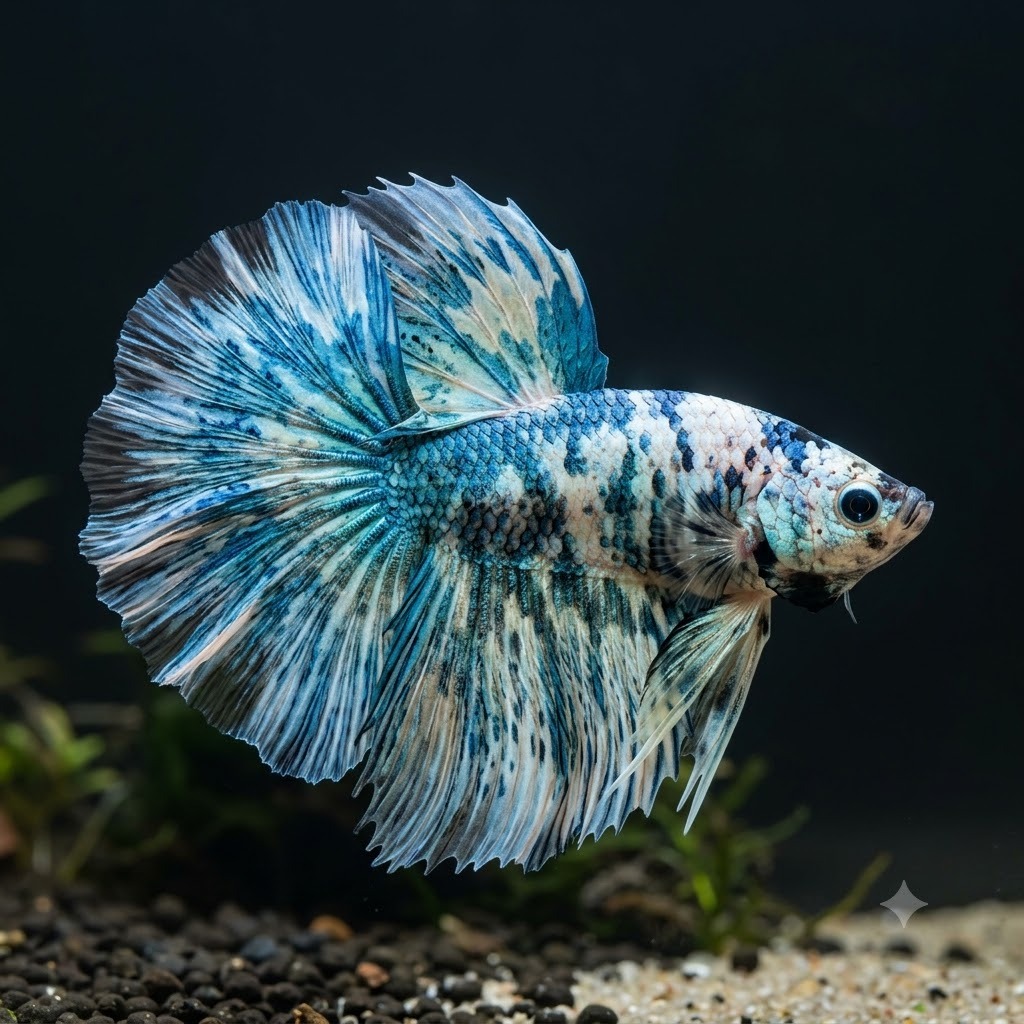
Overview
The Marble Betta is the variety that refuses to stay the same fish. Its pattern - irregular dark blotches over a pale or cellophane body - is produced by an unstable pigment gene that keeps switching cells on and off, so the fish you buy in spring can look genuinely different by autumn. That instability is the whole appeal for some keepers and the dealbreaker for others. Care is standard betta care: heated water, a lid, 5 gallons or more, one male per tank. Just do not buy a marble for the photo on the shop tag.
Natural History
Marble is a domestic mutation, not a wild trait. The hobby credits its appearance to an American hobbyist breeder in the 1970s who was working toward black butterfly fish and instead produced offspring whose markings kept shifting; the exact dates in that account vary from telling to telling, since it was never formally documented. The line was distributed through the American betta scene, then absorbed into Thai breeding programs, and today marble genetics sit behind a large slice of the modern market - the koi and galaxy koi bettas everyone recognizes are marble fish selected for heavy, rounded blotching. It is a pattern class, not a fin type or a species.
Appearance
Body 2-2.5 in (5-6.5 cm), with any fin type: marbles exist as plakats, halfmoons, crowntails, and doubletails. The pattern is asymmetric by definition - dark patches of blue, black, or red scattered across a pale, white, or translucent ground, often with clear "cellophane" areas where no pigment shows at all. Fins may be marbled, solid, or clear, and the two sides of the same fish frequently do not match. The defining feature is not the current pattern but its movement: patches expand, fade, migrate, and reappear over weeks and months, and a fish can go from nearly white to almost solid dark and back again in a year. The usual explanation is a transposable element, a jumping gene that inserts itself into pigment genes and then hops out again.
Temperament & Tankmates
Behaviorally an ordinary betta - territorial, curious, and interactive, with temperament following build rather than pattern. Plakat marbles are quick and assertive, long-finned ones slower. One male per tank, no exceptions, and no long-term female group unless you have the space and experience for a proper sorority. Tankmates in 10 gallons (38 L) or larger: snails, dwarf corydoras (pygmy, salt-and-pepper, dwarf), ember tetras or other small peaceful schoolers - standard corydoras and kuhli loaches need a group of five or six and 20 gallons (75 L). Skip fin nippers such as tiger barbs and serpae tetras, and treat shrimp as food unless the tank is heavily planted.
Tank Size & Setup
5 gallons (19 L) minimum, 10 gallons (38 L) for a more interesting display. Bettas jump, so a tight lid with no big gaps is essential. Heater, gentle filtration, and plenty of cover: live or silk plants, a cave, broad leaves near the surface for resting. Dark substrate and tannins from Indian almond leaves make a pale marble body pop, though the tannins will slightly warm the whole look of the tank.
Water Parameters
76-82 F (24-28 C), heated year round - a betta kept at room temperature is a betta with a slow metabolism and a suppressed immune system. pH 6.5-7.5, soft to moderately hard water, ammonia and nitrite at zero, nitrate under 20 ppm, 25-30 percent weekly water changes. None of this influences the marbling; pattern change is genetic, not water quality.
Diet
Carnivore. A quality betta pellet twice daily in small amounts, plus frozen or live bloodworms, brine shrimp, and daphnia two or three times a week. One fasting day weekly. Color-enhancing foods deepen red pigment in fish that have it, but no diet will freeze a marble pattern in place.
Health & Lifespan
3-5 years. Health is average for a betta and depends mostly on the fin type carried underneath: long-finned marbles get fin rot, tail biting, and swimming fatigue, while marble plakats are sturdy. Watch for ich, velvet, and internal parasites in newly imported stock and quarantine for a few weeks. The honest issue with this variety is not disease but expectation. Marble bettas are sold on their current appearance, and there is no way to predict what a young fish will become - a striking koi-patterned juvenile may mature into a plain dark adult, or the reverse. Show breeders find the same instability maddening, since a fish can lose its class-winning pattern between entries. Buying tips - judge the fish on health, symmetry, and finnage rather than markings, look for clear eyes and active swimming, and if pattern matters to you, buy an adult rather than a juvenile.
Pros & Cons
Pros:
- A pattern that genuinely evolves, so the fish stays interesting for years
- Every fish is one of a kind
- Available in all fin types and price ranges
- Ordinary betta care with no special requirements
Cons:
- The pattern you buy is not the pattern you keep
- Unreliable for showing or for breeding to a standard
- Long-finned marbles carry the usual finnage problems
- Needs a heater and a lid like any betta, which shop displays rarely admit
Marble Betta - frequently asked questions
Why is my marble betta changing color?
Because that is what marble means. An unstable pigment gene keeps turning color cells on and off through the fish's life, so blotches spread, fade, and move. It is not illness and not a water quality problem.
Will it ever stop changing?
Some fish slow down considerably as they mature, others keep shifting until the end. There is no way to lock a pattern in place, and no diet or treatment that will do it.
Are koi bettas the same thing as marbles?
Koi bettas are marble bettas selected for large, rounded, high-contrast patches in red, black, orange, and white. Same underlying genetics, different selection target - and koi fish shift their patterns too.
Is a marble betta harder to keep than a plain one?
No. Care is identical: heated water, a lid, 5 gallons or more, one male per tank, clean water. The only difference is what the fish looks like six months from now.
🧠 Test yourself: guess the fish
Three clues from our quiz bank, each about another of our fish. Can you name them?
Clue 1.Aquarists prize this small loricariid because, unlike its giant relatives, it tops out around five inches and won't outgrow a community tank.
It's the Bristlenose Pleco - read the full profile →
Clue 2.This tooth-carp's name comes from a Dutch word for a creek or ditch where it is often found.
It's the Killifish - read the full profile →
Clue 3.Famous for multiplying fast, these fish carry developing fry internally until the babies emerge swimming.
It's the Molly / Platy / Swordtail (Livebearers) - read the full profile →