Halfmoon Betta
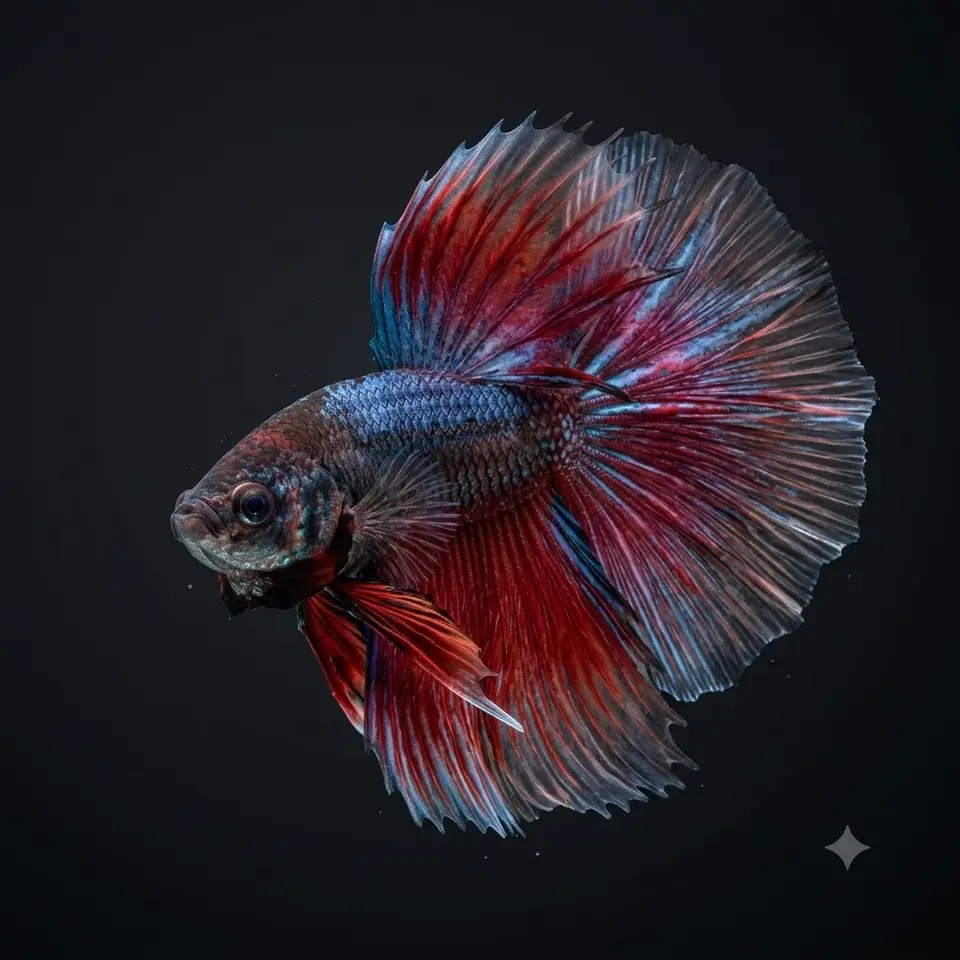
The Halfmoon Betta is a Betta splendens variety bred for a caudal fin that opens a full 180 degrees, forming a perfect half-circle when the fish flares.
Updated: July 2026
Species guide: Betta (Siamese Fighting Fish) · All betta varieties
 AI illustration
 Overview
The Halfmoon Betta is a Betta splendens variety bred for a caudal fin that opens a full 180 degrees, forming a perfect half-circle when the fish flares. It is the show-standard tail type of the betta world - dramatic, available in every color, and slightly more demanding than short-finned bettas because all that finnage is heavy, fragile, and prone to damage.
Natural History
Wild Betta splendens from the rice paddies of Thailand and Cambodia are short-finned and drab; every long-finned variety is a product of selective breeding. The halfmoon standard emerged in the late 1980s when breeders in France and the US line-bred for extra branching in the caudal rays, and the International Betta Congress made the 180-degree spread a show benchmark. It is a polygenic trait - even halfmoon x halfmoon spawns throw plenty of lesser-spread fry.
Appearance
A male halfmoon runs about 2.5-3 in (6-7.5 cm) including fins. The defining feature is the tail: flared, its edge forms a straight-edged half-circle spanning 180 degrees, backed by heavy ray branching. Fish exceeding 180 are sold as over-halfmoons (OHM); 120-180 degrees is a super delta, less is a delta. Halfmoon describes only the tail - colors and scale types (koi, dragon scale, mustard gas, solids) vary freely. Do not confuse it with rosetails and feathertails, extreme offshoots whose excessive branching gives a ruffled edge but weak, collapse-prone rays. Females carry much shorter fins.
Temperament & Tankmates
Standard betta rules apply, amplified. Males are territorial and must never share a tank with another male; the huge tail also makes them slow, so even semi-aggressive tankmates outcompete and nip them. Best options: alone in a planted tank, or with snails and, in 10 gallons (38 L) or more, calm bottom dwellers like kuhli loaches or corydoras. Avoid fin-nippers (tiger barbs, serpae tetras), gouramis, and fancy guppies - a halfmoon may attack a colorful long-finned guppy as a rival. Female sororities are unstable and best left to experienced keepers.
Tank Size & Setup
5 gallons (19 L), heated and filtered, is the sensible minimum. Two variety-specific points: flow must be gentle (a baffled or sponge filter), because a halfmoon fights current with a parachute strapped to its rear; and decor must be soft - live or silk plants only, since plastic plants shred fins (if it snags pantyhose, it snags a halfmoon). Add broad leaves or a betta hammock near the surface so the fish can rest, plus a tight lid - bettas jump.
Water Parameters
76-82 F (24-28 C) on an adjustable heater, pH 6.5-7.5, ammonia and nitrite at zero, nitrate under 20 ppm, weekly 25 percent water changes. Warm, clean, stable water is the best fin-rot prevention there is.
Diet
A carnivore with a stomach the size of its eye. Feed 2-4 quality betta pellets once or twice daily, with frozen or live bloodworms, brine shrimp, and daphnia as treats. Overfeeding causes constipation and swim-bladder trouble; one fasting day per week is cheap insurance.
Health & Lifespan
3-5 years. The variety-specific problems are all fin-related: fin rot in poor water, tears from snags and current, blown rays from constant flaring, and tail biting - halfmoons sometimes chew their own tail from stress or boredom, and the ragged result is often mistaken for disease. Expect the perfect spread to fade too; most fish hold true 180 form for a year or two before the tail relaxes toward delta. Buying tips: choose a young fish, ask to see it flare (breeders will send flaring video), look for clean straight edges and full branching, and skip pinched, ragged, or heavily ruffled rosetail-type tails. Chain-store cup bettas can recover beautifully but are a gamble; hobbyist breeders show you what you are actually getting.
Pros & Cons
Pros:
- The most dramatic tail spread in the hobby
- Available in virtually every color and pattern
- Small footprint - a 5 gallon desktop tank works
- Interactive and personable, learns its keeper
Cons:
- Heavy finnage tears, rots, and gets bitten
- Full 180 spread usually fades with age
- Must live alone or with carefully chosen tankmates
- Needs a heater and gentle flow - not a bowl fish
Everyday gear for aquariums
Links go to Amazon or a partner brand's own store and may earn us a commission at no extra cost to you. As an Amazon Associate we earn from qualifying purchases. An Amazon link leads to a type of gear and you choose the exact product; a card that names a store leads to that partner's own shop.
Halfmoon Betta - frequently asked questions
What is the difference between a Halfmoon and a Delta betta?
Only the spread angle. Flared, a delta opens under 120 degrees, a super delta 120-180, and a true halfmoon a full 180 with straight edges. Same species, same care.
Why is my halfmoon biting its own tail?
Tail biting is a known quirk of heavy-finned bettas - triggers include boredom, stress, reflections, and strong current. Add plants and cover, cut the flow, and keep water pristine so bitten edges heal instead of rotting.
Will my halfmoon keep its full 180-degree tail?
Usually not forever. The spread peaks in young adults; with age the rays relax and many fish end up looking like super deltas. That is normal aging, not a care failure.
Are halfmoons harder to keep than plakats?
Slightly. Same water, tank, and diet, but the long fins demand gentler flow, softer decor, and more vigilance about fin rot and biting. A short-finned plakat forgives more mistakes.
Test yourself: guess the fish
Three clues from our quiz bank, each about another of our fish. Can you name them?
Clue 1.This tall, laterally compressed blackwater fish needs warm, soft, acidic water and is famously sensitive for keepers.
It's the Discus - read the full profile →
Clue 2.Aquarists prize this small loricariid because, unlike its giant relatives, it tops out around five inches and won't outgrow a community tank.
It's the Bristlenose Pleco - read the full profile →
Clue 3.A peaceful aquarium staple, this little fish loses its bright shimmer at night and regains it by day.
It's the Neon Tetra - read the full profile →