Japan Blue Guppy
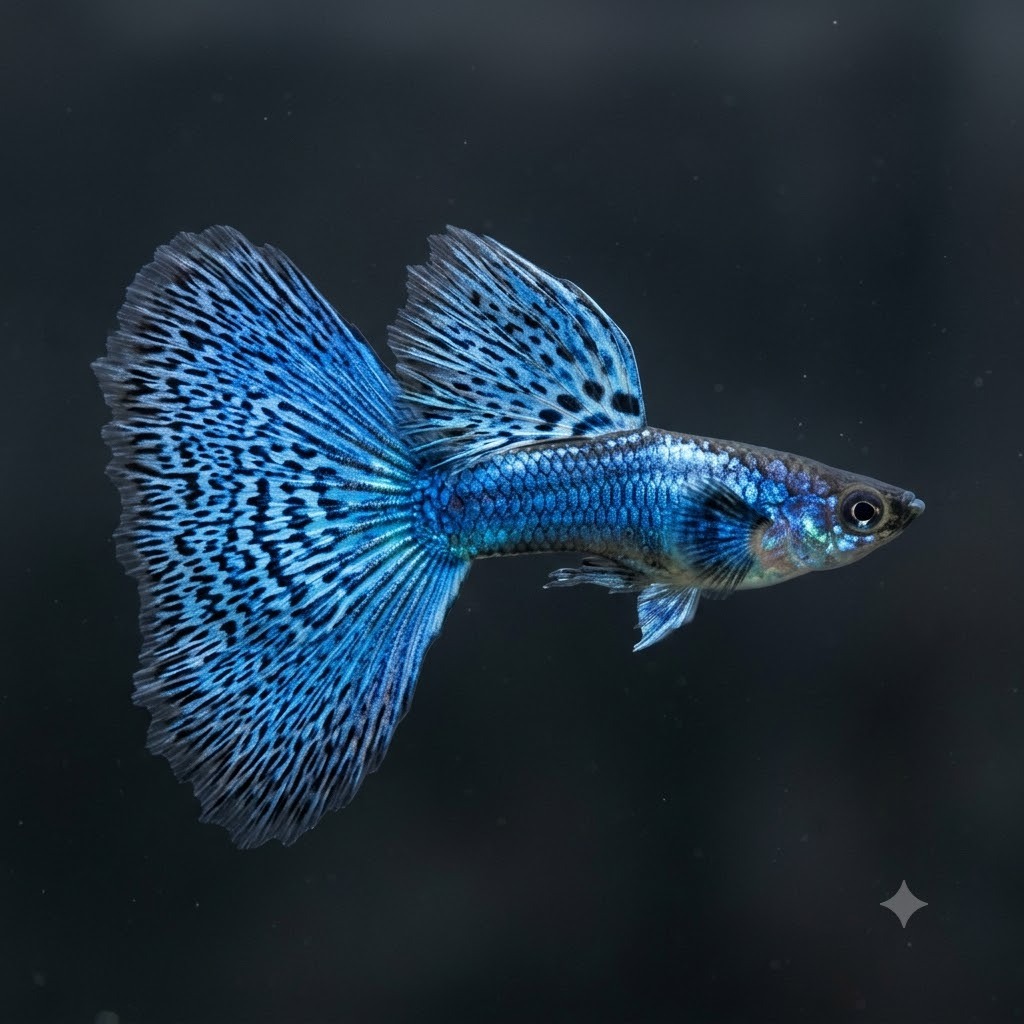
The Japan Blue Guppy is named for a single striking trait: a horizontal electric blue stripe running along the flank and rear body, sitting under whatever tail color the line carries.
🗓️ Last reviewed: July 2026
Overview
The Japan Blue Guppy is named for a single striking trait: a horizontal electric blue stripe running along the flank and rear body, sitting under whatever tail color the line carries. Japanese breeders fixed the trait decades ago and it has since been used as a building block in dozens of other strains, which is why "Japan Blue" appears in so many compound strain names. Bodies tend to be slim and wild-type in build with moderate rather than enormous tails, so this is one of the more athletic and forgiving fancy strains - though still a line-bred fish, not a feeder guppy.
Natural History
Wild guppies from northern South America carry patches of structural blue on the flanks, and that raw material is where the Japan Blue trait comes from. Japanese breeders isolated and fixed it in the late 20th century, giving the strain its name, and European and Asian breeders then crossed it into other lines to produce fish sold as Japan Blue Red Tail, Japan Blue Grass, Japan Blue Snakeskin, and similar combinations. Today it functions less like a single strain and more like a color module that breeders move around, which is why two fish with the name can look quite different.
Appearance
Males 1.2-1.4 in (3-3.5 cm) of body plus tail; females 2-2.4 in (5-6 cm) with little color. The signature is a bright blue lateral band along the rear half of the body and the caudal peduncle, strongest just before the tail. The blue is structural, produced by light scattering in the scales rather than by pigment, so it flares and dims as the fish turns and it looks flat grey under poor lighting. Tails vary by sub-line: some carry a solid red or orange caudal, some a spade or round tail closer to wild shape, some a full delta. Body build is usually slimmer than in heavy show strains, which suits the strain's more active swimming. The trait combines readily with grass, snakeskin, and other patterns.
Temperament & Tankmates
Peaceful and busy, and generally a stronger swimmer than big-finned show guppies because the fins are more modest. That widens the tankmate list a little: corydoras, otocinclus, small rasboras, ember tetras, snails, and shrimp in a planted tank all work. Fin nippers are still a bad idea, and boisterous fast feeders will still outcompete guppies at dinner. Keep 1 male per 2-3 females to spread out courtship, or run males only if you do not want fry. Mixed groups breed relentlessly, and adults eat most of the fry unless there is thick cover.
Tank Size & Setup
10 gallons (38 L) minimum for a trio, 20 gallon long (76 L) for a colony. Plant it - guppy grass, hornwort, java moss - both for fry cover and because plants make blue structural color read better against green. Gentle flow, a sponge filter, smooth decor, and a lid, since guppies jump when startled. Good lighting matters more for this strain than most: side lighting brings the blue band alive, while dim top-down light flattens it.
Water Parameters
72-82 F (22-28 C), pH 7.0-7.8, moderately hard to hard water (GH 8-12 or higher). Guppies want minerals in the water; soft acidic conditions produce clamped fins and shortened lives. Weekly 25 percent water changes, ammonia and nitrite at zero, nitrate well under control. Stability beats chasing precise numbers, and a stable tank keeps structural blue at its brightest.
Diet
Omnivore with a small mouth. Micro pellets or crushed flake as the staple, frozen or live baby brine shrimp and daphnia several times a week, and spirulina or blanched vegetables for the plant side. Two small meals daily. Carotenoid foods help the red tails found in many Japan Blue lines; they do nothing for the blue itself, which is structural and diet-independent.
Health & Lifespan
2-3 years. This is among the sturdier fancy strains, largely because the fins are moderate and the body build stays close to wild proportions - but sturdier is relative. Every line-bred fancy guppy is weaker than the plain feeder stock sold as live food, less tolerant of an uncycled tank, cold water, or missed maintenance. Imported farm fish routinely arrive carrying camallanus worms and columnaris, so quarantine new arrivals for three to four weeks and watch for red threads at the vent, white saddle patches, and clamped fins. Buying tips - view the fish under decent light before judging the blue, since shop lighting exaggerates or hides it; ask what the line was crossed with, because "Japan Blue" covers many different fish; and prefer stock from a local breeder over mass imports.
Pros & Cons
Pros:
- Vivid blue lateral band unlike anything in the standard fancy palette
- Moderate finnage means better swimming and fewer fin problems
- Combines with other strains, so there is real variety to collect
- Blue color does not depend on diet
Cons:
- Structural blue looks dull under poor lighting
- The name covers many different-looking fish, so buy by eye
- Still a line-bred strain, less robust than feeder guppies
- Breeds constantly in mixed-sex groups
Japan Blue Guppy - frequently asked questions
What is the Japan Blue trait exactly?
A fixed color trait producing a bright blue horizontal band along the rear body and caudal peduncle. Breeders treat it as a module they can cross into other strains, which is why it shows up in many compound names.
Why does my fish look grey some of the time?
Because the blue is structural rather than pigment based - it is created by light bouncing off scale structures. Change the viewing angle or the lighting and it returns. Consistent side lighting is the fix.
Do Japan Blues breed true?
The blue trait passes reliably in established lines, though what the tails and body patterns do depends on what the line was crossed with. Ask the breeder how the line is set up before planning a project.
Are they hardier than other fancy guppies?
Somewhat, thanks to modest fins and a wild-type build, but they are still selectively bred fish. Hard, clean, heated water and quarantine of new stock remain non-negotiable.
🧠 Test yourself: guess the fish
Three clues from our quiz bank, each about another of our fish. Can you name them?
Clue 1.Males of this small, vividly colored labyrinth fish are so territorial that two cannot share a tank without fighting, giving rise to a fierce nickname.
It's the Betta (Siamese Fighting Fish) - read the full profile →
Clue 2.Domesticated from a dull carp over a thousand years ago in China, this orange fish is one of the oldest kept pets.
It's the Goldfish - read the full profile →
Clue 3.Aquarists prize this small loricariid because, unlike its giant relatives, it tops out around five inches and won't outgrow a community tank.
It's the Bristlenose Pleco - read the full profile →