Full Red Guppy
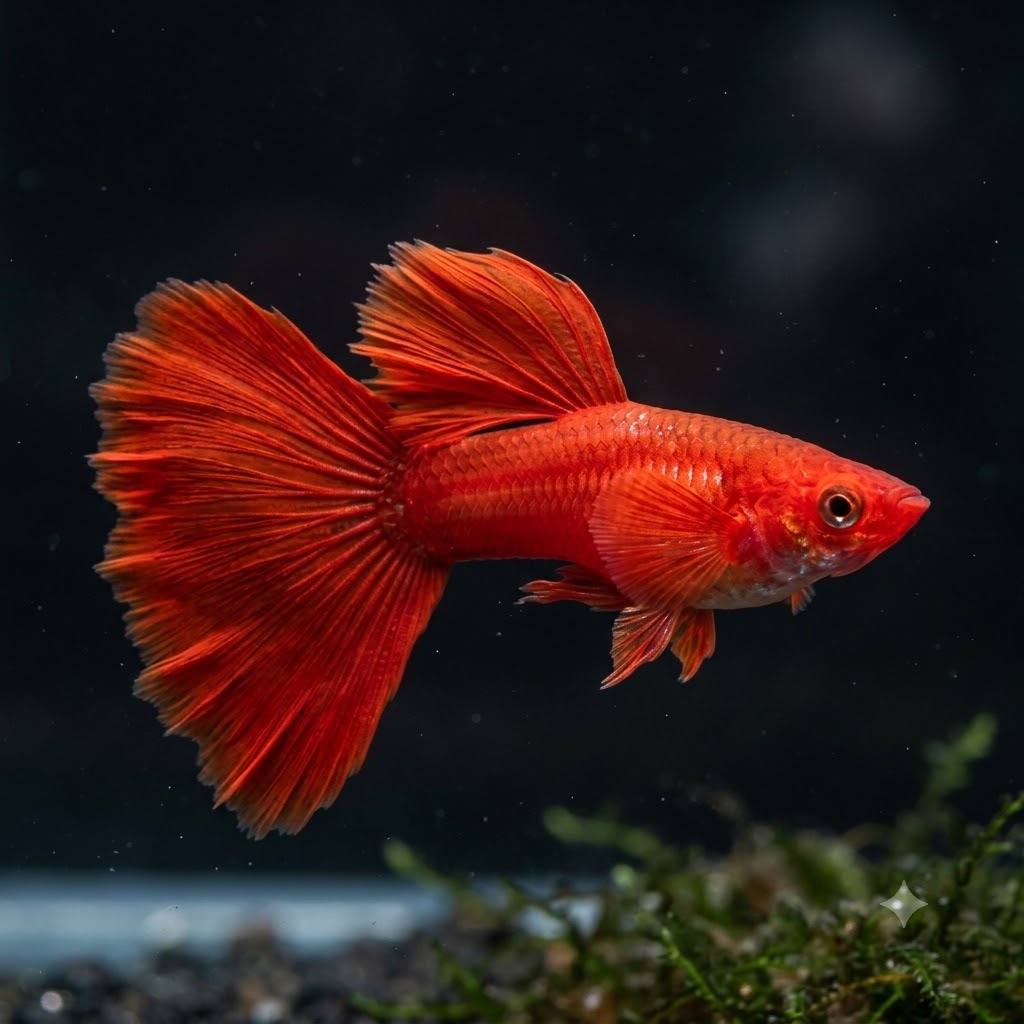
The Full Red Guppy is exactly what the name promises: a male covered in solid red from nose to tail tip, with no contrasting patch, pattern, or metallic panel to break it up.
🗓️ Last reviewed: July 2026
Overview
The Full Red Guppy is exactly what the name promises: a male covered in solid red from nose to tail tip, with no contrasting patch, pattern, or metallic panel to break it up. It is one of the most demanding show categories in the hobby precisely because it is so simple - any grey shoulder, orange fade, or black speck ruins it. Care is standard guppy care in hard, heated, clean water. The honest caveats are two: the red depends heavily on diet, and lines bred this tightly for one trait are among the more fragile guppies you can buy.
Natural History
Wild guppies from northern South America carry small red and orange spots built from two pigment sources at once: carotenoids taken up from food, and drosopterins the fish manufactures itself. Breeders spent decades concentrating those spots until the color covered the entire fish, and Full Red became a recognized solid-color show class in guppy competitions worldwide. The albino version, in which black pigment is absent and the eyes are red, is one of the more widely bred guppy lines. Every full red fish is the product of intense line-breeding; nothing like it exists in the wild.
Appearance
Males run 1.2-1.4 in (3-3.5 cm) of body plus a large caudal, usually a wide delta; females reach 2-2.4 in (5-6 cm) and are typically pale with a red tail wash. The show ideal is a single, even, deep red across body, dorsal, and caudal, with no grey or silver on the shoulders and no black flecking. Real fish fall short in predictable ways: grey or greenish bodies with red fins, an orange rather than crimson tone, and dark specks on the peduncle. Two common sub-lines are worth knowing - the standard full red with dark eyes, and the albino full red, which has red eyes, a paler cream-red tone, and noticeably weaker vision. Some lines also carry the blond body gene, which lightens the background and shifts the red toward a brighter, lighter shade.
Temperament & Tankmates
Peaceful and constantly on the move in the upper half of the tank. The big delta tail makes males slow, so avoid tiger barbs, serpae tetras, and anything else with a nipping habit, and avoid tankmates fast enough to clear the food before the guppies arrive. Corydoras, otocinclus, small rasboras, snails, and shrimp are safe. Keep 1 male to 2-3 females so no single female is pestered constantly, or run an all-male tank for a display of pure color with no fry. These are livebearers: gestation runs roughly a month, females store sperm and keep dropping broods of free-swimming fry for months after a single mating, and the adults eat most of those fry unless there is dense plant cover. Albino lines see poorly and do better in calmer company and softer lighting.
Tank Size & Setup
10 gallons (38 L) minimum for a trio, 20 gallon long (76 L) for a breeding group. Plant densely with guppy grass, hornwort, or java moss for fry cover, and keep flow gentle - a sponge filter is ideal. Smooth decor only, since a big red delta tears easily. A lid is worth having, because guppies jump. Green plants and a dark background make red read far more strongly than a bright bare tank does.
Water Parameters
72-82 F (22-28 C), pH 7.0-7.8, moderately hard to hard water (GH 8-12 or higher). Guppies want minerals; soft, acidic water gives ragged fins and short lives. Weekly 25 percent water changes with ammonia and nitrite at zero and nitrate kept low. For a heavy-finned show strain, clean water is not a nicety - fin edges are the first thing to go when nitrate climbs.
Diet
Omnivore, and this is the strain where diet visibly matters. Guppy red is part carotenoid, which the fish can only get from food, and part drosopterin, which it makes itself - so diet controls saturation and depth rather than the color as a whole, and a fish on a thin, carotenoid-poor diet dulls and flattens over weeks rather than losing red altogether. Use a quality micro pellet as the staple, feed frozen or live baby brine shrimp and daphnia several times a week, and add astaxanthin-rich or spirulina-based foods regularly. Two small meals daily. Good food will hold and deepen the genetic red the fish has; it cannot manufacture color the fish was never bred to show.
Health & Lifespan
2-3 years, often less in heavily inbred lines. Be realistic about hardiness. Full reds are bred for one trait through many generations, and that concentration costs vigor: fry survival is patchier than in mixed-strain guppies, adults are less tolerant of cold, soft, or dirty water, and albino sub-lines are weaker again, with poorer eyesight and greater sensitivity to bright light. Plain feeder guppies will outlive them without trying. The oversized tail is the usual clinical weak spot for fin rot and bacterial infection, and imported farm stock commonly carries camallanus worms and columnaris, so quarantine every new arrival for three to four weeks. Buying tips - check the body color under good light rather than the fins, since grey shoulders are the most common flaw; avoid fish with dark flecking; and prefer a local breeder's stock, which is usually stronger than mass-imported fish.
Pros & Cons
Pros:
- Uniform, saturated red that stands out in any planted tank
- A clear, well-defined show class to breed toward
- Standard guppy care with no exotic requirements
- Peaceful and small-tank friendly
Cons:
- Color dulls on a carotenoid-poor diet, so feeding quality shows
- Tight line-breeding makes these among the less robust guppies
- Albino sub-lines are weaker still and see poorly
- Grey bodies and orange tones are common in shop stock
Full Red Guppy - frequently asked questions
Why is my full red guppy turning orange?
Usually diet, though only partly. Some of a guppy's red is carotenoid based and comes straight from food, and some is pigment the fish synthesizes itself, so a carotenoid-poor diet dulls and flattens the tone rather than stripping the color out. Feed astaxanthin-rich pellets, live or frozen brine shrimp, and spirulina. If the fish never had deep red, the genetics are the limit.
What is the difference between a full red and an albino full red?
Albinos lack black pigment, so they have red eyes, a lighter cream-red body, and weaker eyesight. They are more delicate, dislike bright light, and need calmer tankmates.
Do full reds breed true?
Established lines mostly do, since the trait has been fixed for generations, but expect some fry with grey bodies or off tones that need culling from the breeding group. Buying from one line rather than mixing sources helps a lot.
Are they hardy fish?
Less than their reputation suggests. Guppies as a species are tough; heavily line-bred show strains are not. Hard, warm, clean, stable water and a proper quarantine make the difference.
🧠 Test yourself: guess the fish
Three clues from our quiz bank, each about another of our fish. Can you name them?
Clue 1.Easy to breed and colorful, the males of this small species sport flashy fan-shaped tails to court drab females.
It's the Guppy - read the full profile →
Clue 2.Renowned for intelligence and complex breeding behavior, members of this freshwater group are a textbook example of explosive evolutionary radiation.
It's the Cichlid (Overview) - read the full profile →
Clue 3.Domesticated from a dull carp over a thousand years ago in China, this orange fish is one of the oldest kept pets.
It's the Goldfish - read the full profile →