Delta Tail Guppy
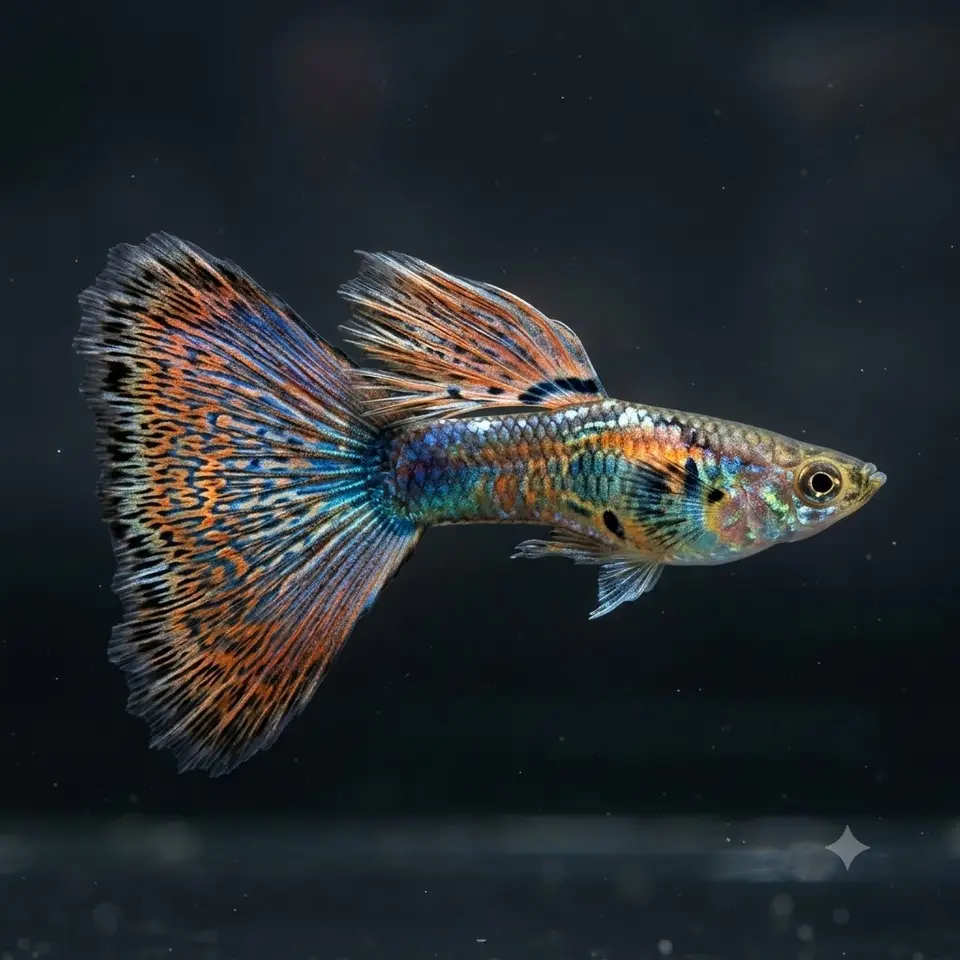
The Delta Tail Guppy carries the largest tail in the guppy hobby - a wide, sharp-edged triangle that can match the body in size and is the standard show type in US competitions.
Updated: July 2026
Species guide: Guppy · All guppy strains
 AI illustration
 Overview
The Delta Tail Guppy carries the largest tail in the guppy hobby - a wide, sharp-edged triangle that can match the body in size and is the standard show type in US competitions. It is what most people picture when they hear "fancy guppy": a tiny livebearer hauling a banner of color behind it. That banner is the whole point of the variety, and also the source of nearly every extra care consideration it needs over a common guppy.
Natural History
Wild Poecilia reticulata from Trinidad and northeastern South America are drab little fish with small rounded tails - the delta shape exists nowhere in nature. It was built through decades of selective breeding and formalized by the International Fancy Guppy Association (IFGA), whose US show standards made the big triangular caudal the benchmark. Tail size and shape come from a mix of Y-linked and autosomal genes, which is why serious lines are bred, not bought at random.
Appearance
What defines the variety is geometry: the caudal fin forms a triangle with straight top and bottom edges, ideally spreading around 70 degrees, with a matching enlarged dorsal. In good show lines the tail is roughly as long as the body. Males run 1.5-2 in (4-5 cm) including tail; females are larger at 2-2.5 in (5-6 cm) and far plainer, showing at most some tail color. Any color pattern can ride on a delta tail - Moscow blue, red albino, tuxedo, snakeskin, cobra. Compared with other guppy types, the veiltail is narrower and flowing, the fantail rounded, and the roundtail small and circular; the delta is the big crisp triangle.
Temperament & Tankmates
Peaceful and social, like all guppies - but that trailing tail is a target. Skip known fin-nippers (tiger barbs, serpae tetras) and anything fast enough to outcompete a slow-swimming male at feeding time. Corydoras, otocinclus, snails, and shrimp are safe picks. Keep one male to two or three females so courtship pressure spreads out, or run a males-only display tank. Avoid mixing with Endlers unless you want hybrids.
Tank Size & Setup
10 gallons (38 L) minimum, and 20 gallons (75 L) if you keep a breeding group - guppies multiply fast. The key variety-specific detail is flow: a big delta tail acts like a sail, so use a sponge filter or a baffled hang-on-back rather than strong current. Smooth decor and soft-leaved live plants protect the fins; a lid is wise since guppies jump.
Water Parameters
72-82 F (22-28 C), pH 7.0-7.8, and moderately hard water (GH 8-12) - guppies genuinely prefer minerals in the water. Weekly 25 percent water changes matter more for this variety than for common guppies, because pristine water is the main defense against fin rot on all that finnage.
Diet
Quality flake or micro-pellets as the staple, with live or frozen baby brine shrimp and daphnia a few times a week and some spirulina for fiber. Feed small amounts once or twice daily. Protein-rich variety supports fin growth and color; overfeeding fouls the water the fins depend on.
Health & Lifespan
2-3 years. The delta's health story is mostly a finnage story: the oversized caudal splits, snags, and invites fin rot, and heavily inbred show lines are less robust than feeder-grade fish. Watch for clamped or ragged tails and treat water quality first. Imported stock frequently carries "guppy disease" (Tetrahymena) plus ich and columnaris, so quarantine every new fish for two to four weeks. Old males may struggle to swim as the tail keeps growing - gentle flow and easy access to food help.
Pros & Cons
Pros:
- The showiest tail shape in the guppy world
- Huge range of colors and patterns on one body plan
- Peaceful, hardy base species, easy to feed
- Active breeding scene with real show standards
Cons:
- Big fins mean fin rot and tear risk
- Slow swimmer - loses races for food
- Show lines can be inbred and delicate
- Prolific breeding fills tanks fast
Everyday gear for aquariums
Links go to Amazon or a partner brand's own store and may earn us a commission at no extra cost to you. As an Amazon Associate we earn from qualifying purchases. An Amazon link leads to a type of gear and you choose the exact product; a card that names a store leads to that partner's own shop.
Delta Tail Guppy - frequently asked questions
How is a delta tail different from a veiltail?
Edge shape and spread. A delta is a wide triangle with straight edges and roughly a 70 degree spread; a veiltail is narrower and drapes like fabric. Fantails fall in between with rounded corners.
Do delta tail guppies breed true?
Mostly, within an established line - tail genetics are part Y-linked, so sons tend to resemble fathers. Cross random pet-store fish, though, and tail shape scatters within a generation or two.
What should I look for when buying?
An actively swimming male holding the tail open, with clean straight edges and no splits, plus a matching large dorsal. Buy from a breeder line if you can - pet-store "deltas" are often mixed-tail stock.
Can delta guppies live with a betta?
Risky. Many bettas read the colorful flowing tail as a rival and shred it. If you want the delta look with a betta temperament, keep them in separate tanks.
Test yourself: guess the fish
Three clues from our quiz bank, each about another of our fish. Can you name them?
Clue 1.This small South American scavenger has tiny barbels and a sharp spine in each fin that can lock upright for defense.
It's the Corydoras Catfish - read the full profile →
Clue 2.Diamond-shaped with long flowing dorsal and anal fins, this popular tank fish needs a tall aquarium to accommodate its towering body.
It's the Angelfish - read the full profile →
Clue 3.This dazzling Amazonian schooling fish wears a full-length red stripe beneath its blue band, distinguishing it from a similar smaller cousin.
It's the Cardinal Tetra - read the full profile →