Dragon Scale Betta
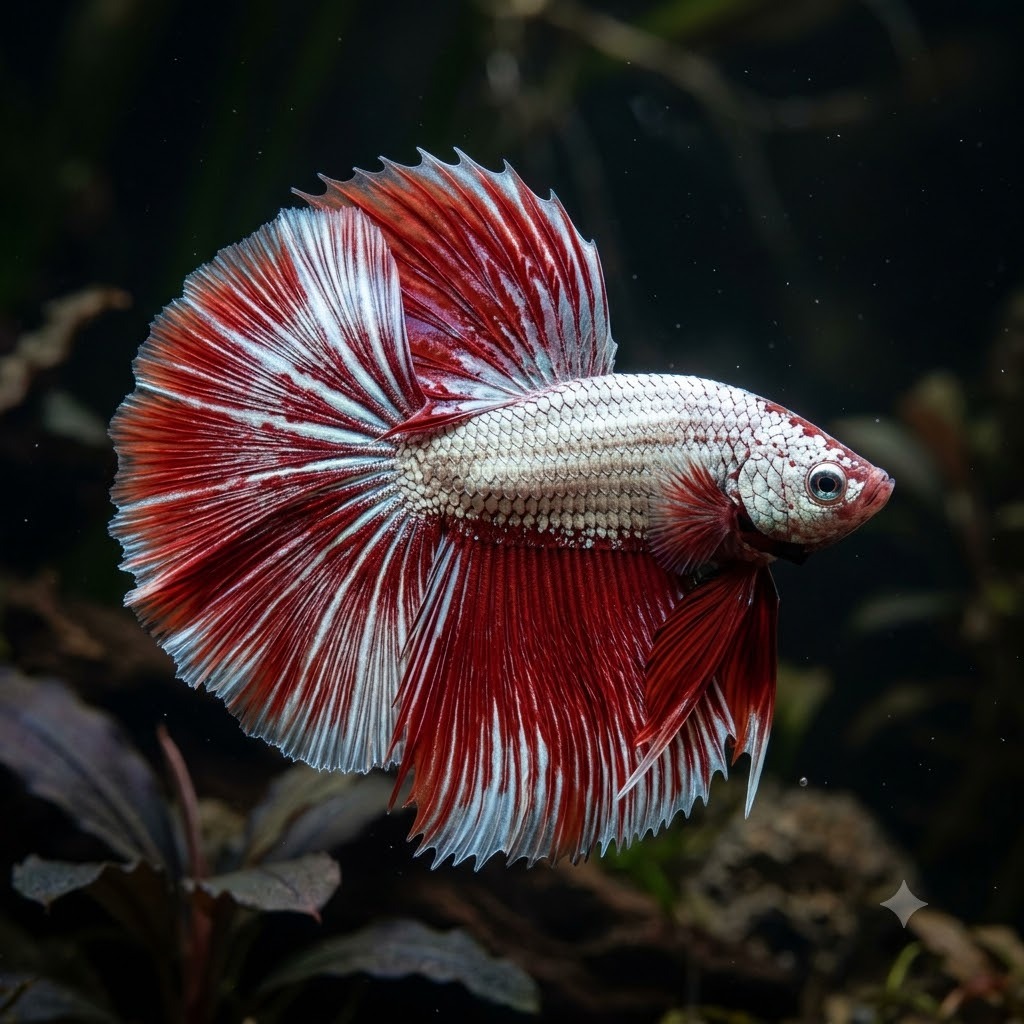
The Dragon Scale Betta is not a fin shape but a scale trait: a thick, opaque metallic layer that sits over the body like plate armor, usually white, gold, or copper, laid over a red, blue, or black base.
🗓️ Last reviewed: July 2026
Overview
The Dragon Scale Betta is not a fin shape but a scale trait: a thick, opaque metallic layer that sits over the body like plate armor, usually white, gold, or copper, laid over a red, blue, or black base. Because it is a scale feature, "dragon" turns up on plakats, halfmoons, and crowntails alike, so the label tells you what the fish is wearing, not how it swims. Care is ordinary betta care - a heater, a lid, 5 gallons or more - with one variety-specific catch worth knowing before you pay a premium: the same scale growth that makes the fish spectacular can creep across the eye and blind it.
Natural History
No wild betta looks like this. Dragon scaling came out of Thai breeding programs in the mid-2000s, when breeders stacking copper and metallic genes onto domestic Betta splendens found lines whose scales kept thickening generation after generation. The look was named "dragon", fixed by selective breeding, and spread worldwide within a few years. It is now stacked onto almost every fin type and color class, and many of the heavily patterned fish sold as koi bettas carry dragon scaling on top of marble genetics. Like alien and koi bettas, dragon is a modern breeder project rather than anything found in a rice paddy.
Appearance
A 2-2.5 in (5-6.5 cm) fish whose body scales are unusually large, raised, and solid. Each scale has a defined edge, so the flanks read as chainmail rather than as the fine shimmer of an ordinary iridescent betta. Common forms are red dragon (white or gold armor over red fins), copper dragon, blue dragon, and black dragon. The fins keep the base color and normally stay free of the metallic layer, which is what creates the striking two-material look. Females carry the same scaling and are often easier to appreciate than in other varieties, since the trait sits on the body rather than the fins. The scaling is also progressive: over months it commonly spreads onto the face and gill plates, and in some fish across the eye itself, where it forms the milky cap the hobby calls "diamond eye".
Temperament & Tankmates
Temperament tracks the fin type underneath more than the armor on top. Plakat-bodied dragons are fast, pushy, and quick to flare; long-finned dragons are slower and more sedentary. All the usual betta rules hold: one male per tank, never two males together, no long-term female groups without real experience and space. Tankmates are possible in 10 gallons (38 L) or more - nerite snails, ember tetras, and dwarf corydoras (pygmy, salt-and-pepper, dwarf); standard corydoras and kuhli loaches want a group of five or six and 20 gallons (75 L) - but a fish with clouding eyes is a bad candidate for a community, because it cannot track competitors and loses out at feeding time. Shrimp are always a gamble with any betta.
Tank Size & Setup
5 gallons (19 L) minimum, 10 gallons (38 L) better. A tight-fitting lid is not optional: bettas jump, and a startled fish with impaired vision is even more likely to launch itself out of an open tank. Add a heater, keep flow gentle, and furnish with live or silk plants, a cave, a resting leaf near the surface, and Indian almond leaves if you like the tannin look. If eyesight starts to go, keep the layout stable - do not rearrange decor - and feed in the same corner every time so the fish learns where dinner appears.
Water Parameters
76-82 F (24-28 C) with a real heater; unheated room-temperature tanks remain the most common preventable cause of illness in bettas, whatever a shop display suggests. pH 6.5-7.5, soft to moderately hard water, ammonia and nitrite at zero, nitrate under 20 ppm, and a 25-30 percent weekly water change. Stability beats chasing exact numbers.
Diet
A carnivore. Feed a quality betta pellet as the staple in two small daily meals, and rotate frozen or live bloodworms, brine shrimp, and daphnia two or three times a week. One fasting day per week helps the gut. For a fish with reduced vision, use slow-sinking foods, drop them in the same spot, and give it time - target feeding a partly blind betta with tongs or a pipette works well once it learns the routine.
Health & Lifespan
3-5 years. The variety-specific problem is diamond eye. Scale tissue grows over the cornea, first as a haze and then as a solid white cap, and the process is progressive with no treatment that reverses it. It does not appear to be painful, and a blind betta can live a full life if food reliably reaches it, but it needs a stable tank layout, hand feeding, and no competition. Beyond the eyes, health follows the fin type: long-finned dragons get the familiar fin rot, tail biting, and swimming fatigue, while plakat dragons are among the sounder betta builds. Velvet, ich, and internal parasites show up in freshly imported fish, so quarantine. Buying tips - check the eyes first and pass on any fish with cloudiness or metallic creep near the eye, since it only advances; then look for even scaling with no bare patches, alert posture, and unclamped fins.
Pros & Cons
Pros:
- Armor-plated metallic look unlike any other betta
- Available on every fin type, so you can pick the build you want
- Scaling holds its color as the fish ages, unlike marble patterns
- Standard betta care with no special equipment
Cons:
- Real risk of diamond eye blindness that worsens with age
- Heavily scaled lines are tightly bred and vary in vigor
- Long-finned versions inherit all the usual finnage problems
- Jumps like any betta, so a lid is mandatory
Dragon Scale Betta - frequently asked questions
What exactly makes a betta a "dragon"?
Thick, opaque, oversized scales that cover the body in a solid metallic sheet. It is a scale trait, not a tail shape or a color class, so a dragon can be a plakat, a halfmoon, or a crowntail.
Will my dragon scale betta go blind?
Not all of them do, but the risk is real and rises with age as the metallic layer spreads. Watch for haze on the cornea. There is no cure, so the practical answer is to manage it: stable decor, target feeding, no boisterous tankmates.
Can I breed dragon scale bettas?
Yes, and the trait passes on readily. Experienced breeders usually avoid pairing two very heavily scaled parents and outcross to a lighter-scaled partner to keep eye coverage down, though nothing guarantees clear-eyed fry.
Does the armor pattern change over time?
The colors stay far more stable than marble bettas, which is part of the appeal. What does change is coverage: scaling tends to expand onto the head and face as the fish matures.
🧠 Test yourself: guess the fish
Three clues from our quiz bank, each about another of our fish. Can you name them?
Clue 1.Native to the rice paddies of Southeast Asia, this fish has a special organ that lets it gulp air directly from the surface to survive low-oxygen water.
It's the Betta (Siamese Fighting Fish) - read the full profile →
Clue 2.Often confused with a deeper-red cousin, this small fish has red only on its back half, not its whole belly.
It's the Neon Tetra - read the full profile →
Clue 3.Unlike most aquarium fish, this beginner-friendly group gives birth to free-swimming young instead of laying eggs.
It's the Molly / Platy / Swordtail (Livebearers) - read the full profile →