Dumbo Ear Betta
The Dumbo Ear Betta is a Betta splendens variety defined by hugely oversized pectoral fins that fan out like elephant ears, often in pale white or pastel shades against a vividly colored body.
Updated: July 2026
Species guide: Betta (Siamese Fighting Fish) · All betta varieties
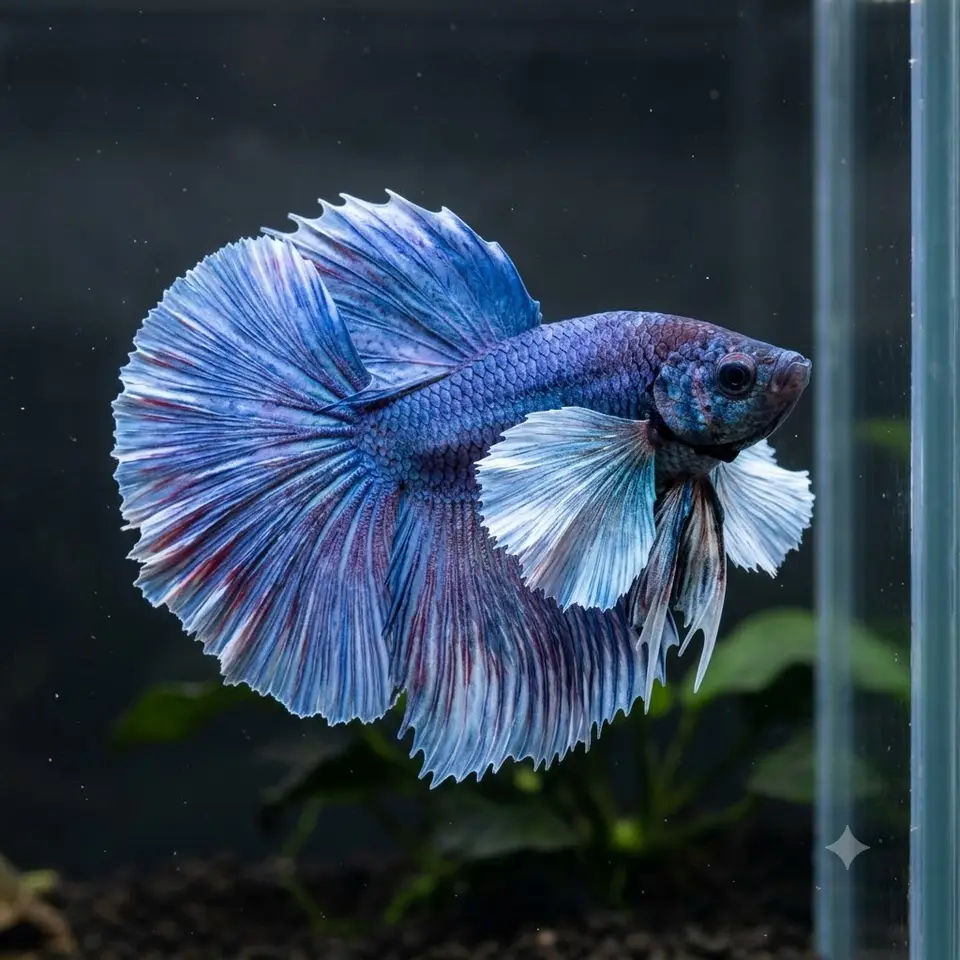 AI illustration
 Overview
The Dumbo Ear Betta is a Betta splendens variety defined by hugely oversized pectoral fins that fan out like elephant ears, often in pale white or pastel shades against a vividly colored body. Also sold as the Elephant Ear Betta, it carries standard betta care needs plus one big caveat: those dramatic pectorals act like sails, so flow, tankmates, and decor all need extra thought. For keepers who want a showpiece fish in a modest 5-10 gallon setup, few varieties photograph better.
Natural History
Betta splendens comes from shallow, slow rice paddies and ditches of Thailand and Cambodia, which is why the species tolerates still, warm water and breathes surface air through its labyrinth organ. The dumbo trait has no wild counterpart - it emerged from Thai breeding farms in the 2010s, where lines with exaggerated pectoral fins were fixed and crossed into halfmoon, plakat, and koi color programs. The trait is stable enough that dumbo-to-dumbo pairings reliably produce big-eared fry, so it now shows up across nearly every tail type and color.
Appearance
A typical male runs 2.5-3 in (6-7.5 cm) including finnage. What defines the variety is pectoral fins reaching one third to one half of body length, often ruffled at the edges and frequently white or translucent, which makes them flash dramatically when the fish turns. Bodies come in blue, red, mustard gas, koi, and galaxy patterns. Dumbo plakats (short-finned) look sporty and swim well; dumbo halfmoons pair the big ears with a 180-degree tail and are the heaviest-finned, slowest option. Females show the same enlarged pectorals in smaller proportion.
Temperament & Tankmates
Standard betta rules apply: one male per tank, no exceptions, and no male-female cohabiting outside supervised breeding. Dumbos are, if anything, slightly less aggressive in practice simply because chasing costs them more effort. Safe tankmates in 10+ gallons (38+ L) include nerite or mystery snails, kuhli loaches, and calm bottom dwellers like pygmy corydoras. Skip anything nippy - tiger barbs, serpae tetras, and many danios treat those huge white pectorals as targets. Shrimp are hit or miss; expect some losses.
Tank Size & Setup
Minimum 5 gallons (19 L), with 10 gallons (38 L) a genuinely better fit for a heavy-finned male. The non-negotiable is gentle flow: a sponge filter or a baffled hang-on-back, because a dumbo fighting current will exhaust himself and start clamping or biting fins. Add broad-leaved or silk plants and a betta hammock near the surface so he can rest without long swims, keep decor smooth (test with pantyhose - if it snags fabric, it will tear pectorals), and use a tight lid, since bettas jump.
Water Parameters
76-82 F (24-28 C) with a heater - room temperature is not enough in most US homes. pH 6.5-7.5, soft to moderately hard water, ammonia and nitrite at zero, nitrate under 20 ppm. Weekly 25-30% water changes matter more for this variety than most: all that thin white fin tissue is the first place ammonia burns and fin rot show up.
Diet
A carnivore first - feed a quality betta pellet (2-4 pellets, twice daily) as the staple, with frozen or live bloodworms, brine shrimp, and daphnia a few times a week. Dumbos burn energy hauling their fins around but are also prone to bloat like any betta, so keep portions small and consider one fast day per week.
Health & Lifespan
2-4 years. The variety-specific issues are all finnage-related: torn or shredded pectorals from decor and flow, fin rot taking hold in damaged edges, and tail biting when a heavy-finned male gets stressed or bored. Pectoral tears heal in clean warm water without medication, so resist the urge to dose at the first nick. Beyond that, expect the usual betta lineup - ich, velvet, and swim bladder trouble from overfeeding. Buying tips: choose a fish that swims level and flares readily, with symmetrical, intact pectorals; avoid listless fish resting on the bottom in cups, and prefer breeders or well-run local stores over big-box chains, where dumbos often arrive already fin-damaged.
Pros & Cons
Pros:
- Spectacular, unmistakable look in a small tank
- Standard betta care, no exotic requirements
- Stable, widely available trait in many colors
- Plakat versions swim well despite the ears
Cons:
- Big pectorals tear and snag easily
- Needs very low flow, limiting filter choice
- Halfmoon dumbos tire quickly and rest a lot
- Nippy tankmates will destroy the pectorals
Everyday gear for aquariums
Links go to Amazon or a partner brand's own store and may earn us a commission at no extra cost to you. As an Amazon Associate we earn from qualifying purchases. An Amazon link leads to a type of gear and you choose the exact product; a card that names a store leads to that partner's own shop.
Dumbo Ear Betta - frequently asked questions
Are Dumbo Ear and Elephant Ear Bettas the same fish?
Yes - two trade names for the same oversized-pectoral variety. Sellers use them interchangeably, sometimes with tail type added, like Elephant Ear Halfmoon.
Why does my dumbo rest so much?
Hauling pectorals that size is real work, especially for halfmoon types. Frequent resting on leaves near the surface is normal; constant bottom-sitting with clamped fins is not - check temperature and water quality first.
Should I pick a plakat or halfmoon dumbo?
Plakat, if swimming ability matters to you - the short tail offsets the heavy pectorals. Halfmoon dumbos are showier but slower and more prone to fin damage and tail biting.
Do the big pectoral fins grow back if torn?
Usually yes. Clean, warm, well-maintained water regrows most tears within weeks, though the regrown edge may look slightly uneven or less white.
Test yourself: guess the fish
Three clues from our quiz bank, each about another of our fish. Can you name them?
Clue 1.Domesticated from a dull carp over a thousand years ago in China, this orange fish is one of the oldest kept pets.
It's the Goldfish - read the full profile →
Clue 2.Native to the rice paddies of Southeast Asia, this fish has a special organ that lets it gulp air directly from the surface to survive low-oxygen water.
It's the Betta (Siamese Fighting Fish) - read the full profile →
Clue 3.This tall, laterally compressed blackwater fish needs warm, soft, acidic water and is famously sensitive for keepers.
It's the Discus - read the full profile →