Crowntail Betta
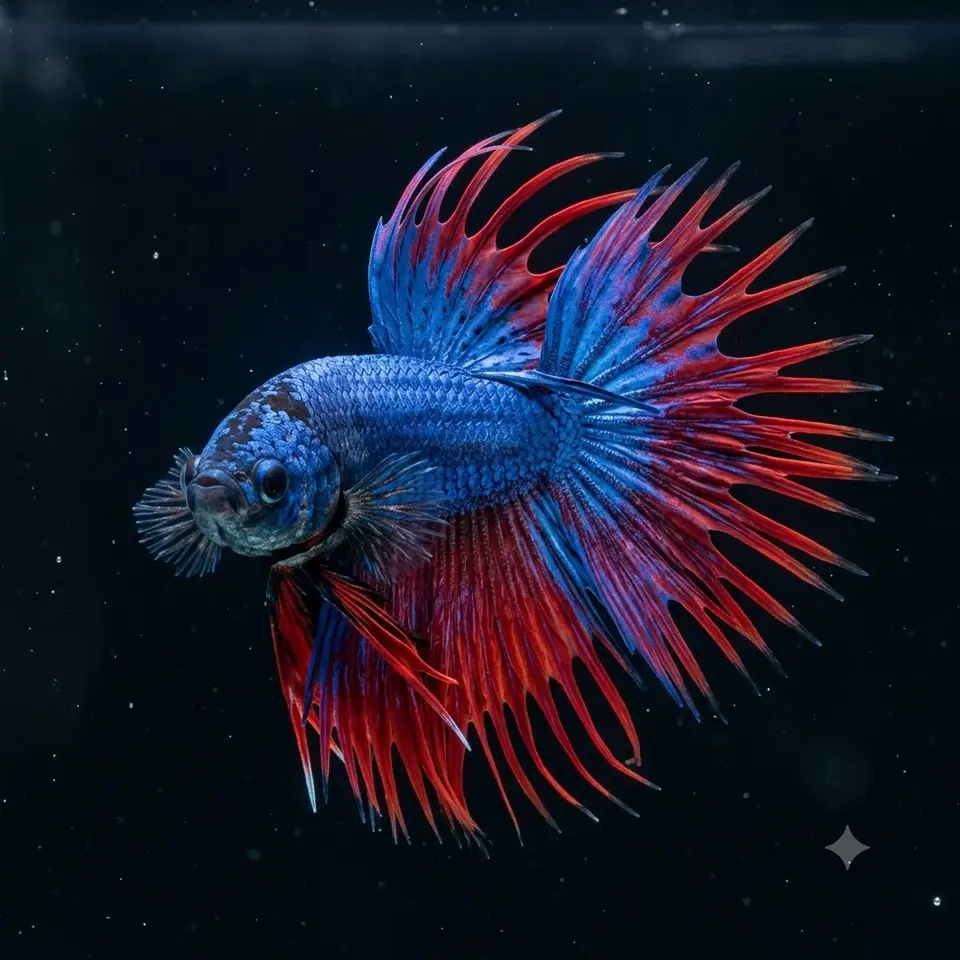
The Crowntail Betta is the spikiest betta variety - its fin webbing is reduced by a third or more, leaving long free-standing rays that fan out like a jagged crown.
Updated: October 2026
Species guide: Betta (Siamese Fighting Fish) · All betta varieties
 AI illustration
 Overview
The Crowntail Betta is the spikiest betta variety - its fin webbing is reduced by a third or more, leaving long free-standing rays that fan out like a jagged crown. Care is standard Betta splendens with one twist: all those exposed rays snag, tear, and curl more readily than solid fins, so decor choice and water quality matter even more than usual. For keepers who find halfmoons too soft-edged, this is the dramatic option.
Natural History
Every crowntail is a domesticated Betta splendens, a species from the warm, still rice paddies and floodplains of Thailand and Cambodia. The variety itself is recent: Indonesian breeder Ahmad Yusuf fixed the reduced-webbing trait in Jakarta around 1997, and the spiky look spread through the hobby within a few years. Nothing about the crown exists in the wild - it is purely a selected fin mutation layered on ordinary betta genetics, and it appears in males and (more subtly) females.
Appearance
A standard betta body, 2.5-3 in (6-7.5 cm) including fins, in any color or pattern - red, blue, koi, copper, black. What defines the variety is the webbing: by show standards it must be reduced at least 33% relative to ray length, so the rays extend past the fin membrane as visible spikes. Breeders sort them by ray structure: single ray, double ray, and crossed ray, where paired extensions crisscross for the fullest crown. A fish with less than 33% reduction is a combtail, not a crowntail; the fringe is there but the drama is not.
Temperament & Tankmates
Same rules as any betta. Males are territorial and must be kept one per tank - never with another male, and not with guppies, whose bright tails read as rival bettas. Safe company in 10+ gallons: corydoras, kuhli loaches, snails, and small peaceful schoolers like harlequin rasboras. Skip anything nippy (tiger barbs, some tetras). Those trailing rays are irresistible targets, and a nipped crowntail shreds fast. Many keepers simply house them alone, which the fish handles fine.
Tank Size & Setup
5 gallons (19 L) minimum, heated and filtered - not a bowl. Flow should be gentle (a baffled or sponge filter), because the heavy, drag-prone finnage tires the fish in current. Crowntail-specific detail: audit the decor. Sharp plastic plants and rough resin ornaments that a plakat would shrug off will tear free-standing rays, so use silk or live plants and smooth hides. Add a broad leaf or betta hammock near the surface for resting, and a tight lid: bettas jump.
Water Parameters
76-82°F (24-28°C), pH 6.5-7.5, ammonia and nitrite at zero, nitrate under 20 ppm, with 25% weekly water changes. One quirk worth knowing: crowntail rays often curl or bend at the tips in very hard water or when quality slips. Soft to moderately hard water keeps the crown straight. Curling is cosmetic, but treat it as an early warning to test the water.
Diet
A carnivore - feed a quality betta pellet twice daily, only what disappears in about two minutes, plus frozen or live bloodworms, brine shrimp, or daphnia a couple of times a week. One fasting day weekly helps prevent bloat. Diet is identical to any betta; there is nothing variety-specific here beyond keeping the fish in good enough condition to regrow torn ray tips.
Health & Lifespan
3-5 years. The betta staples apply - fin rot, ich, velvet, and dropsy, almost all downstream of cool or dirty water. The variety-specific risks are mechanical: exposed rays tear on decor, and torn tissue is an open door for fin rot, so any ragged edge calls for immediate clean water and observation. Some crowntails also tail-bite out of boredom or stress, which looks like overnight fin loss. Rays do regrow, though the new webbing may look uneven. Buy from displays with clean, straight, evenly spaced rays and active fish: clamped or fuzzy fins mean trouble already started.
Pros & Cons
Pros:
- The most dramatic, aggressive-looking betta silhouette
- Any color available; males and females both show the trait
- Standard betta care: no exotic requirements
- Cheap and widely available compared to halfmoons and rosetails
Cons:
- Exposed rays tear easily on decor and tankmates
- Ray tips curl in hard or poor-quality water
- Heavy finnage tires the fish in strong flow
- Torn fins invite fin rot without quick water fixes
Everyday gear for aquariums
Links go to Amazon or a partner brand's own store and may earn us a commission at no extra cost to you. As an Amazon Associate we earn from qualifying purchases. An Amazon link leads to a type of gear and you choose the exact product; a card that names a store leads to that partner's own shop.
Crowntail Betta - frequently asked questions
Why are my crowntail's rays curling?
Usually water - very hard water or declining quality makes the ray tips bend and curl. Test hardness and nitrates, tighten the water-change schedule, and new growth should come in straighter. Older fish also curl somewhat with age.
Will torn rays grow back?
Yes, in clean warm water most tears regrow within weeks. Feed well and keep the water pristine so fin rot cannot take hold in the damaged edge. The regrown section may never look perfectly symmetrical.
Crowntail vs combtail - what's the difference?
Webbing reduction. A true crowntail has at least 33% of the ray length free of webbing; a combtail has less, giving a light fringe rather than distinct spikes. Pet stores mislabel them constantly, so judge the fish, not the cup.
Are crowntails harder to keep than other bettas?
Slightly. Core care is identical, but the free-standing rays demand smoother decor, gentler flow, and stricter water quality than a short-finned plakat needs. If you can keep any betta well, a crowntail just asks you to be a little more careful.
Test yourself: guess the fish
Three clues from our quiz bank, each about another of our fish. Can you name them?
Clue 1.Males of this small, vividly colored labyrinth fish are so territorial that two cannot share a tank without fighting, giving rise to a fierce nickname.
It's the Betta (Siamese Fighting Fish) - read the full profile →
Clue 2.This dazzling Amazonian schooling fish wears a full-length red stripe beneath its blue band, distinguishing it from a similar smaller cousin.
It's the Cardinal Tetra - read the full profile →
Clue 3.This tall, triangular freshwater fish from the Amazon basin swims with trailing fin filaments and is a graceful staple of community aquariums.
It's the Angelfish - read the full profile →