Butterfly Betta
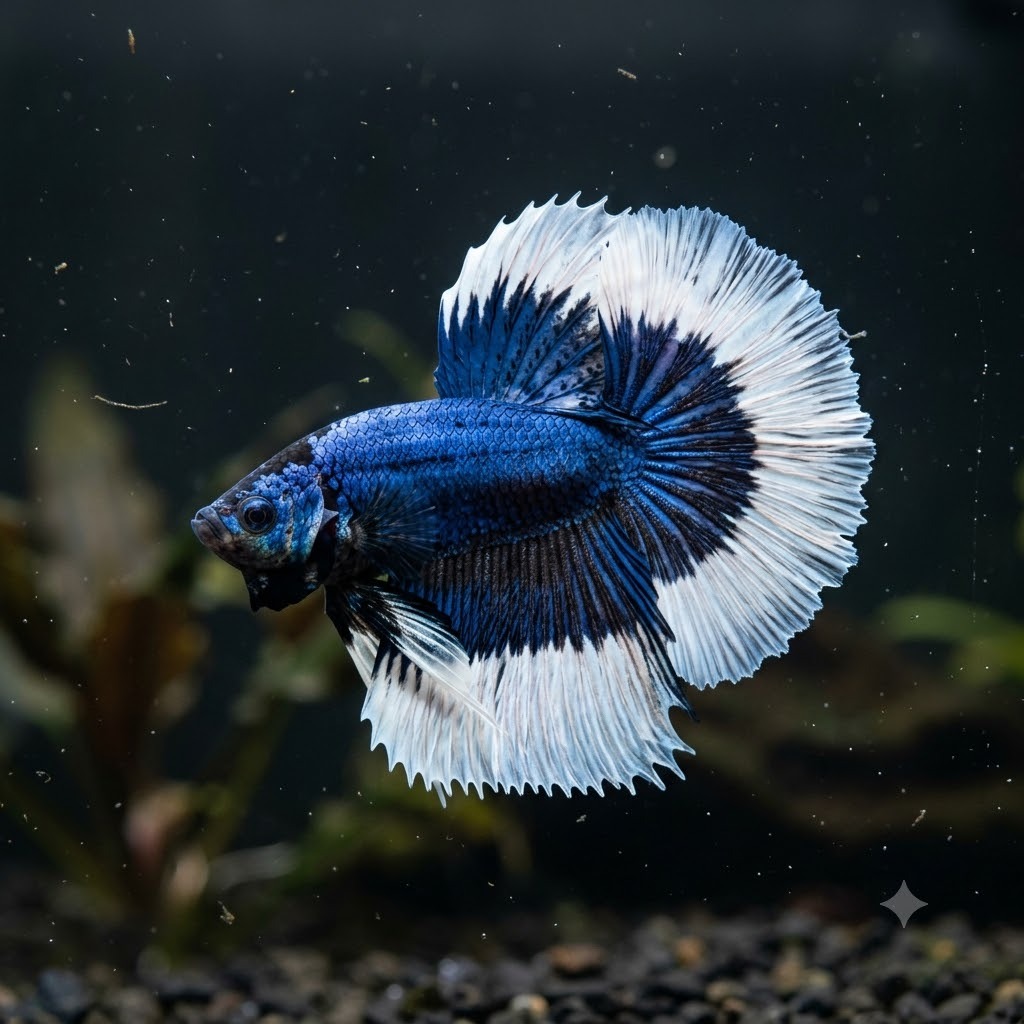
The Butterfly Betta is defined by a band: the body color runs out into the fins and then stops at a clean line, leaving the outer portion white, pale, or fully transparent.
🗓️ Last reviewed: July 2026
Overview
The Butterfly Betta is defined by a band: the body color runs out into the fins and then stops at a clean line, leaving the outer portion white, pale, or fully transparent. Done well it looks like the fish is wearing a ringed skirt, and it is one of the recognized show pattern classes. It is a pattern, not a fin shape, so butterflies exist as halfmoons, plakats, crowntails, and doubletails, though the halfmoon is the classic canvas. The honest part: a crisp, even band is genuinely rare, and many butterfly lines carry marble genetics that quietly redraw the pattern over the fish's life.
Natural History
Butterfly patterning is a domestic development in Betta splendens, formalized as a pattern class by betta show organizations, where judges look for the color to break at the same point on every fin and cover roughly half the fin area. Breeders in the United States, Europe, and Thailand have worked the pattern since the late 20th century, and it has been layered onto every modern fin type and color base. The pattern's history is tangled with marble breeding, which is part of why banding in many lines is unstable rather than fixed.
Appearance
2-2.5 in (5-6.5 cm) of body with fins depending on the type underneath. The signature is the break: a solid inner band of body color - red, blue, black, purple, or koi-style multicolor - ending in a sharp edge, with a clear or white outer band beyond it. In show-quality fish the break falls at the same radius on the caudal, dorsal, and anal fins, producing a concentric ring effect when the fish flares. In ordinary fish the line is ragged, the break sits at different points on different fins, or one side of the caudal is banded and the other is not. Some lines show a triple band, adding a second color ring before the clear edge. Females carry the pattern too, though the smaller fin area makes it subtler.
Temperament & Tankmates
Standard betta temperament, with swimming ability determined by the fin type: halfmoon butterflies are slow and tire easily against current, plakat butterflies are fast and assertive. One male per tank, no pairings, no casual sororities. In 10 gallons (38 L) or larger, calm company works - nerite snails, dwarf corydoras (pygmy, salt-and-pepper, dwarf), ember tetras, harlequin rasboras; standard corydoras and kuhli loaches need a group of five or six and 20 gallons (75 L). Fin nippers are out of the question with a heavily finned butterfly, and shrimp should be considered snacks unless the tank is thickly planted.
Tank Size & Setup
5 gallons (19 L) minimum, 10 gallons (38 L) better, especially for long-finned fish that need room to move without fighting flow. A tight-fitting lid is mandatory, because bettas jump and a lidless tank kills more of them than disease does. Heater, gentle filtration, smooth decor without sharp edges - the pale outer band of a butterfly shows every snag and tear - plus live or silk plants and a surface resting leaf.
Water Parameters
76-82 F (24-28 C) with a heater. pH 6.5-7.5, soft to moderately hard water, ammonia and nitrite at zero, nitrate under 20 ppm, 25-30 percent weekly water changes. Clean water matters a little more here than for a plain plakat, since the clear outer fin tissue is thin and is usually the first place fin rot takes hold.
Diet
Carnivore. A quality betta pellet twice daily in small portions, rotated with frozen or live bloodworms, brine shrimp, and daphnia two or three times weekly, and one fasting day per week. Color-enhancing foods can deepen the inner band on red-based fish; nothing in a diet affects where the band falls.
Health & Lifespan
3-5 years. Health follows the fin type. Halfmoon butterflies get the whole long-finned package: fin rot, tail biting under stress, torn edges from decor, and fatigue in current. Plakat butterflies avoid most of that. Quarantine new fish for ich, velvet, and internal parasites. The variety-specific catch is pattern stability. Many butterfly lines are built on or crossed with marble genetics, and in those fish the band creeps, thickens, or dissolves over months until the pattern is gone - a common and disappointing outcome for buyers who chose the fish for that clean ring. The clear outer band also makes fin damage extremely visible, which is a cosmetic minus and a diagnostic plus, since you spot early rot sooner than on a solid-colored fish. Buying tips - look for a break that lands at the same point on all fins, check the outer band for fraying, and prefer a mature fish if the pattern is what you are paying for.
Pros & Cons
Pros:
- Distinctive banded look recognized as a show pattern class
- Available on every fin type, including sturdy plakats
- Early fin damage is easy to spot against the pale band
- Ordinary betta care, no special equipment
Cons:
- Truly even banding is rare, and many fish are asymmetric
- Marble genetics in many lines erase the pattern over time
- Halfmoon versions carry all the usual heavy-finnage problems
- Requires a heater and a tight lid, like every betta
Butterfly Betta - frequently asked questions
What makes a betta a butterfly?
A clean break in fin color: solid body color in the inner half of the fins, then a sharply defined pale or clear outer band. Show standards want the break in the same place on every fin.
Why did my butterfly betta lose its band?
Almost always marble genetics in the line. The unstable pigment gene keeps reorganizing color, so the band spreads, shifts, or fades. Nothing you do in the tank will restore it.
Do butterfly bettas breed true?
Not reliably. Even good pairs throw a range, and lines carrying marble genes produce very mixed spawns. Serious breeders select over several generations and cull hard for band placement.
Is a butterfly betta harder to care for?
Only if you buy a halfmoon or other long-finned version, and then the difficulty comes from the fins rather than the pattern: gentle flow, smooth decor, clean water. A butterfly plakat is as easy as any betta.
🧠 Test yourself: guess the fish
Three clues from our quiz bank, each about another of our fish. Can you name them?
Clue 1.Males of this small, vividly colored labyrinth fish are so territorial that two cannot share a tank without fighting, giving rise to a fierce nickname.
It's the Betta (Siamese Fighting Fish) - read the full profile →
Clue 2.This small South American scavenger has tiny barbels and a sharp spine in each fin that can lock upright for defense.
It's the Corydoras Catfish - read the full profile →
Clue 3.This tiny, hardy aquarium fish gives birth to live young rather than laying eggs, earning it the nickname 'rainbow fish.'
It's the Guppy - read the full profile →