Albino Guppy
The Albino Guppy is a fancy guppy variety defined by a recessive gene that erases all black pigment, producing true red eyes and a pale, glowing body - the foundation of prized show strains like Albino Full Red and Albino Koi.
Updated: July 2026
Species guide: Guppy · All guppy strains
 AI illustration
 Overview
The Albino Guppy is a fancy guppy variety defined by a recessive gene that erases all black pigment, producing true red eyes and a pale, glowing body - the foundation of prized show strains like Albino Full Red and Albino Koi. Care is ordinary guppy care with a few honest twists: albinos are mildly light-sensitive, some show lines lack vigor from heavy inbreeding, and store look-alikes fool plenty of buyers. If you want a guppy that looks rarer than it is to keep, this is the one.
Natural History
Every fancy guppy descends from Poecilia reticulata, a tiny livebearer from streams and ditches in Venezuela, Trinidad, and nearby coasts. Albinism appeared as a spontaneous mutation in aquarium stock and breeders fixed it decades ago; today the gene is deliberately crossed into red, koi, and snakeskin lines. The variety could never persist in the wild - a red-eyed ivory fish is the first thing a predator picks off.
Appearance
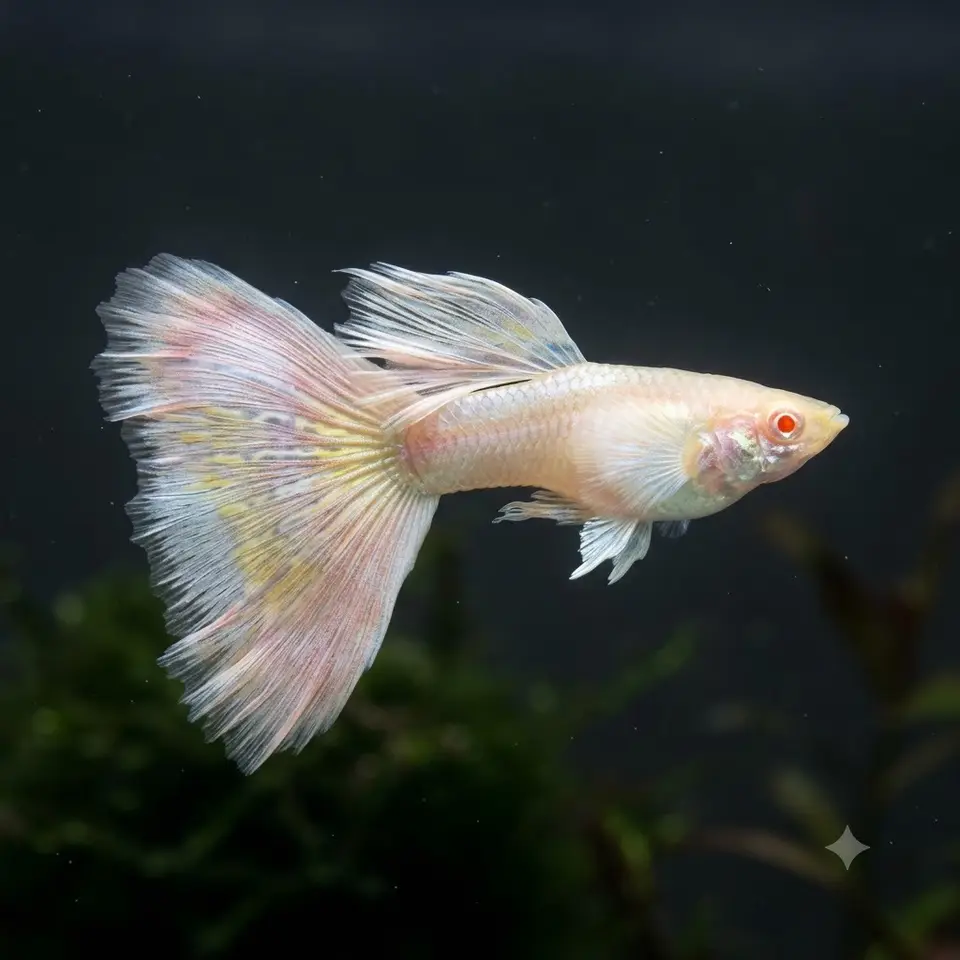
Albino is a color rule, not a body type: an autosomal recessive gene (written aa) that blocks melanin entirely. The giveaway is the eye - true albinos have red or pink eyes, while the similar "blond" and "gold" guppies keep black eyes. Body color depends on what else the strain carries: Albino Full Reds glow solid cherry, Albino Koi wear red-and-white patches, and plain albinos run ivory to pale gold. Males reach about 1-1.4 in (2.5-3.5 cm) plus tail and carry all the color; females hit 1.5-2.4 in (4-6 cm) and stay plainer. Most albino show lines have wide delta tails, so a little fin-heaviness comes with the package.
Temperament & Tankmates
Temperament is pure guppy: peaceful, busy, always begging. Males display at each other constantly but rarely do damage. Good tankmates are other small, peaceful species - corydoras, kuhli loaches, small rasboras, snails, and adult shrimp. Skip fin-nippers like tiger barbs and anything with a guppy-sized mouth. One variety-specific note: albino eyesight is slightly weaker than wild-type, so in a fast, crowded community they can be last to the food. Keep 2-3 females per male, or run an all-male group to avoid endless fry.
Tank Size & Setup
A 10 gallon (38 liter) tank suits a trio; 20 gallons (75 liters) gives a colony room to grow, which it will. Use gentle filtration (sponge filters are ideal around fry), a tight lid, and live plants like java moss and hornwort. The variety twist is lighting: red eyes lack the screening pigment of normal eyes, so keep light moderate and provide shaded, planted zones - albinos visibly settle better with cover. A dark substrate makes the pale body glow.
Water Parameters
72-82°F (22-28°C), pH 7.0-8.0, moderately hard to hard water. Guppies dislike soft, acidic conditions, and albino show lines - often raised in pristine breeder water - crash harder in neglected tanks than farm-bred fish do. Weekly 25% water changes and a stable temperature matter more than chasing exact numbers.
Diet
Quality micro pellets or crushed flake as the staple, plus frozen or live baby brine shrimp and daphnia a few times a week and some vegetable content (spirulina flake works). Feed small portions once or twice daily. Scatter food across the surface so slower-sighted albinos are not outcompeted, and condition breeding pairs on live food - it noticeably improves fry numbers in weaker lines.
Health & Lifespan
1-3 years. Expect the usual guppy problems: ich, fin rot, and columnaris in dirty or cold water, plus wasting disease in mass-farmed imports. The variety-specific issues come from the genetics: fixing a recessive gene requires inbreeding, and tight albino lines can show smaller broods, fragile fry, and shorter lifespans. Their weaker vision is a feeding nuisance more than a health problem. Buy from breeders who outcross regularly, quarantine new fish for 2-3 weeks, and keep the water clean - most "weak albino" complaints are really water-quality complaints.
Pros & Cons
Pros:
- Red eyes and glowing color look genuinely rare
- Care is standard, easy guppy care
- Breeds 100% true when paired albino to albino
- Excellent starter project for line-breeding
Cons:
- Inbred lines can be fragile with small broods
- Slightly light-sensitive; wants planted shade
- Stores often mislabel black-eyed blonds as albinos
- Breeds constantly, like every guppy
Everyday gear for aquariums
Links go to Amazon or a partner brand's own store and may earn us a commission at no extra cost to you. As an Amazon Associate we earn from qualifying purchases. An Amazon link leads to a type of gear and you choose the exact product; a card that names a store leads to that partner's own shop.
Albino Guppy - frequently asked questions
How do I tell a true albino from a blond guppy?
Look only at the eyes. True albinos have red or pink eyes; blond and gold guppies have pale bodies but solid black eyes. Body color proves nothing - eye color settles it in one glance.
Do albino guppies breed true?
Yes. Albino is recessive, so albino x albino gives 100% albino fry. Crossed to a normal guppy, all fry are black-eyed carriers, and pairing two carriers returns roughly one albino in four.
Are albino guppies harder to keep than regular guppies?
Marginally. Same tank, water, and food, but weak lines are less forgiving of poor maintenance, and the fish prefer dimmer, planted tanks. A healthy line from a good breeder is no harder than any fancy guppy.
Can I keep them with regular guppies?
They coexist fine, but they interbreed freely, and one generation of mixing buries the albino gene under black-eyed carriers. Keep the line in its own tank if you care about the strain.
Test yourself: guess the fish
Three clues from our quiz bank, each about another of our fish. Can you name them?
Clue 1.Contrary to popular myth, this hardy pet has a memory spanning months and should never be kept in a tiny bowl.
It's the Goldfish - read the full profile →
Clue 2.Males of this small, vividly colored labyrinth fish are so territorial that two cannot share a tank without fighting, giving rise to a fierce nickname.
It's the Betta (Siamese Fighting Fish) - read the full profile →
Clue 3.Keepers love this diverse group for bold personalities but warn that many dig substrate and fiercely defend a chosen territory.
It's the Cichlid (Overview) - read the full profile →