Veiltail Betta
The Veiltail is the classic pet-store betta - a long, drooping caudal fin that trails behind the fish like a veil, backed by a dominant gene that makes it the most common fancy Betta splendens in the US.
Updated: July 2026
Species guide: Betta (Siamese Fighting Fish) · All betta varieties
 AI illustration
 Overview
The Veiltail is the classic pet-store betta - a long, drooping caudal fin that trails behind the fish like a veil, backed by a dominant gene that makes it the most common fancy Betta splendens in the US. Show breeders dismiss it precisely because it is everywhere, but a healthy veiltail is a graceful, hardy, cheap introduction to bettas, with finnage that causes fewer problems than halfmoons or rosetails.
Natural History
Betta splendens was domesticated in Thailand centuries ago as a fighting fish; ornamental long-finned lines came later, and the veiltail emerged mid-20th century as the first mass-bred long-tail form. Its tail trait is genetically dominant over other fin types, so any careless cross throws veiltail offspring - which is exactly why pet-store stock is overwhelmingly veiltail, and why show circuits (the IBC no longer awards them classes) moved on to halfmoons and crowntails.
Appearance
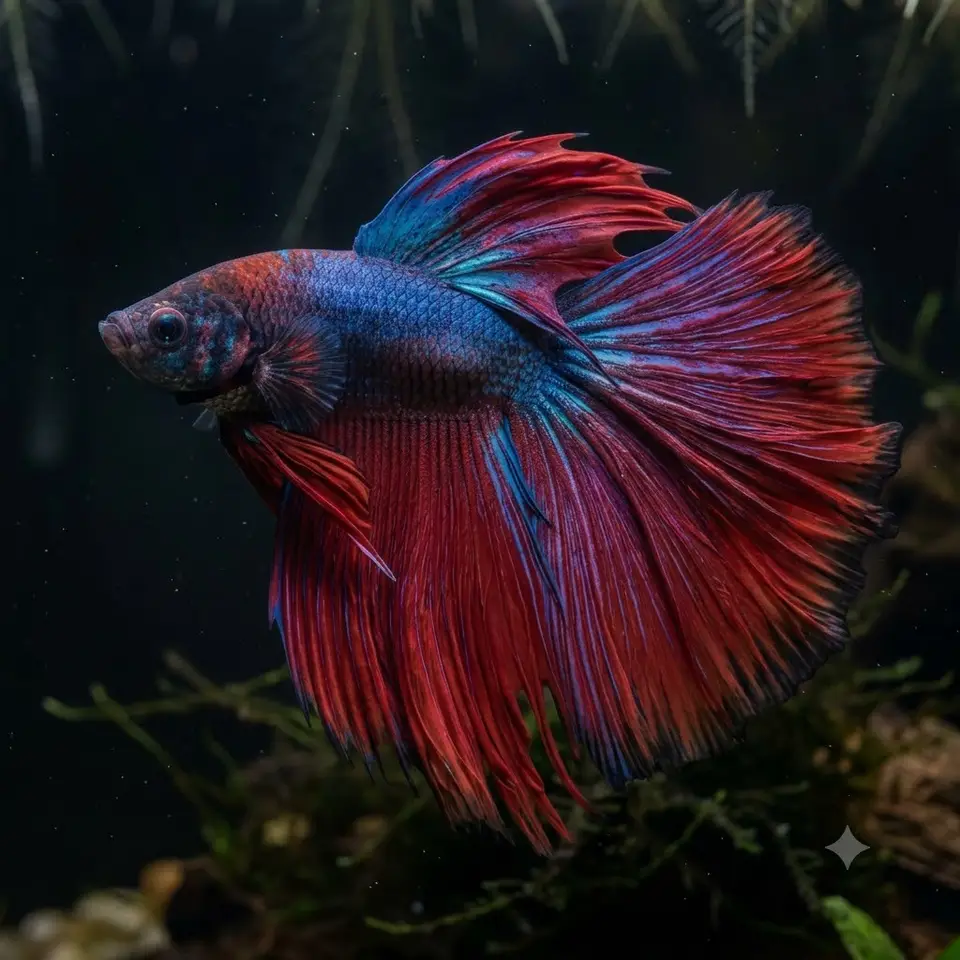
A veiltail male carries a long, narrow caudal fin that arcs up, then droops and trails downward - it never opens into the flat 180-degree fan of a halfmoon or the spiky reduced webbing of a crowntail. Body runs about 2.5 in (6.5 cm), with fins pushing males past 4 in (10 cm) total. Every betta color turns up: red and blue dominate store shelves, but koi, marble, dragon-scale and cellophane veiltails all exist. Females share the body but have much shorter fins and are often mislabeled as plakats.
Temperament & Tankmates
Standard betta rules apply, softened slightly by the veiltail's slow, fin-heavy swimming. One male per tank, always. Skip fin-nippers (tiger barbs, serpae tetras) and anything flashy enough to trigger constant flaring, like fancy guppies. Safe picks in 10+ gallons: snails, dwarf corydoras (pygmy, salt-and-pepper, dwarf), and calm schoolers such as ember tetras - standard corydoras and kuhli loaches need a group of five or six and 20 gallons (75 L). Many veiltails are happiest completely alone, and a solo 5-gallon is a perfectly good life.
Tank Size & Setup
5 gallons (19 L) minimum, heated and filtered - the store cup is shipping packaging, not housing. Veiltail-specific points: gentle flow (sponge filter or a baffled hang-on-back), because that trailing fin turns the fish into a sail; silk or live plants only, never sharp-edged plastic that shreds fins; and broad leaves or a betta hammock near the surface, since hauling the tail up for air is real work. A tight lid is mandatory - bettas jump.
Water Parameters
76-82 F (24-28 C) with a heater; room-temperature bettas are lethargic, immune-suppressed bettas. pH 6.5-7.5, soft to moderately hard water, ammonia and nitrite at zero, nitrate under 20 ppm. Long-finned varieties punish poor water fast - fin rot starts at the edges of that big caudal before anything else shows. Weekly 25-30 percent changes on a cycled tank keep it away.
Diet
A carnivore with a stomach the size of its eye. Feed quality betta pellets (2-4 pellets twice daily), rotate in frozen or live bloodworms, brine shrimp and daphnia weekly, and fast one day a week. Overfeeding is the top killer of pet bettas - bloat and swim-bladder trouble show fastest in fin-heavy, slow-moving veiltails because they already work hard to stay level.
Health & Lifespan
3-5 years.
The finnage is the main clinical feature: watch for fin rot (ragged, darkening edges - fix the water first, medicate second), tears from rough decor, and tail-biting, a stress behavior in which the fish chews off its own caudal. Torn fins regrow in clean, warm water. Compared with halfmoons and rosetails, the veiltail's narrower tail has stronger rays and less weight, so it swims better and suffers fewer blowouts - a real advantage for beginners. The usual betta issues round it out: velvet, ich, and swim-bladder problems from overfeeding.
Pros & Cons
Pros:
- Cheapest, most available betta variety ($3-6 anywhere)
- Hardier finnage than halfmoon or rosetail types
- Full range of betta colors and patterns
- Graceful, flowing look with easy care
Cons:
- Long fins still tear, snag and invite fin rot
- Slow swimmer that needs gentle flow
- Males can never share a tank
- No show or breeding-project value
Everyday gear for aquariums
Links go to Amazon or a partner brand's own store and may earn us a commission at no extra cost to you. As an Amazon Associate we earn from qualifying purchases. An Amazon link leads to a type of gear and you choose the exact product; a card that names a store leads to that partner's own shop.
Veiltail Betta - frequently asked questions
Is a veiltail the same as a halfmoon?
No. A halfmoon's caudal spreads a full 180 degrees into a D shape; a veiltail's arcs and droops downward. Veiltail is also genetically dominant while halfmoon is not, so they breed very differently.
Why are veiltails so cheap?
The dominant tail gene makes them trivial to mass-produce, and show fashion left them behind decades ago. Price says nothing about the pet: a $4 veiltail lives just as well as a $40 halfmoon in the same tank.
My veiltail's fins look shorter - what happened?
Either fin rot (ragged, dark or fuzzy edges - test your water immediately) or tail-biting from stress or boredom. Clean warm water regrows fin tissue in weeks; add plants and enrichment if biting is the cause.
Can I keep a veiltail in a bowl?
No. An unheated, unfiltered bowl shrinks a 3-5 year lifespan to months. A heated, filtered 5-gallon (19 L) tank is the honest minimum.
Test yourself: guess the fish
Three clues from our quiz bank, each about another of our fish. Can you name them?
Clue 1.Popular with aquarists who ship dormant eggs by mail, the males of this fish are far flashier than females.
It's the Killifish - read the full profile →
Clue 2.This category of hardy tropical fish includes the swordtail and platy and breeds readily in home tanks.
It's the Molly / Platy / Swordtail (Livebearers) - read the full profile →
Clue 3.Prized for vivid stripes and patterns, this disc-shaped fish is one of the most colorful freshwater species kept.
It's the Discus - read the full profile →