Why Cats Knock Things Off Tables
Cats push objects off edges because a paw is their main investigation tool, because falling things behave like prey, and because it reliably makes you look up. Here is how to tell the three apart, what actually reduces it, and the rarer case where a sudden increase is worth a vet visit.
On health questions, we are not the authority. Most edge-pushing is ordinary cat behaviour. But a sudden change in any behaviour can be medical, and behaviour is not something to diagnose from an article. Your veterinarian is the right place for that, and for older cats, your vet plus bloodwork. We do not give veterinary advice - this piece is about reading normal behaviour, not treating an animal.
The short version: a cat pushes your glass off the table for three overlapping reasons, and only one of them is about you. First, the paw is how a cat investigates - vision at close range is poor, so a tap is the equivalent of a hand reaching out. Second, an object that tips, falls and clatters behaves like something alive, which pulls on the same motor pattern as hunting. Third, and this is the part people underestimate, it works. You look up every single time. In behavioural terms that is a reinforcement schedule most trainers would envy.
Which of the three is driving it changes what you do about it, so it is worth learning to tell them apart.
The paw as an instrument
A cat’s close vision is genuinely bad. They are long-sighted, built to spot movement at ten metres rather than read detail at ten centimetres, and there is a blind zone right under the chin. Whiskers cover some of that gap, and the front paws cover the rest. Paw pads are densely supplied with mechanoreceptors, and a cat can get texture, weight and whether a thing is fixed or loose from a single deliberate tap.
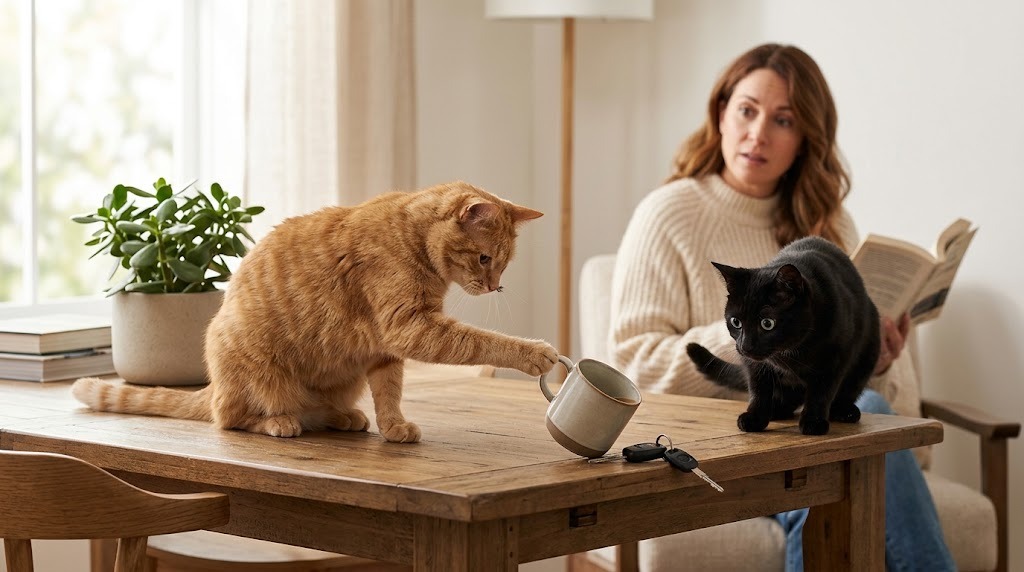
You can spot investigative pawing by its rhythm. It is slow. The cat leans in, taps once, watches, taps again, often with the head tilted. There is a pause between contacts. Nothing about it looks urgent. This is the version you see with a new object on a familiar surface - a set of keys that were not there yesterday, a pen, a full mug.
If the object then moves in an unexpected way, the second system takes over.
Falling objects look like prey
Cats are wired to respond to small, erratic, partly unpredictable movement. A pen rolling toward an edge and then dropping is about as close as a household gets to a fleeing mouse. The behaviour that follows - the fast bat, the stare over the edge, the trot down to the floor to look at it - is the same sequence that would run against live prey, minus the ending.
This is why the second and third items go faster than the first. The cat is no longer asking a question; it is playing out a pattern. It is also why the behaviour clusters in cats who do not get much else to chase. Indoor cats with a quiet afternoon and no moving targets will find their own, and your desk is full of them.
The practical implication is not “stop the cat pawing”. It is that a cat running a hunting pattern on your coffee cup is a cat with spare predatory motivation and nowhere to put it. Two short, real play sessions a day with something that moves away from the cat and ends in a catch will absorb more of that than an entire floor of static toys. Our notes on choosing cat toys go into what actually holds feline interest, which is mostly movement and a finishable ending, not novelty.
The part that is about you
Here is the uncomfortable bit. A cat does not need to understand that you are annoyed for your reaction to work. Any reliable response - looking up, saying the cat’s name, getting out of the chair, picking the object up - is attention delivered instantly, every time, for a behaviour that costs the cat one paw movement. If you have ever noticed that your cat makes eye contact before pushing, that is not your imagination and it is not spite. It is a cat who has learned that the sequence works, and is checking that the audience is present.
You can usually identify this version by the eye contact and by the timing. It happens when you are in the room, often when you are busy with something else, and it tends to target the object you are most likely to react to. It does not happen at three in the morning to an empty kitchen.
What reduces it:
- Break the contingency, not the cat. The reaction is the reinforcer. Not reacting works, but only if you genuinely never react, which for a glass of water is unrealistic - so pair it with the next point rather than relying on it alone.
- Remove the good targets. Nothing rolls, nothing sits within a paw’s reach of an edge, breakables live behind a door. This sounds like giving in. It is simply removing the reward from the environment.
- Give the same behaviour somewhere to go. A window perch, a puzzle feeder, a toy that can actually be pushed off a surface without consequence. Cats will keep doing the thing; the question is only what they do it to.
- Feed attention on a different schedule. Three or four short unprompted interactions a day - play, a grooming session, a few minutes of lap time initiated by you - lowers the value of attention that has to be extracted by knocking something over.
Punishment does not belong on that list. Startling a cat mid-behaviour suppresses it while you are present and teaches the cat that you are unpredictable, which costs you more than a mug did. The same logic applies to redirecting scratching, which we cover in where to put a scratching post - you move the behaviour, you do not try to delete it.
When a change is worth a phone call
Ordinary edge-pushing is stable. It has been going on for years, it happens in the same contexts, and it has not got worse. What is worth paying attention to is change.
A cat who suddenly becomes far more active, vocal, restless or destructive - particularly an older cat, particularly alongside weight loss with a good appetite - is describing something a vet should look at rather than something an article should explain. Hyperthyroidism, pain and declining vision and hearing in senior cats can all show up first as a shift in ordinary behaviour, and none of them are diagnosable from the outside. The same goes for a cat who starts mouthing or eating non-food objects rather than pushing them, which is a different behaviour with a different set of causes.
Our senior cat care guide covers what changes to track as cats age and what is worth raising at a check-up. The general rule holds for any species: new behaviour, or a sharp increase in an old one, is a question for a veterinarian first and a behaviour question second.
So why does it feel personal?
Because the eye contact makes it look deliberate, and in a narrow sense it is - the cat has learned a reliable cause and effect involving you. What is missing is the malice we read into it. The same paw that maps a strange object, the same motor pattern that would pin a mouse, and the same social learning that produces kneading on a lap are all running as designed. The glass is just in the way.
