Why Cats Bring You Dead Animals
A cat that leaves a mouse on the doormat is not paying tribute or teaching you to hunt - it is carrying prey to the safest place it knows. What drives the habit, why it peaks in autumn, and what research shows actually reduces it without punishing the cat.
On health questions, we are not the authority. Wild prey can carry parasites and infections, and rodents may have eaten poison bait. If your cat eats prey regularly, seems unwell after a catch, or you are worried about worming and parasite control, your veterinarian is the right person to ask. Handle any carcass with gloves or a bag. We do not give veterinary advice - this piece is about reading normal behaviour.
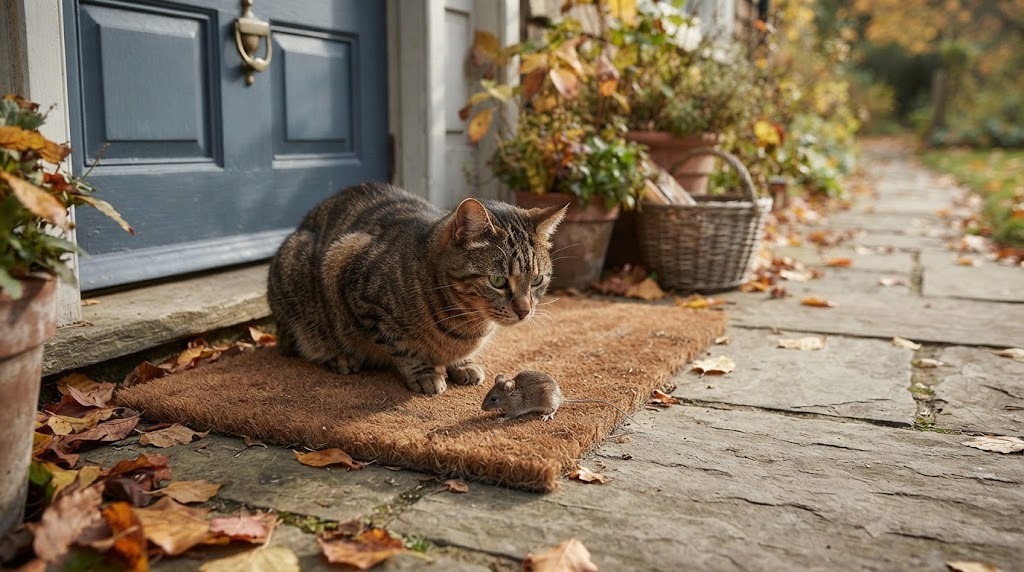
The short version: your cat is not giving you a present and is not trying to teach you to hunt. It is carrying prey back to the place it considers safe - its core territory, which is your home - and then often losing interest once it gets there. The catch satisfies the hunting sequence; eating it is a separate decision a well-fed cat frequently skips. That is why the mouse ends up intact on the kitchen floor.
It is ordinary, it is not a sign of a bad cat, and it can be reduced. Punishment is the one approach that does nothing useful.
Hunting and hunger are separate systems
The most important thing to understand is that cats do not hunt because they are hungry. A cat that has just eaten will still stalk and pounce if a mouse runs past. Hunting is driven by its own motor pattern - watch, stalk, chase, pounce, kill bite - and completing that pattern is rewarding by itself.
In the wild, a cat needs roughly ten or more small prey animals a day to meet its energy needs, and many hunts fail. An animal built that way cannot afford to wait until it feels hungry to start trying. So the drive to hunt runs whether the bowl is full or not, and a pet cat simply has nowhere useful to put the result.
This is also why the quality of play matters so much, which we will come back to.
Why it lands on your doorstep
Cats rarely eat prey where they catch it. Open ground is exposed, and a cat eating is a cat not watching for larger predators or rival cats. The instinct is to carry the catch somewhere secure first.
For an indoor-outdoor pet, the most secure place in its world is your home. So the prey travels there. Once the cat is inside, safe and already fed, the urge to eat is weak, and the animal is dropped - often right where you will find it, because that is where the cat spends its time.
The popular explanation that cats are “teaching” their clueless human to hunt, the way a mother brings half-dead prey to kittens, is appealing but unproven. It is sometimes supported by the claim that spayed females bring prey home more than males, but there is no solid data behind that. The safe-place explanation fits what we can actually observe with far fewer assumptions.
Why it seems worse right now
Many owners notice more deliveries in late summer and autumn, and there are a few ordinary reasons for it:
- More young prey. Rodent and bird populations peak after the breeding season, and young animals are inexperienced and easier to catch.
- Shorter days. Cats are most active at dawn and dusk. As days shorten, those peak hours overlap more with the times your cat is out.
- Rodents moving in. As temperatures drop, mice move toward buildings, which puts them squarely in a house cat’s territory.
None of this means your cat has changed. The opportunities have.
What actually reduces it
The most useful evidence here comes from a 2021 study led by researchers at the University of Exeter, published in Current Biology. They tested simple changes over twelve weeks in 219 households with 355 cats. Two stood out:
- A grain-free, meat-rich diet reduced the number of prey animals cats brought home by roughly a third. The researchers suggested some cats may hunt partly to make up for nutrients in lower-meat diets, though that part is not settled.
- Five to ten minutes of daily object play - a feather or fur toy on a wand that the cat can stalk, chase and “catch” - reduced prey brought home by about a quarter.
The play finding is the easiest to put into practice. The key is letting the cat complete the sequence: let the toy hide, move erratically, and then be caught, rather than waving it around nonstop. Ending with a small meal or treat closes the loop the way a real hunt would. Our guide to cat toys that hold interest covers which types work best for this.
Other options, with more mixed results:
- Keeping cats in at dawn and dusk. This cuts the highest-risk hours without a full indoor-only switch, and is especially relevant in bird nesting season.
- Brightly coloured collar covers. Studies have found these reduce birds caught - birds see colour well - but have little effect on mammals. Any collar should be a quick-release type.
- Bells. The evidence is mixed. Some cats learn to move without ringing them, and they do nothing about prey that is already cornered.
Before changing your cat’s diet, talk to your veterinarian, particularly for older cats or cats with existing conditions. A cat age calculator can help put your cat’s life stage in perspective before that conversation.
What not to do
Scolding a cat for bringing prey home does not stop the hunting. It only teaches the cat that you are unpredictable near the doorway, and some cats respond by eating the catch outside or hiding it somewhere you will find later by smell.
The better response is dull: stay calm, distract the cat with a toy or treat if it is still carrying a live animal, and remove the prey with gloves once the cat has moved away. If the animal is alive and injured, a local wildlife rescue can advise you.
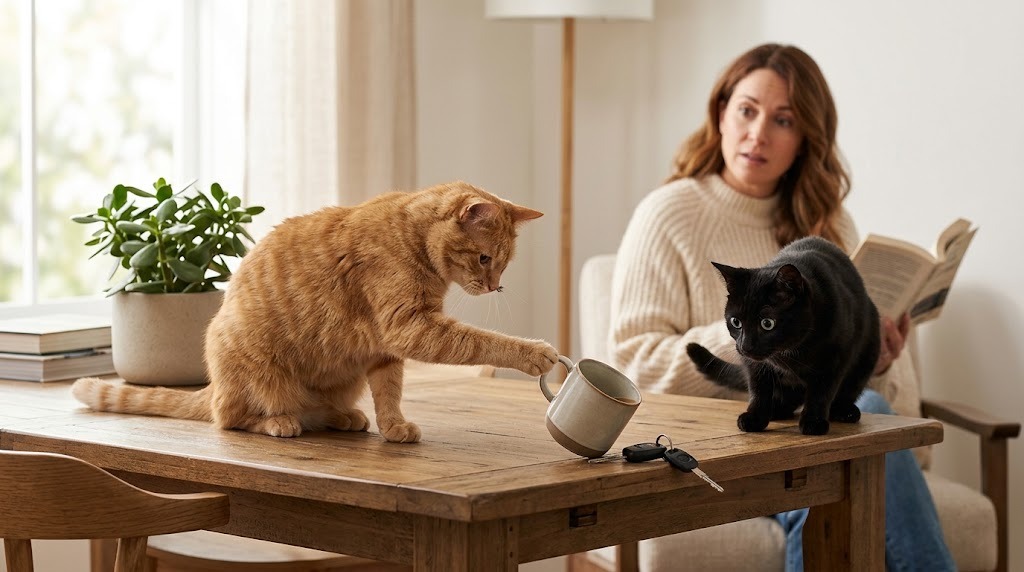
Like knocking things off tables or kneading with their paws, bringing prey home is a normal cat behaviour showing up in a human setting. The goal is not to shame the instinct out of the cat, which is impossible, but to give it somewhere better to go.
When to call your vet
Talk to your veterinarian if your cat regularly eats what it catches (to discuss parasite prevention for your area), seems unwell after a catch, or starts hunting far more or far less than usual without an obvious reason. A sudden change in any long-standing behaviour is worth mentioning at the next check-up.
🛒 Recommended Gear on Amazon
- Wand toys - browse current options and reviews on Amazon.
- Bird-safe collar cover - browse current options and reviews on Amazon.
As an Amazon Associate, we earn from qualifying purchases - at no extra cost to you. This helps us keep producing free, in-depth guides.