How to Introduce Two Cats
Putting a new cat straight in front of the resident cat is the usual mistake. The feline vets' own step-by-step guide works the other way round: a separate room first, then scent, then play behind a closed door, then sight, then supervised time together. What each stage looks like and when to slow down.
On health and behaviour problems, we are not the authority. A new cat should see a veterinarian before it meets your resident cat, and cats that fight, stop eating, hide for days or start urinating outside the litter box need a vet or a qualified feline behaviourist, not an article. We do not give veterinary advice; this piece walks through the published guide from the American Association of Feline Practitioners so you know what to expect and what to ask.
The short version: do not let the cats meet on day one. Give the new cat its own closed room, let both cats get used to each other’s smell first, then to each other’s presence behind a door, then to the sight of each other through a barrier, and only then to short supervised time in the same room. Move forward only when both cats are relaxed at the current stage.
That order comes from the step-by-step introduction guide of the American Association of Feline Practitioners, a handout that accompanies the association’s 2024 guidelines on tension between cats. Everything below follows that handout. Where we mention a number, it is the handout’s number.
Why slow is the whole method
How long does it take? The AAFP handout says the process can take anywhere from a few days to a few months, and sometimes longer. It does not give a schedule, and that is deliberate: the rule is to stay at a step until each cat is comfortable with it.
The handout is blunt about the cost of hurrying. Pushing ahead while one cat is still uneasy, it says, can result in long-term tension between the cats. A first meeting that goes badly is hard to undo, so the method spends most of its time on stages where the cats cannot reach each other at all.
Before the new cat arrives
Two things come first in the guide.
Health. All cats should have had a recent veterinary check-up, and the new cat should be tested by your vet for common contagious diseases. The handout also advises against adding a cat to a home where the resident cat is in poor health or is a senior with medical concerns. That is a conversation to have with your vet before you commit.
A transition room. This is a quiet room with a door that closes securely, set up with everything the new cat needs: food, water, a litter box, a scratching surface, toys, places to hide and something to climb. Cardboard boxes and the carrier with a towel over it count as hiding places. The point is that the new cat can live there comfortably without seeing the resident cat.
The rest of the home matters too. The AAFP handout asks for one litter box, food bowl, water bowl, bed and scratching post per cat, plus one extra, placed so the cats cannot see one resource from another. Our guides to scratching post placement and a litter box hygiene routine cover the practical side of spreading these around a home.
The handout also suggests plugging in feline synthetic pheromone diffusers before the cat arrives. Whether that is worth doing in your home is a fair question for your vet.
Stage one: settle, then swap scents
The new cat arrives in a covered carrier and goes straight to the transition room, so the cats do not see each other. Open the carrier and let the cat come out in its own time. Stay at this stage until the new cat is no longer hiding all the time and explores the room with confidence.
Then scent. Swap bedding or soft toys between the cats, so each can investigate the other’s smell with nobody attached to it. Repeat it daily until neither cat reacts with tension.
What tension looks like, according to the handout: avoiding the item, growling or hissing at it, pacing, toileting outside the litter box, or any change from the cat’s normal behaviour. A cat that sniffs the bedding and walks off, or lies down on it, is doing fine.
When swapped items no longer bother anyone, the guide adds scent transfer: rub a soft cloth carrying one cat’s scent gently over the other cat’s cheeks and chin and between the eyes and ears, then leave the cloth where the cats can smell it.
Stage two: a closed door between them
Next the cats share an activity without seeing each other. The handout’s idea is a toy on each side of the closed door, tied together with strong string, so that one cat’s play moves the other cat’s toy.
Sessions are kept short - the AAFP handout says 5 to 20 minutes - and should end before the cats lose interest. If one cat hisses or growls at the door, the guide says not to discipline it: stop, give the cats more distance, and try again later.
Around the same time the new cat starts exploring the rest of the home in short visits, while the resident cat waits in a favourite room with treats and toys. Then they swap back. Each cat gets to learn the other’s territory without meeting its owner.
Stage three: seeing each other
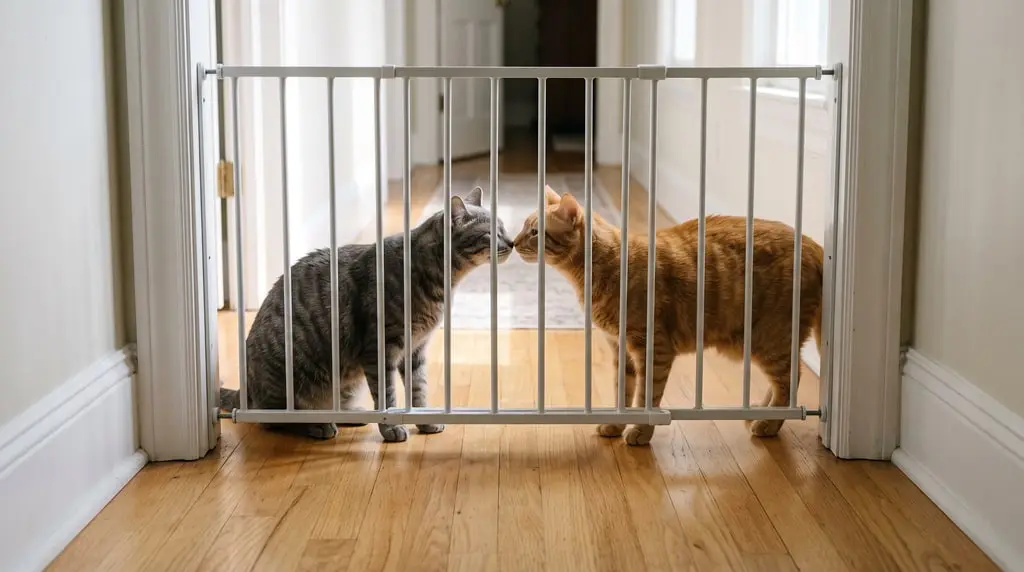
Only now do the cats get a look at each other, and still not with open access. The handout lists a screen, a glass door or a door-height pet gate as suitable barriers.
Keep these sessions short too, and pair them with something the cats like, such as play or treats. Watch body language and listen. If either cat is uncomfortable, the guide’s instruction is to stop at once and go back to the closed-door stage for a few more days. Going back is part of the method, not a failure.
Stage four: the same room, supervised
When both cats are calm at the barrier, they can share a large room for short supervised visits. A second person helps: one of you plays with each cat on opposite sides of the room. A wand toy keeps a cat’s attention on you and gives the visit a pleasant association.
Two safety points from the handout are worth repeating:
- Do not pick up or handle a cat that is hissing, growling or flicking its tail. A cat that cannot reach the cat it is upset with may redirect onto the nearest target, which is you.
- Keep something nearby to block the view - a large towel, a cushion, a piece of cardboard - and put it between the cats if a stare-down starts.
If the visits go well, repeat them over several days and lengthen them gradually until the cats can share space without tension. Climbing space helps here, because a cat that can get up high has a way to stay in the room without being close. Our cat tree buying guide covers what to look for.
When to ask for help
Not every pair of cats becomes friends. Many settle into sharing a home politely, and that counts as success. The handout names the most common cause of tension as too few resources, or resources bunched together, so adding and spreading them out is the first thing to check.
Ask your veterinarian for help if the cats fight, if one cat is being kept away from food, water or the litter box, if either cat hides constantly or stops eating, or if you are stuck at one stage for weeks. A vet can rule out pain and illness and refer you to a behaviourist. If your new arrival is elderly, our senior cat care guide lists changes worth mentioning at that visit.
Recommended Gear on Amazon
- Extra tall pet gates - browse current options and reviews on Amazon.
- Cat wand toys - browse current options and reviews on Amazon.
- Cat scratching posts - browse current options and reviews on Amazon.
As an Amazon Associate, we earn from qualifying purchases - at no extra cost to you. This helps us keep producing free, in-depth guides.