Why Cats Knead With Their Paws
Kneading is a retained kitten behaviour that never switches off, layered with scent marking and comfort. Here is what the behaviour means, why some cats drool or suckle while doing it, and the few changes that are worth a vet conversation.
 AI illustration
 Please read this first. Behaviour and health overlap more than most owners expect. Pain, skin disease, anxiety and cognitive change can all alter how a cat kneads, grooms and settles. This article is a reading guide to help you understand ordinary kneading and recognise which changes are worth investigating. It is not veterinary advice, and we do not give any. Your own vet is the right place for anything about your specific cat.
The short answer: kneading is a nursing behaviour that never gets switched off. Kittens tread their paws against their mother to stimulate milk flow, and in domestic cats that motor pattern survives into adulthood attached to comfort rather than food. Layered on top are two other things - the scent glands between the toes, which quietly mark the surface as familiar, and a settling routine that predates domestication.
So a cat kneading your leg is not doing one thing. It is running a comfort reflex, leaving its scent on you, and preparing a spot to lie down, all at once. None of it needs fixing.
What kneading actually looks like
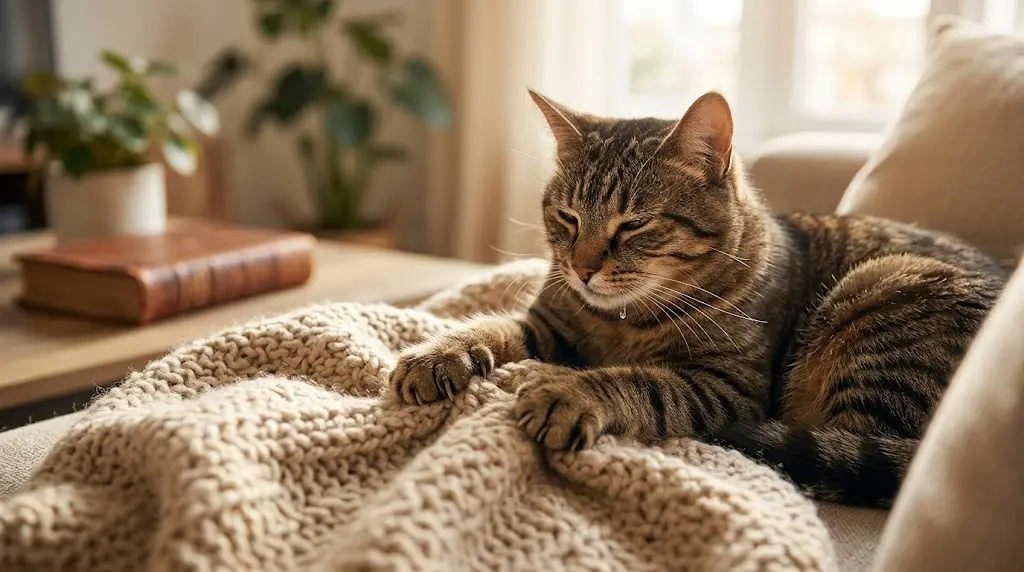
The full pattern is alternating front paws pushing rhythmically into a soft surface, usually at roughly one push per second, often with the claws extending and retracting on each stroke. Some cats use all four paws. Many purr throughout, some close their eyes to a slit, and a fair number drool.
It typically shows up on soft, giving surfaces - blankets, fleece, laundry, a lap, a cushion, the belly of an obliging dog. Hard floors rarely trigger it. The behaviour is usually short, thirty seconds to a couple of minutes, and ends with the cat lying down on the exact spot it was working.
The explanations that hold up
Retained kitten behaviour. Neonatal kittens tread against the mammary gland while nursing, which helps milk let down. In domestic cats, many juvenile behaviours persist into adulthood - a pattern sometimes described as extended juvenile behaviour, and one reason housecats stay more playful and more vocal with humans than wild felids do. Kneading is the clearest example. The trigger changes from milk to comfort, but the motor pattern is the same one.
Scent marking. Cats have glands between the toe pads that deposit scent onto whatever the paws work. It is the same equipment involved in scratching, which is why a scratching post is a visual and chemical signpost rather than just a claw file - our scratching post placement guide covers where that matters in a home. Kneading is a much softer version of the same message: this surface, this person, is mine and familiar.
Nest preparation. Wild felids tread down grass and leaf litter before lying down. Treading a bed flat, checking it is stable, and settling into it is an old sequence, and the fact that it happens on a duvet that needs no flattening does not make it strange.
Why some cats drool, suckle or stare
Drooling during kneading is common and, on its own, unremarkable. It is the same association at work: the motor pattern belongs to nursing, and nursing came with salivation. Cats that were weaned early, orphaned, or hand-raised are often said to be the heavy droolers and the ones that suckle blanket corners, jumper cuffs or their own flank while treading; we know of no study to cite for it.
Suckling wool or fabric is worth watching rather than worrying about. Occasional, calm, self-limiting suckling as part of settling down is normal for these cats. What changes the picture is if the cat starts eating the fabric rather than mouthing it, because ingested textile is a genuine gut problem and is a vet conversation, not a behaviour one. Some breeds, notably Siamese and other oriental types, are more prone to fabric-directed behaviour generally.
The unbroken stare at your face while kneading is just attention. Cats orient on the thing they are interacting with, and slow blinking back at them is a reasonable answer.
When it hurts, and what actually helps
Claws out on bare skin is the usual complaint, and the honest answer is that you cannot train the claw extension out of the behaviour - it is part of the motor pattern, not a decision.
What works is changing the surface rather than the cat:
- Keep a dedicated blanket within reach and move the cat, or the blanket, so the treading happens on that instead of your thighs. Many cats accept the substitution, because the surface is better than skin anyway.
- Keep front claws trimmed on a routine you and the cat can actually maintain. Blunt tips change the experience completely without changing the behaviour.
- Do not punish, push off sharply, or spray. You would be punishing a comfort behaviour directed at you, and the usual result is a cat that is more hesitant around you rather than one that kneads less.
- Redirect early, before the cat is fully settled. Interrupting halfway through is more disruptive than steering the first ten seconds.
Declawing is not a solution to kneading and is banned or heavily restricted in much of Europe and in a growing number of US and Canadian jurisdictions. It removes the last bone of each toe, not just the claw, and the trade-offs are well outside what a scratched lap justifies.
Cats that never knead
Plenty of perfectly happy cats do not knead at all, or do it once a year. It is not a required sign of contentment and its absence says nothing about the relationship. Early weaning history, individual temperament and simply not having a surface that invites it all play a part. There is no way to teach kneading, and no reason to.
Changes that are worth a vet conversation
Kneading itself is benign. What matters is a change in pattern, especially in an older cat:
- Kneading that becomes near-constant, frantic, or hard to interrupt, particularly alongside overgrooming or a bald patch
- A cat that used to knead and stops entirely, which in a senior cat can accompany the joint stiffness discussed in our senior cat care guide
- Vocalising, flinching or biting during or right after kneading, which points at discomfort in the paws, wrists or elbows rather than at behaviour
- Any fabric that is being swallowed rather than mouthed
- Kneading paired with disorientation, night-time yowling or litter box changes in an older cat
None of those mean something is wrong. They mean the question has moved from behaviour to medicine, and that is your vet’s to answer, not an article’s.
For most cats, most of the time, kneading is the least complicated thing they do: a leftover from being three weeks old, aimed at whatever they currently find safest. If that happens to be you, take the compliment and keep a blanket handy.
Recommended Gear on Amazon
- Soft cat blanket - browse current options and reviews on Amazon.
- Scratching post - browse current options and reviews on Amazon.
- Cat bed - browse current options and reviews on Amazon.
As an Amazon Associate, we earn from qualifying purchases - at no extra cost to you. This helps us keep producing free, in-depth guides.