Why Dogs Roll in Smelly Things
Rolling in fox poo, dead fish and worse is normal canine behaviour with a few competing explanations - scent masking, scent collecting and plain enjoyment. Here is what the evidence actually supports, how to spot the pre-roll, and when a roll is worth a call to the vet.
Why Dogs Roll in Smelly Things
A note before we start. This article explains a normal behaviour. It is not veterinary advice. If your dog has rolled in or eaten part of a carcass, chemicals or something you cannot identify, or the skin looks red, broken or itchy afterwards, your vet is the right person to ask - they know your dog and your local risks.
The short answer: nobody has proven exactly why dogs roll in foul things, but it is normal, it is old, and it is almost certainly inherited from their wild relatives. The three explanations with the most support are that rolling masks the dog’s own scent, that it collects an interesting scent to carry home, and that dogs simply find strong smells rewarding. None of them means your dog is dirty, dominant or trying to annoy you. It does mean the behaviour is hard to erase - but very manageable.
What the behaviour actually looks like
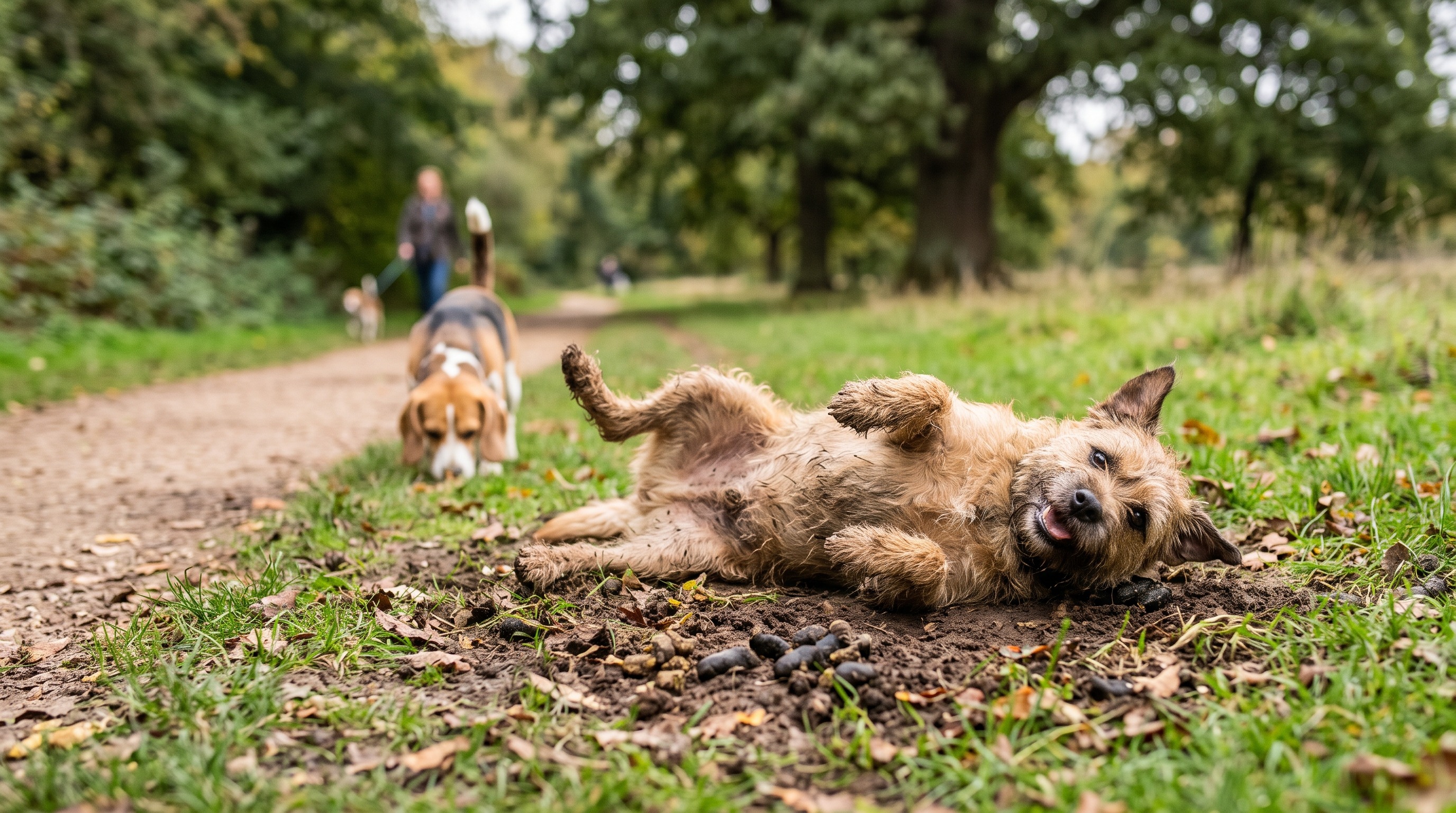
Almost every dog does the same sequence. A sudden, intense sniff that stops them mid-stride. A lowered head. Then the shoulder or the side of the neck drops onto the smell, often followed by the whole back, legs in the air, wriggling with obvious delight. Many dogs get up, sniff again and go for a second round.
The favourites are remarkably consistent across dogs: fox faeces, dead fish, rotting birds or small mammals, other animals’ droppings, and sometimes things that are merely new and strong, like fresh fertiliser or a perfumed patch of grass. It is the neck and shoulder that go down first, which matters for the theories below.
The three main explanations
1. Masking their own scent. The oldest idea is that a predator smelling of dead fish or fox is harder for prey to detect. It fits the neck-first rolling pattern and the fact that wild canids do it too. The weakness: prey animals like deer are wary of predator smells in general, so smelling of fox is not obviously better camouflage than smelling of dog. Most behaviourists treat this as plausible, not settled.
2. Collecting a scent to share. Observations of captive wolves have described animals rolling in novel smells - including things with no hunting value at all, like perfume or motor oil - and pack members then showing intense interest in the returning wolf. On this reading, the roll is a way of carrying information home: “something interesting is out there.” It explains why dogs roll on smells that are new rather than useful.
3. It simply feels good. Dogs live in a world of scent at a resolution humans cannot imagine, and a powerful new smell may be as rewarding for them as a favourite song is for us. This is the least dramatic explanation and probably part of every roll, whatever else is going on.
These are not mutually exclusive. A reasonable honest summary is: rolling is an inherited canine behaviour, likely serving some mix of scent communication and scent enjoyment, and the exact balance probably varies by dog and situation. Similar “it is normal, the why is debated” territory covers why dogs eat grass.
Is it a problem?
For most dogs, most of the time, it is an unpleasant bath rather than a health issue. The situations worth taking seriously are the ones where rolling comes with contact or ingestion:
- Carcasses. Dead animals can carry bacteria and parasites, and dogs that roll often also take a bite.
- Other animals’ faeces. Wildlife droppings, including fox faeces, can carry parasites. Your vet can tell you which ones are relevant where you live and whether your dog’s parasite control covers them.
- Chemicals. A roll on a treated lawn, an oil patch or a spill is a different situation from a roll on a dead fish. Contact your vet or a pet poison helpline if you are unsure what it was.
- Skin reactions. Redness, scratching or hot spots in the days after a roll deserve a vet check rather than home experimenting.
If you are wondering whether something counts as urgent, our guide to when to go to the emergency vet is a sensible starting point - and when in doubt, phone.
Cleaning up after a roll
The realistic goal is to get the smell and residue off without irritating the skin:
- Deal with it promptly. Residue dries into the coat and gets harder to lift.
- Use a dog-appropriate shampoo. Human shampoos are formulated for human skin and can irritate dogs. Lather the neck and shoulders first, since that is where most rolls land.
- Rinse thoroughly. Leftover shampoo causes its own itch. Our home grooming guide covers bathing and drying technique by coat type.
- Protect eyes and ears. Keep suds and dirty water out of both.
- Skunk spray is its own category. Tomato juice mostly masks the odour rather than removing it. Ask your vet what they recommend for skunk exposure, especially if the spray hit the face or eyes.
Fox faeces is notoriously sticky and may take more than one wash. That is normal - it does not mean something is wrong with the coat.
How to reduce the rolling
You are unlikely to remove the instinct, but you can make successful rolls much rarer.
Learn the pre-roll. The warning signs are reliable: the sudden stop, a deep focused sniff, head lowering and the first dip of the shoulder. You usually get one or two seconds. That is enough if you are watching.
Train an interrupter before you need it. A strong recall and a “leave it” taught with high-value rewards at home, then practised in easy outdoor settings, give you something to say in that one-second window. Reward generously when the dog chooses you over the smell - you are competing with something they find extremely rewarding.
Manage the hotspots. Beaches after a storm, fields where foxes cross, riverbanks in fish season: a long line in known rolling spots prevents the practice that makes the habit stronger.
Meet their scent needs elsewhere. Sniff walks, scatter feeding and simple scent games give the nose legitimate work. A dog whose sniffing needs are met is not guaranteed to stop rolling, but many owners notice fewer frantic dives. Our exercise needs helper can help you gauge whether your dog is getting enough activity overall.
Do not punish after the fact. A dog scolded as it comes back from a roll learns that coming back is unpleasant, not that rolling is. That damages recall - the one tool that actually prevents rolls.
The honest bottom line
Rolling in smelly things is one of the most normal things a dog can do. The science on why is still partly theory, the practical answers are not: watch for the pre-roll, build a recall worth listening to, manage the worst spots, bathe gently, and bring your vet in when a roll involves carcasses, chemicals or skin that does not settle.