Why Dogs Tilt Their Heads
The head tilt is not a dog trying to look cute. The best evidence links it to listening and recalling something meaningful, with ear position and muzzle shape as possible extras. What the research found, what is still a guess, and how a normal tilt differs from one that needs a vet.
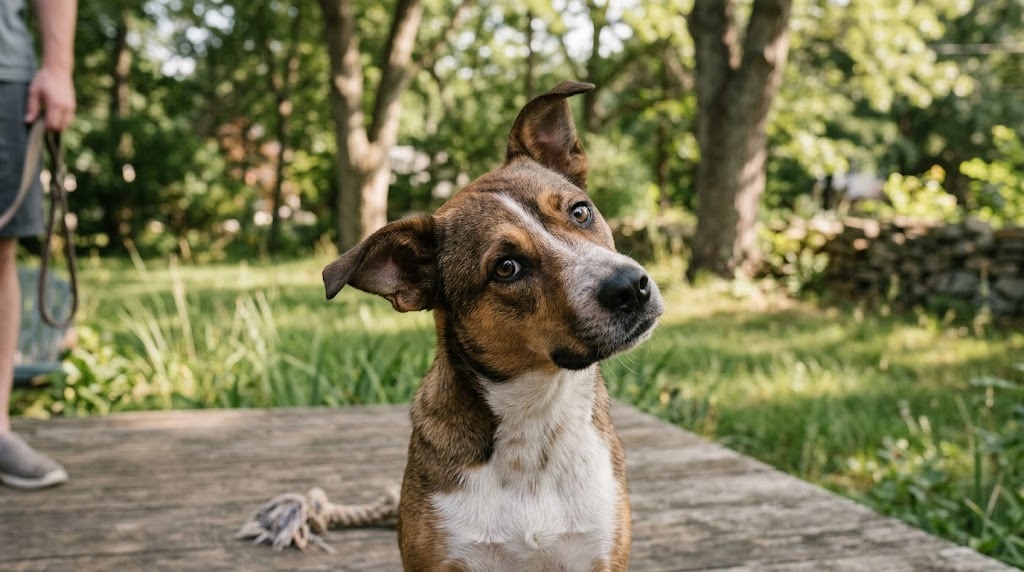
On health questions, we are not the authority. A brief tilt while a dog is listening is normal behaviour. A head that stays tilted, or a tilt that comes with stumbling, circling, flicking eyes, vomiting, ear scratching or head shaking, is a medical sign - the Cornell Riney Canine Health Center and the Merck Veterinary Manual both describe it as a typical sign of ear and balance-system problems. Your veterinarian is the right person to assess it. We do not give veterinary advice - this piece is about reading normal behaviour.
The short version: a dog that tilts its head when you speak is most likely concentrating on a sound that means something to it. The one proper study on the subject found that dogs tilt far more often when they hear a word they have learned and are working out what it refers to. Better hearing and a clearer view of your face are plausible extras, but they are less well supported than most articles suggest.
It is not a trick, and it is not a sign of confusion in the sense of “I have no idea what you said”. It looks more like the opposite.
What the research actually found
For a behaviour this famous, there is surprisingly little science. The main piece is a 2022 paper in Animal Cognition by a team at Eötvös Loránd University in Budapest. They did not set out to study head tilts at all - they were testing whether dogs could learn the names of toys, and noticed the tilting on video.
The study followed 40 dogs. Most were ordinary family dogs that failed to learn toy names. Seven were what the researchers call gifted word learners - dogs, mostly Border Collies, that could reliably fetch a named toy from another room. When the owner asked for a toy by name:
- the gifted dogs tilted their heads in roughly 43 percent of trials
- the typical dogs tilted in about 2 percent
Both groups heard the same kind of request in the same setting. The difference was whether the word meant something to the dog. The authors suggest the tilt may go with increased attention or with matching a word to a remembered image of the object.
A second detail is worth knowing: each dog tended to tilt to the same side, and that side stayed stable across months of testing. That kind of consistent side preference shows up in other dog behaviours too, such as which paw a dog reaches with or the direction of a tail wag.
The honest limits: seven gifted dogs is a tiny sample, the finding was a by-product of another experiment, and it tells us when tilting happens rather than why. It is the best data available, not a final answer.
The hearing explanation
The older and most repeated idea is that a dog tilts its head to locate a sound. Dogs find the source of a sound partly by comparing when and how loudly it reaches each ear. Changing the angle of the head changes that comparison, which can help with judging whether a sound comes from above or below.
This is reasonable physics, and it fits the fact that odd, high or unfamiliar sounds - a squeaky toy, a whistle, a strange voice on a phone - are classic tilt triggers. But it has not been tested directly in dogs. Dogs also have mobile ear flaps that do much of this work already, so the tilt may add less than the theory assumes.
The muzzle explanation
Psychologist Stanley Coren proposed that a dog’s muzzle blocks part of its view of your face, especially the mouth, and that tilting helps it see more. He ran an informal online survey of 582 owners: about 71 percent of owners of longer-muzzled dogs said their dog tilted often, against about 52 percent for flat-faced breeds.
That gap points in the direction he predicted, but it is modest, it relies on owners’ impressions, and it was never published as a peer-reviewed study. Flat-faced dogs clearly tilt too. Treat this one as an interesting idea, not an established cause.
Did we teach them to do it?
Partly, probably. Almost everyone reacts to a head tilt with a smile, a softer voice or a treat. Dogs are very good at repeating whatever earns that reaction. A dog that tilted for its own reasons as a puppy can end up doing it more because it works on you.
This does not make the behaviour fake. It means an instinctive response and a learned one can stack up in the same dog. It also explains why some dogs tilt constantly and others, equally bright, almost never do. A dog that rarely tilts is not less attentive - like following you from room to room, it is a habit that varies a lot between individuals.
Normal tilt or a problem?
This is the part worth remembering. The two look quite different once you know what to watch for:
- A listening tilt is brief. It appears when there is a sound or you are speaking, lasts a second or two, and the head returns to level. The dog is otherwise moving and behaving normally.
- A medical tilt stays. The head is held to one side while the dog is resting, walking or eating, with no sound to explain it.
Veterinary sources describe a persistent tilt as a sign that something is affecting the ear or the balance system. Ear infections are a common cause. So is vestibular disease, which is seen most often in older dogs and can come on suddenly with loss of balance and rapid eye movements. Only an examination can tell these apart from rarer causes, which is why a head that stays tilted is a question for your vet rather than for an article.
Age matters for context. Sudden balance problems are more common in senior dogs, and our dog age calculator can help you place your dog’s life stage. If an older dog also seems disoriented at night or forgets familiar routines, our overview of cognitive decline in dogs lists the changes worth writing down before the appointment.
What to do with this
Mostly, enjoy it. A tilt during conversation suggests your dog is paying attention to you and, quite possibly, recognising a word.
If you want more of that engaged look, give the dog more words that mean something. Naming toys and asking for them one at a time is the same game the Budapest team used. Most dogs will not learn dozens of names - the gifted learners are rare - but the practice is good mental work either way, and a food puzzle or a simple hide-and-find game does a similar job.
And keep the one distinction in mind: short and tied to a sound is behaviour, constant and tied to nothing is a question for your veterinarian.
🛒 Recommended Gear on Amazon
- Dog puzzle toys - browse current options and reviews on Amazon.
- Plush toy sets for name games - browse current options and reviews on Amazon.
As an Amazon Associate, we earn from qualifying purchases - at no extra cost to you. This helps us keep producing free, in-depth guides.