Why Your Dog Follows You Everywhere
The short answer: following is normal dog behaviour, not a problem, and most velcro dogs are simply doing what their species does. Here is how to tell ordinary shadowing apart from the kind that needs a professional look.
Please read this first. Sudden clinginess in a dog that was previously independent can have medical roots, including pain, failing eyesight or hearing, and age-related cognitive change. This article is a reading guide to help you tell ordinary behaviour from a change worth investigating - it is not veterinary or behavioural advice, and we do not give any. If your dog’s shadowing is new, escalating, or paired with any other change, your own vet is the right first call.
The short answer: a dog that follows you from room to room is usually just being a dog. Domestic dogs are a social species that evolved alongside humans for something in the range of 15,000 to 30,000 years, and staying near the group is the default setting, not a malfunction. Most “velcro dogs” are healthy, well-adjusted animals whose owners have simply noticed something that was always there.
What matters is not whether your dog follows you. It is whether the following is calm or frantic, lifelong or new, and whether the dog can settle when you are out of sight.
The ordinary reasons, ranked by how common they are
Social default. Group-living animals stay with the group. Your dog does not experience the bathroom door as a boundary, it experiences it as the group splitting up. Nothing is wrong.
You are the source of everything. Food, walks, doors, toys, and attention all originate from a human. Following the human is, from the dog’s point of view, an efficient strategy. It has been reinforced thousands of times without anyone deciding to train it.
Breed history. Herding and companion breeds were selected for close, continuous handler contact. Border Collies, Shetland Sheepdogs, Vizslas, and most toy breeds shadow more than average, and that is the job description, not a fault. Livestock guardians and many northern breeds shadow less. Neither is better.
Boredom. An under-stimulated dog follows because you are the most interesting thing in the house. If your dog trails you on a rainy day but settles on the sofa after a long walk, you have your answer, and the fix is more to do rather than less contact. A lick mat or food puzzle gives a dog something to do that is not you.
Life stage. Puppies under roughly six months shadow heavily as part of normal attachment. Many loosen up on their own between six and twelve months. Older dogs often become more shadowing again, which is a different story and covered further down.
Following is not the same as anxiety
This is the distinction that actually matters, and it is easy to make from the sofa.
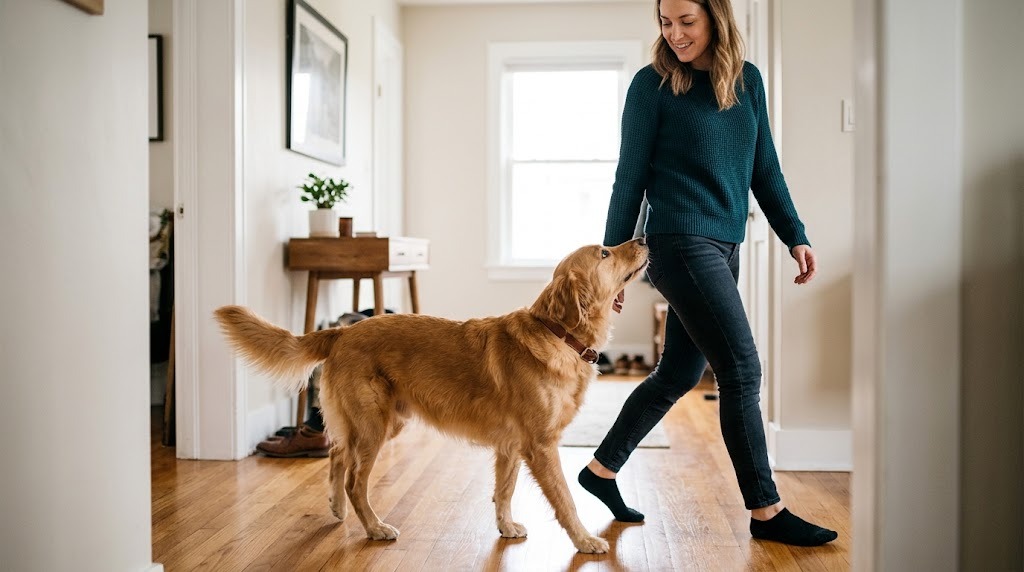
A shadowing dog moves with you, lies down, and rests. Ears soft, breathing normal, eyes half closed. It will get up when you move and settle again when you stop. It might sigh at you for going up the stairs. That dog is relaxed and merely sociable.
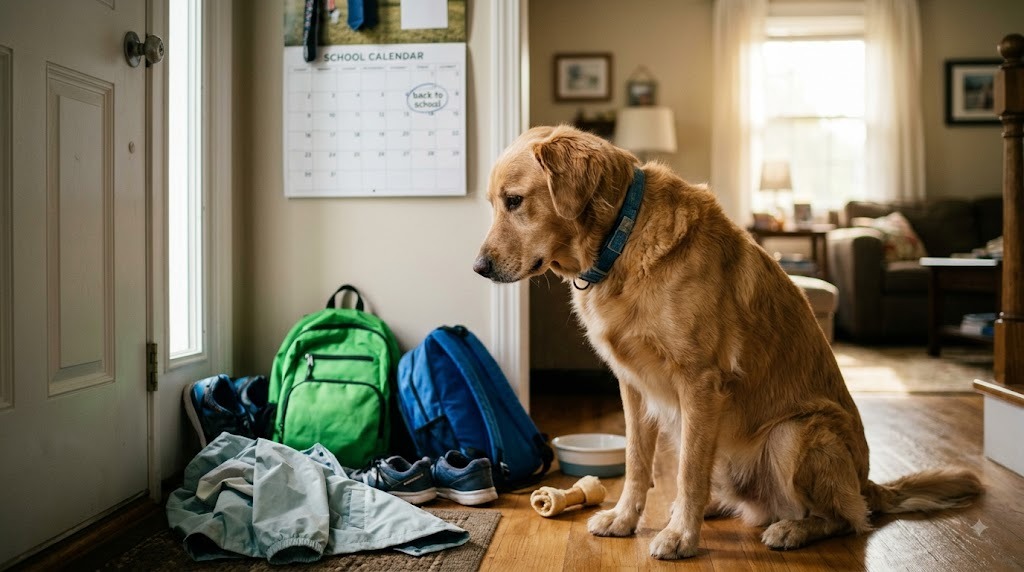
An anxious dog cannot settle. It paces, whines, blocks doorways, watches you constantly rather than dozing, and shows real distress the moment a door closes. Pacing, drooling, panting when it is not hot, destruction focused on exits, and vocalising that starts within minutes of your leaving all point somewhere else entirely. That is a pattern worth a professional conversation, and we have written a separate reading guide on the seasonal version of it in back-to-school separation anxiety.
The single most useful test costs nothing: set a phone or pet camera recording and leave the house for twenty minutes. A dog that shadows you all evening and then sleeps quietly for the whole recording does not have a separation problem. A dog that starts panicking at minute two does, and no amount of doorway training substitutes for a proper assessment.
When new clinginess is worth a vet call
Behaviour that changes is more informative than behaviour that has always been there. Flag it if the shadowing is:
- New in an adult dog that used to nap alone happily
- Paired with any physical change - stiffness, reluctance on stairs, appetite change, toileting accidents, bumping into furniture
- Worse at night, especially in a dog over about eight, or over six in giant breeds
- Accompanied by disorientation, staring at walls, or getting stuck in corners
- Escalating week on week rather than holding steady
Pain is a common and badly under-recognised driver of sudden clinginess, and so is declining vision or hearing, because a dog that can no longer track you across the room will physically follow instead. Age-related cognitive change is another, and there is a real, well-documented condition behind it that your vet can assess. We keep a reading guide on the signs in cognitive decline in dogs. None of these are things to diagnose from a blog post, including this one.
What to do if you simply want more space
If the dog is relaxed and you just want to make a cup of tea alone, this is a training question, not a behaviour problem.
Build value in a spot that is not you. A bed near where you usually sit, fed with something good several times a day while the dog is already lying on it, becomes a place worth choosing. The dog learns that the bed pays, and it pays whether or not you are looking.
Practise short, boring absences. Step behind a door for three seconds, come back, say nothing. Then ten seconds. Then thirty. Undramatic departures and undramatic returns teach the dog that doors are not events. Keep the steps small enough that the dog never gets worried, because a worried repetition teaches the wrong lesson.
Meet the exercise and sniffing need first. A dog that has had a proper decompression walk has far less reason to audit your movements. Twenty minutes of free sniffing is worth more than the same twenty minutes of heel work for this specific purpose.
And accept the ceiling. Some dogs, especially the herding breeds, will never be the sort that sleeps in another room. That is not a training failure, it is what they were bred to do.
The honest summary
Most shadowing needs no fixing. Ask three questions: has this always been true, can the dog rest while it shadows, and can the dog cope when you actually leave. Three yeses mean you have a sociable dog. Any no, and particularly a recent change in an adult dog, is a reason to book a vet appointment rather than to search for training tips. Related reading on the noisy end of the same spectrum lives in how to stop dog barking.
🛒 Recommended Gear on Amazon
- Puzzle toys - browse current options and reviews on Amazon.
- Dog bed - browse current options and reviews on Amazon.
- Indoor gate - browse current options and reviews on Amazon.
As an Amazon Associate, we earn from qualifying purchases - at no extra cost to you. This helps us keep producing free, in-depth guides.