Back-to-School Separation Anxiety in Dogs
The short answer: it is not the empty house that upsets the dog, it is the sudden change. A dog that had company all summer needs a two-week fade-out, not a cold-turkey Monday morning. Here is how to run one.
Please read this first. True separation anxiety is a recognised behavioural disorder, not a training failure, and it sometimes overlaps with pain, cognitive decline or other medical problems. This article is a reading guide to help you spot the pattern and find the right professional - it is not veterinary or behavioural advice, and we do not give any. If your dog panics when left alone, talk to your own vet, who can rule out medical causes and refer you to a qualified behaviourist.
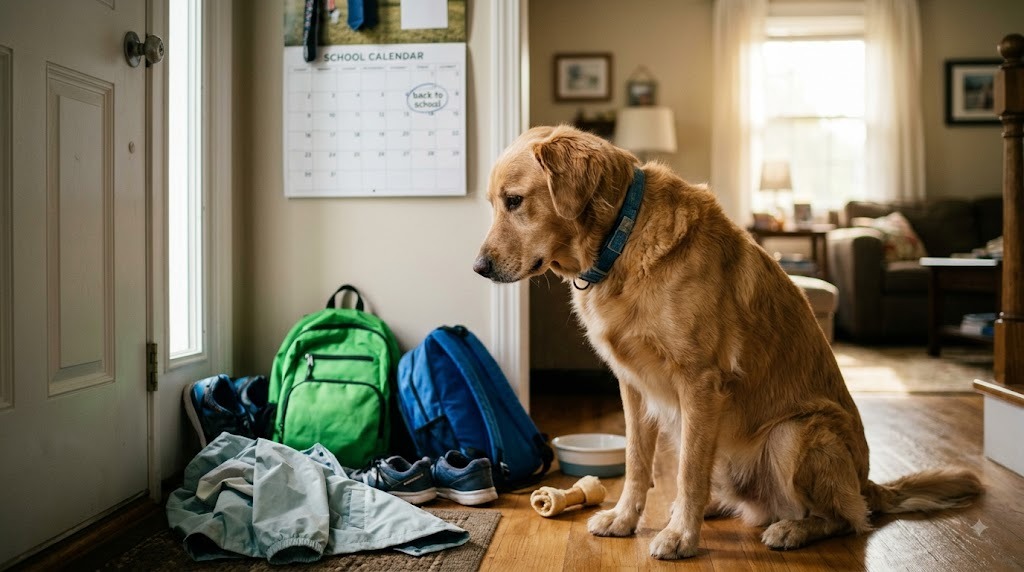
The short answer: the thing that upsets most dogs in late August is not solitude itself, it is how fast solitude arrives. A dog that spent ten weeks with someone home almost every hour goes, on a single Monday morning, to six or eight hours alone. Nothing about the house changed. The schedule changed, overnight, by 100 percent. Dogs cope badly with cliffs and well with slopes, so the fix is to build a slope: start shortening the company two weeks before term, in small steps, and make departures dull long before they become long.
Below is what the pattern looks like, what to do about it while you still have time, and where the line sits between ordinary adjustment and something that needs a professional.
What you are actually looking at
Not every unhappy dog has separation anxiety. Three different things get the same label, and they need different responses.
- Boredom. The dog is fine being alone but has nothing to do. Signs: chewing that starts hours in, a nap-then-mischief pattern, calm greetings when you return.
- Frustration or under-exercise. The dog is wound up rather than frightened. Signs: pacing, barking at the window, destruction concentrated on things that move or make noise.
- Genuine distress. The dog is panicking. Signs: drooling, trembling, refusing food the whole time you are out, scratching at doors and window frames until paws or teeth are damaged, house-soiling in an otherwise reliable dog, and vocalising that begins within a minute or two of the door closing and does not stop.
The last one is the one that needs help. It is also the one people miss, because the evidence looks like naughtiness. A dog that destroys the doorframe specifically - the exit point - and not the sofa is telling you something different from a dog that shreds a cushion.
The only honest way to know which you have is to record it. Set a phone or a pet camera on the room and watch the first twenty minutes back. Almost all the diagnostic information is in that window.
Why the last two weeks of August matter
Summer builds habits quietly. Someone is home for lunch. The dog follows a child from room to room all day. There are three walks instead of one. Then term starts and every one of those things stops at once, usually in the same week the house also gets louder at 7am and emptier at 8:30.
This is why plenty of dogs who were fine last spring struggle in September. Nothing is wrong with them - they simply learned a summer routine very well, and it is being deleted without notice.
You have roughly two weeks. That is enough, if you use them.
Build the slope: a two-week fade-out
The principle is simple. Alone time should get longer gradually, and it should stop predicting anything dramatic.
- Reintroduce alone time now, in minutes. Leave the house for five minutes. Come back, ignore the fuss for thirty seconds, then greet normally. Repeat two or three times a day.
- Extend unevenly. Five minutes, then twenty, then ten, then forty. A random ladder teaches “you always come back”. A steadily rising one teaches the dog to count.
- Move the routine to term-time hours this week, not next. Feed, walk and settle the dog at the times that will apply in September, even while everyone is still home.
- Practise the boring version of leaving. Pick up keys, put on shoes, open the door - then sit back down. Do it until those cues mean nothing.
- Separate inside the house too. A closed door between dog and family for fifteen minutes while everyone is home is one of the most useful exercises there is, and the least used.
- Rehearse the real thing once. In the last few days, do a full-length absence that matches an actual school day, and check the footage.
If your dog shadows one particular person, run steps 1 to 5 with that person leaving, not whoever is most convenient.
Make the empty house worth something
Alone time is easier when it is not just an absence.
- Give a genuinely long-lasting chew or a stuffed, frozen lick mat at the moment of departure, not five minutes before. Licking and chewing are self-soothing behaviours.
- Exercise before departure, not after. A dog that has already worked usually sleeps through the first hours.
- Leave background sound - talk radio or a podcast beats silence, which makes every noise in the street an event.
- Give the dog a defined resting place with a view of the door if it likes one, or away from the window if street traffic winds it up. Watch the footage; the dog will tell you which.
- Keep departures and returns flat. No emotional goodbye, no reunion party. Boring is the goal.
What does not help: a second dog acquired specifically as company (dogs with separation distress are usually attached to a person, not to canine company), scolding the mess on your return, or a crate introduced for the first time in the same week the schedule changes. If crate training is on your list, it is a separate project with its own timeline - see our dog crate guide before you start.
When to stop DIY and get help
Some cases will not be trained away by a fade-out, and pushing harder makes them worse. Contact your vet, and ask about referral to a certified behaviourist, if you see any of the following:
- Self-injury: broken nails, bloodied paws, damaged teeth, wounds from escape attempts.
- Panic that starts before you leave, while you are still getting ready.
- A dog that will not eat or drink at all in your absence, over multiple days.
- Any sudden onset in an adult dog that was previously fine - that pattern can point to pain, sensory loss or age-related cognitive change rather than anxiety.
- No improvement after two to three weeks of consistent, gradual work.
Your vet is the right first call in all of those cases, not the internet and not us. They can check for medical causes first, which is the step people skip, and then point you at someone qualified. For milder cases, structured help from a professional trainer is often faster than solo trial and error - our overview of online training programmes explains what those actually cover.
The short version
Start now, not on the first day of term. Shorten the company gradually, shift the routine early, make departures dull, and film one full rehearsal so you know what you are dealing with. Ordinary adjustment settles within a couple of weeks. Genuine panic does not, and that is a conversation for your vet - it responds well to proper treatment, and badly to waiting it out.
More on reading canine stress signals in our guide to natural calming approaches, and if the noise complaints have already started, why dogs bark when left alone.