Why Dogs Eat Grass
The short answer: grass eating is common, mostly normal, and rarely the sign of illness people assume it is. Here is what the survey research found, and the small number of situations that are worth a vet call.
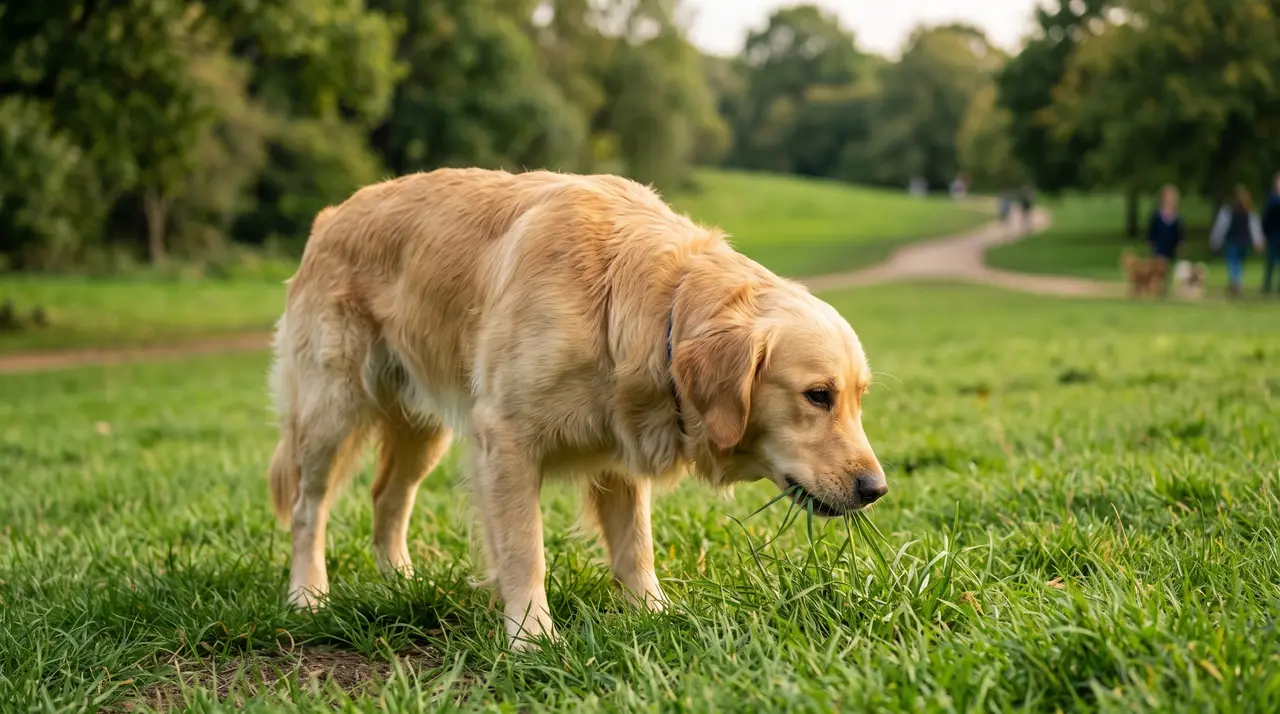
Please read this first. Eating grass overlaps with genuinely medical territory - nausea, gastrointestinal disease, parasites, dietary problems and pica can all look identical from the outside, and lawn treatments and some garden plants are toxic. This article is a reading guide to help you understand what is normal and what is worth investigating; it is not veterinary advice, and we do not give any. Your own vet is the right place for anything about your specific dog, and a poison control service or emergency clinic is the right call if you suspect your dog has eaten something treated or toxic.
The short answer: most dogs eat grass, most of them are perfectly healthy when they do it, and the popular explanation - that a dog eats grass to make itself sick - is not what the available research describes. The behaviour is best understood as ordinary canine foraging rather than self-medication. That does not make it always harmless, but it does mean the default assumption of “my dog is ill” is usually wrong.
What the research found
The most-cited work here is a survey study from researchers at UC Davis, published in 2008, that collected reports from around 1,500 dog owners about plant-eating behaviour. Two findings stand out and both cut against the folk explanation:
- The large majority of dogs ate plants at least occasionally, with a substantial share doing so weekly or more.
- Only a small minority of owners reported that their dog appeared ill beforehand, and only a minority reported vomiting afterwards.
Two smaller preliminary surveys within the same study - one of veterinary students with dogs, one of owners of healthy dogs at the same university clinic - found much the same pattern. The picture that emerges is of a common, usually asymptomatic behaviour, not a sick dog treating itself.
There is also a straightforward evolutionary footnote. Analyses of wolf and other wild canid scat routinely find plant material, so plant eating is well within the normal behavioural range of the species rather than a domestic quirk. Treat all of this as the direction the evidence points rather than a settled explanation - grass eating has not been studied nearly as much as its popularity in dog conversation would suggest.
The ordinary reasons, ranked by how likely they are
Because it is there and it is interesting. Dogs explore the world orally. Fresh spring or post-rain grass has a smell and texture that changes, and many dogs graze the way they sniff - as an activity, not a symptom.
Boredom and under-stimulation. A dog left alone in a garden with nothing else to do will find something to do. Grazing is one of the cheaper options available.
Taste and texture preference. Plenty of dogs are selective, going for one specific type of grass or one patch and ignoring the rest, which is hard to square with an illness-driven explanation.
Attention. If grass eating reliably produces an owner sprinting across the garden, some dogs work that out quickly.
Occasionally, nausea. Some dogs do graze when their stomach is uncomfortable. This exists, it is just not the majority case, and it is the reading of the behaviour that matters most when it is new.
When it is worth a vet call
Frequency and change matter far more than the behaviour itself. Reasons to book an appointment rather than to keep reading:
- Grass eating that is new or has sharply increased in an adult dog
- Grazing that is frantic or compulsive rather than casual
- Any vomiting, diarrhoea, appetite change, weight loss or lethargy alongside it
- Eating non-food items generally - soil, stones, fabric, plastic - which is a different behaviour with its own medical differentials
- A dog straining, retching repeatedly without producing anything, or with a swollen abdomen, which is an emergency-clinic situation rather than a wait-and-see one
- Puppies and senior dogs, where the same behaviour carries more weight
Our reading guide on when to go to an emergency vet covers the signs that do not wait for an appointment slot.
The real risk is usually not the grass
The grass itself is rarely the problem. What is on it and around it can be:
- Lawn treatments. Herbicides, pesticides, fertilisers and slug or snail products are the genuine hazard, and the safe interval after application is stated on the product label - that label, or the manufacturer, is the authority, not general guidance.
- Toxic plants and bulbs growing in the same beds. Toxicity is species-specific and dose-dependent, and the reference sources here are veterinary poison control services and your own vet.
- Parasites. Grass in areas used by other animals can carry parasite stages, which is one reason routine parasite control exists as a veterinary conversation.
- Foxtails and grass awns in some regions, which can migrate into skin, ears, eyes and airways and are a well-known veterinary problem rather than a theoretical one.
- Long tough blades occasionally causing irritation or, uncommonly, an obstruction.
If you are unsure whether a specific plant or food is a problem, our can they eat it tool is a starting point for looking things up, and your vet or a poison control line is the answer for anything urgent.
What to do if you simply want less of it
If your dog is healthy and you just want less grazing, this is a management and enrichment question rather than a medical one. More sniffing time on walks, food-based enrichment at home, and something to do in the garden all reduce the amount of unsupervised grazing available. Interrupting and redirecting works better than punishing, since a dog that is punished mid-graze often just learns to do it out of sight. And for dogs on the compulsive end, this is a behaviour question worth taking to a vet or a qualified behaviourist rather than solving from articles.
In short
Grass eating is normal in dogs, widespread, and mostly uninteresting. The old story about dogs eating grass to induce vomiting is not what the surveys describe. Ask three questions instead: is this new, is it frantic, and is anything else about the dog different. Three noes and you have a dog doing dog things. Any yes, and the useful next step is your vet, not more reading - including this page.
Recommended Gear on Amazon
- Slow feeder bowl - browse current options and reviews on Amazon.
- Lick mat - browse current options and reviews on Amazon.
- Pet grass kit - browse current options and reviews on Amazon.
As an Amazon Associate, we earn from qualifying purchases - at no extra cost to you. This helps us keep producing free, in-depth guides.