How to Stop a Dog Digging
The short answer: dogs dig for a reason - heat, boredom, prey, escape or instinct - and you stop it by fixing that reason, not by scolding the hole. Here is how to find the why and redirect it.
 AI illustration
 The short answer: dogs dig for a specific, identifiable reason - to cool down, burn energy, chase something underground, escape, or simply because the breed is wired for it - and you stop the digging by removing or redirecting that reason, not by filling holes or telling the dog off after the fact. Punishing a dog it finds a fresh hole teaches nothing except to dig when you are not looking. Find the why, meet the need a better way, and the holes stop.
Summer is peak digging season, and that is a clue in itself. Below is how to read what your dog is telling you and what actually works.
First, work out why your dog digs
Digging is a symptom. The same hole can mean five different things, and the fix is completely different for each.
- Cooling off. In warm weather many dogs dig a shallow pit in shade and lie in the cool soil. The giveaway: holes appear in shady spots, near the house foundation, or under a deck, and your dog flops straight into them.
- Boredom and excess energy. An under-exercised, under-stimulated dog invents its own job. The giveaway: random holes all over the yard, worse on days the dog got no walk.
- Prey drive. Some dogs smell moles, voles, grubs or insects and dig to reach them. The giveaway: focused, obsessive digging in one spot, often along tunnels or garden beds.
- Escape. Digging under a fence line is about getting out - to a bitch in heat, a distraction, or the neighbour’s dog. The giveaway: holes concentrated at the fence, usually in one corner.
- Instinct and breed. Terriers, dachshunds, huskies and many northern breeds dig because it is hardwired. You will manage this one rather than erase it.
Watch where and when the holes appear for a few days before you do anything. The pattern names the cause.
Cooling and comfort digging
If your dog is digging to escape the heat, the hole is a good idea badly located - it means your dog is too hot. Fix the heat, not the dog.
- Provide dense shade that lasts all day, not just morning shade that disappears by noon.
- Offer a raised cot bed or a clam-shell pool of cool water.
- Bring the dog in during the hottest hours.
Heat also raises a safety question. Heavy panting, drooling, wobbliness or collapse are signs of overheating, which is an emergency, not a behaviour problem - our first-aid page points you to what to watch for, and anything beyond mild you take to a vet, not a training manual. We do not give medical advice here.
Boredom digging
Many yard-destroying dogs are simply under-worked. Digging is entertainment, and it is a very good game - it moves, it changes, it smells interesting. To out-compete it you have to offer something better.
- Exercise first. A genuinely tired dog rarely excavates. Match the amount to the breed; our exercise needs helper gives a realistic daily target for your dog’s type and age.
- Add brain work. Snuffle mats, food-dispensing toys, scatter-feeding in the grass and short training sessions tire a dog faster than a walk alone.
- Do not leave a bored dog alone in the yard for hours. The yard is not a substitute for interaction, and long unsupervised stretches are where most digging habits form.
This is the same principle behind stopping most nuisance behaviours - meet the underlying need and the symptom fades. It is the exact logic we walk through for problem barking too.
Prey-driven and escape digging
Prey drive is hard to beat head-on because the reward is underground and self-delivering. Deny access rather than argue with instinct: fence off garden beds, deal with the mole or grub problem humanely, and supervise so you can interrupt and redirect the moment the dog locks onto a spot.
Escape digging is both a training issue and a safety one - a loose dog is in danger. Reinforce the fence line (buried wire mesh, an L-footer of mesh bent inward at the base, or concrete pavers along the bottom), and address the reason for wanting out. Intact dogs have an extra reason to roam, and a dog left alone all day has more reason to leave. If the digging is bound up with distress at being alone, treat the anxiety itself - our natural calming approaches cover where to start.
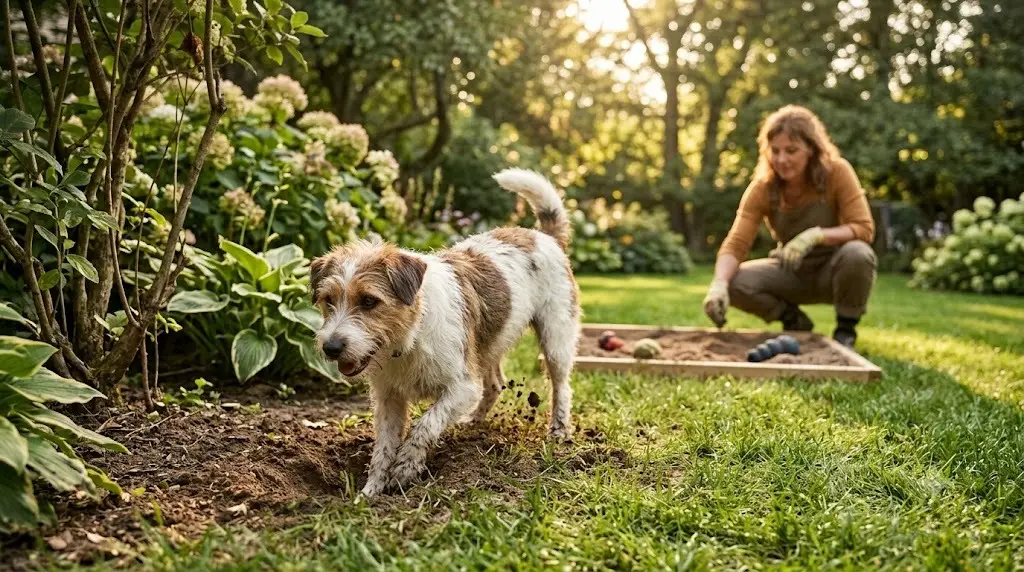
Give instinctive diggers a legal outlet
You will not switch off a terrier or a husky. Give the drive a place to happen instead.
- Build a dig pit: a sandbox or a cordoned patch of loose soil and sand.
- Bury toys and treats in it and “discover” them together so the dog learns this is the spot.
- Praise digging in the pit; calmly interrupt and redirect digging elsewhere.
Given time, many dogs come to prefer the pit, because that is where the good stuff is buried.
What does not work
- Punishing after the fact. A dog cannot connect a telling-off to a hole it dug an hour ago. It just learns you are unpredictable.
- Filling holes with water, poop or chilli. These folk remedies mostly fail, can upset a dog’s stomach, and never address the cause.
- Leaving the dog out longer to “get it out of its system”. More unsupervised yard time makes digging worse, not better.
The bottom line
Digging is a dog solving a problem it has, whether that problem is heat, boredom, a mole, a locked gate or a thousand years of breeding. Spend a few days working out which one it is, fix that specific thing, and give hardwired diggers a pit of their own. Do that and the yard survives the summer. Skip the diagnosis and no amount of filled holes will hold.
Recommended Gear on Amazon
- Sandbox digging pit - browse current options and reviews on Amazon.
- Durable chew toys - browse current options and reviews on Amazon.
As an Amazon Associate, we earn from qualifying purchases - at no extra cost to you. This helps us keep producing free, in-depth guides.