Irish Wolfhound
The Irish Wolfhound is a giant, rough-coated sighthound from Ireland.
Updated: November 2026
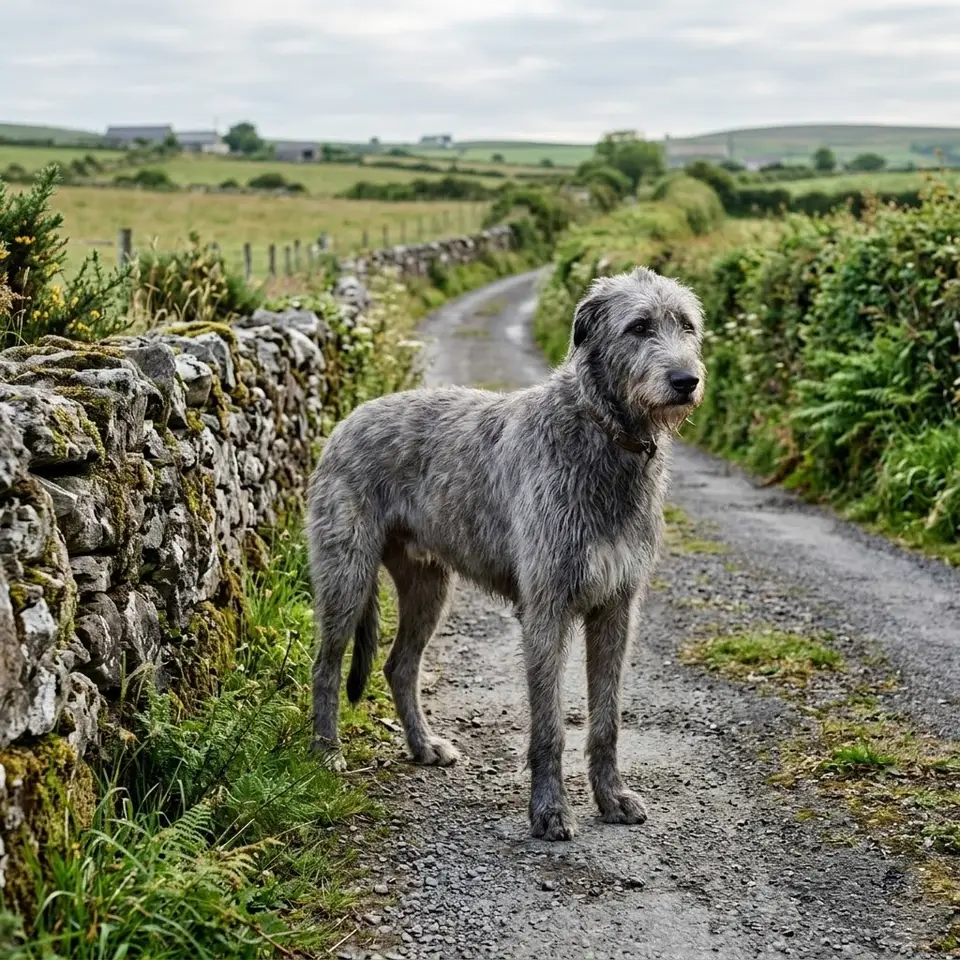 AI illustration
Overview
The Irish Wolfhound is a giant, rough-coated sighthound from Ireland. The Royal Kennel Club describes it as a gentle giant, the tallest of all the breeds (Royal Kennel Club). Its breed standard asks for a dog of great size, strength, symmetry and commanding appearance, very muscular yet gracefully built (Royal Kennel Club).
History & Origins
The Royal Kennel Club's account is that Phoenician sailors are thought to have brought greyhound-type dogs from the Middle East to Ireland, where crosses with Mastiffs produced a dog of gigantic size with the speed and strength to see off the wolves that threatened livestock (Royal Kennel Club). By the end of the 18th century the wolf was extinct in Ireland and the breed's numbers dwindled, and with the Great Famine of the 1840s it became very rare (Royal Kennel Club).
A group of devotees led by the Scotsman Captain George Augustus Graham then developed a breeding programme to revive the breed from the few surviving dogs, using outcrosses to the heavier type of Deerhound, the Great Dane and the Tibetan Mastiff (Royal Kennel Club). The breed was once smooth or rough coated, but only the rough-coated variety exists today, and the Royal Kennel Club lists it as a vulnerable native breed (Royal Kennel Club). The FCI lists Ireland as the breed's country of origin and accepted it on a definitive basis on 26 April 1955 (FCI).
Appearance
The Royal Kennel Club's breed standard sets a minimum height of 79 cm for dogs and 71 cm for bitches, and aims for a breed in which dogs average 81-86 cm in height (Royal Kennel Club). It also sets a minimum weight of 54.5 kg for dogs and 40.9 kg for bitches, and notes that a dog might be larger or smaller than the measurements it gives (Royal Kennel Club). In a study of 46 healthy adult Irish Wolfhounds, body weights were 53-85 kg, with a mean of 66.09 kg (Westrup and McEvoy, 2013). A study of 645 adult Irish Wolfhounds screened for heart disease in North America recorded a mean body weight of 64.8 kg (Tyrrell et al., 2020).
Key features in the breed standard (Royal Kennel Club):
- Coat: rough and harsh on the body, legs and head, especially wiry and long over the eyes and under the jaw.
- Head: long and carried high, with a long, moderately pointed muzzle.
- Ears: small and rose-shaped, of fine velvet texture.
- Body: a very deep chest, a wide breast, a back long rather than short and a belly well drawn up.
- Tail: long and slightly curved, well covered with hair and carried low with an upward sweep towards the tip.
- Colour: grey, brindle, red, black, pure white, fawn, wheaten and steel grey are the recognised colours.
Temperament & Character
The breed standard asks for a gentle, kind and friendly nature in a dog of great power, activity, speed and courage (Royal Kennel Club). The Royal Kennel Club's breed page adds that despite his size the Irish Wolfhound is gentle and calm (Royal Kennel Club).
The Royal Kennel Club places the breed in its Hound group, breeds originally used for hunting either by scent or by sight (Royal Kennel Club), and the FCI classes it among the rough-haired sighthounds of Group 10 (FCI). The Royal Kennel Club describes a breed standard as the guideline for the ideal characteristics, temperament and appearance of a breed (Royal Kennel Club); it is not a promise about any one dog.
Care
Coat & Grooming
The Royal Kennel Club lists the Irish Wolfhound as a breed with a medium-length coat that sheds and needs grooming more than once a week (Royal Kennel Club). The coat in the standard is rough and harsh, especially wiry and long over the eyes and under the jaw (Royal Kennel Club).
Exercise & Activity Needs
The Royal Kennel Club lists more than 2 hours of exercise a day for the breed (Royal Kennel Club). Its breed page gives a large house and a large garden as the size of home and garden for an Irish Wolfhound, and the country rather than the town (Royal Kennel Club).
Growing puppies need care with exercise: in a Norwegian study that followed 501 puppies of four breeds, Irish Wolfhounds among them, puppies that walked on stairs in their first 3 months had a higher risk of hip dysplasia, while off-leash exercise in that period was linked to a lower risk (Krontveit et al., 2012). Ask your vet how much exercise suits your puppy.
Health & Lifespan
Average lifespan is 6.2-7.5 years in the three studies that Orleifson and colleagues set side by side: a median of 6.2 years in Great Britain, a mean of 7 years in Norway and a median of 7.5 years in their own questionnaire study of Swedish Irish Wolfhounds (Orleifson et al., 2017). The Royal Kennel Club lists the breed's lifespan as under 10 years (Royal Kennel Club).
A review of the veterinary literature found that mean lifespan estimates for the breed vary between 4.95 and 8.75 years, and noted that right-censored data often bias them (Urfer et al., 2007). In a study of over 350,000 insured Swedish dogs, survival to 10 years of age was lowest in Irish Wolfhounds, 91% of which had died by that age (Egenvall et al., 2005). In the Swedish questionnaire study, the most common causes of death were neoplastic disease (24%), cardiac disease (18%) and respiratory disease (16%), and 37% of the dogs had pneumonia at least once (Orleifson et al., 2017).
The same review names dilated cardiomyopathy, osteogenic sarcoma, gastric dilation and volvulus and diseases of the osteochondrosis spectrum as the diseases reported most often in the breed, and adds that intrahepatic portosystemic shunt plays an important role (Urfer et al., 2007).
- Heart: in a clinical study of 500 Irish Wolfhounds, dilated cardiomyopathy (DCM) was diagnosed in 121 dogs (24.2%), and 106 of them also had atrial fibrillation (Vollmar, 2000).
- Liver shunt: when 566 Irish Wolfhound puppies aged 6 to 15 weeks were screened with a dynamic bile acid test, 19 of them (3.4%) had a portosystemic shunt (Kerr and van Doorn, 1999); a later study found the intrahepatic form familial and likely genetic (van Steenbeek et al., 2009).
- Eyes: the Royal Kennel Club lists eye testing under the BVA/KC/ISDS Eye Scheme among its Best Practice tests for the breed (Royal Kennel Club), and the BVA Eye Scheme uses a panel of veterinary ophthalmologists to examine dogs for inherited and non-inherited eye conditions.
- Genetic diversity: prioritising genetic diversity is the Royal Kennel Club's Good Practice recommendation for breeders of the breed (Royal Kennel Club).
This is not veterinary advice; for any health question, ask your vet.
Health screening
| Test | Dogs NZ accredited breeders | How often |
|---|---|---|
| Eye certificate | Mandatory | Every year |
| Cardiac certificate | Mandatory | Every year |
| Liver shunt | Mandatory | Once, valid for life |
| Thyroid | Mandatory | Once, valid for life |
| DNA profile | Mandatory | Once, valid for life |
| Hip dysplasia | Optional | Once, valid for life |
| Elbow dysplasia | Optional | Once, valid for life |
The table follows the health tests that Dogs New Zealand (Dogs NZ) sets for its accredited Irish Wolfhound breeders (Dogs NZ). In the UK, the Royal Kennel Club lists its own recommended tests for the breed (Royal Kennel Club), and the BVA runs the eye scheme (BVA).
Checked: 14 November 2026
Feeding & Nutrition
We do not give feeding amounts: what an adult Irish Wolfhound needs depends on the food and on the dog, so start from the food's label and your vet. Gastric dilation and volvulus is among the diseases reported most often in the breed (Urfer et al., 2007).
The Merck Veterinary Manual describes gastric dilation and volvulus (bloat) as an acute, life-threatening condition that primarily affects large- and giant-breed dogs (Merck Veterinary Manual). It lists feeding multiple small meals rather than one large meal, restricting exercise before and after meals, decreasing stress at mealtime and avoiding elevated feed bowls among the recommendations that may be given to owners of high-risk breeds, and says such owners should learn the signs and seek immediate veterinary care if they appear (Merck Veterinary Manual). Ask your vet which of these suit your dog.
Best Suited For
Good fit if:
- you can give the more than 2 hours of exercise a day that the Royal Kennel Club lists for the breed (Royal Kennel Club).
- you have the room the Royal Kennel Club gives for the breed: a large house and a large garden, in the country (Royal Kennel Club).
- you want a gentle companion: the breed standard asks for a gentle, kind and friendly nature (Royal Kennel Club).
Think twice if:
- you want a long-lived dog: the Royal Kennel Club lists the breed's lifespan as under 10 years (Royal Kennel Club).
- you want a dog that does not shed: the Royal Kennel Club lists the Irish Wolfhound as a breed that sheds (Royal Kennel Club).
- you are not prepared for heart disease: dilated cardiomyopathy was diagnosed in 24.2% of 500 Irish Wolfhounds in a clinical study (Vollmar, 2000).
Similar breeds
The FCI places the Irish Wolfhound in Group 10 (Sighthounds); the table shows it and five other breeds that the FCI lists in the same group (FCI):
| Breed | FCI standard No. | FCI section | Country of origin | Accepted by the FCI |
|---|---|---|---|---|
| Irish Wolfhound | 160 | Rough-haired Sighthounds | Ireland | 26 April 1955 |
| Scottish Deerhound (FCI: Deerhound) | 164 | Rough-haired Sighthounds | Great Britain | 29 April 1955 |
| Borzoi | 193 | Long-haired or fringed Sighthounds | Russian Federation | 13 January 1956 |
| Saluki | 269 | Long-haired or fringed Sighthounds | Middle East | 8 April 1966 |
| Whippet | 162 | Short-haired Sighthounds | Great Britain | 27 April 1955 |
| Italian Greyhound (FCI: Italian Sighthound) | 200 | Short-haired Sighthounds | Italy | 22 October 1956 |
Checked: 14 November 2026
Everyday gear for dogs
Links go to Amazon or a partner brand's own store and may earn us a commission at no extra cost to you. As an Amazon Associate we earn from qualifying purchases. An Amazon link leads to a type of gear and you choose the exact product; a card that names a store leads to that partner's own shop.
Irish Wolfhound puppy growth chart
A computed growth curve for a giant breed like the Irish Wolfhound, worked out from its adult weight of 53-85 kg. The ends of the curve follow the WALTHAM growth-chart study (Salt et al., PLOS ONE 2017); the points in between are our approximation, not a published table. Puppies vary with sex, genetics and diet, so treat this as a guide - for your own puppy, use the puppy weight predictor.
| Age | Computed weight | % of adult |
|---|---|---|
| 2 mo | 9.5-15.3 kg | 18% |
| 3 mo | 14.8-23.8 kg | 28% |
| 4 mo | 19.6-31.5 kg | 37% |
| 6 mo | 27.6-44.2 kg | 52% |
| 9 mo | 37.1-59.5 kg | 70% |
| 12 mo | 44-70.6 kg | 83% |
| Adult | 53-85 kg | 100% |
Irish Wolfhound - frequently asked questions
How big does an Irish Wolfhound get?
The Royal Kennel Club's breed standard sets a minimum height of 79 cm for dogs and 71 cm for bitches, and aims for dogs that average 81-86 cm in height (Royal Kennel Club). In a study of 46 healthy adult Irish Wolfhounds, body weights were 53-85 kg (Westrup and McEvoy, 2013).
How long do Irish Wolfhounds live?
The Royal Kennel Club lists the breed's lifespan as under 10 years (Royal Kennel Club). In a Swedish questionnaire study of Irish Wolfhounds born between 2006 and 2008, the median lifespan was 7.5 years, and males had a shorter lifespan than females (Orleifson et al., 2017).
Do Irish Wolfhounds shed?
Yes. The Royal Kennel Club lists the Irish Wolfhound as a breed with a medium-length coat that sheds and needs grooming more than once a week (Royal Kennel Club).
Are Irish Wolfhounds good with children?
The breed standard asks for a gentle, kind and friendly nature (Royal Kennel Club). A standard describes the ideal, not a promise about every dog.
Can an Irish Wolfhound live in a flat?
The Royal Kennel Club gives a large house and a large garden as the size of home and garden for the breed, and the country rather than the town (Royal Kennel Club).
Do Irish Wolfhounds have heart problems?
Heart disease is common in the breed: in a clinical study of 500 Irish Wolfhounds, dilated cardiomyopathy was diagnosed in 24.2% of the dogs (Vollmar, 2000), and Dogs NZ requires a yearly cardiac certificate from its accredited breeders (Dogs NZ).
Sources
Sources this profile draws on, as linked in the text:
- Royal Kennel Club(royalkennelclub.com)
- Royal Kennel Club(royalkennelclub.com)
- FCI(fci.be)
- Westrup and McEvoy, 2013(doi.org)
- Tyrrell et al., 2020(doi.org)
- Krontveit et al., 2012(doi.org)
- Orleifson et al., 2017(doi.org)
- Urfer et al., 2007(doi.org)
- Egenvall et al., 2005(doi.org)
- Vollmar, 2000(doi.org)
- Kerr and van Doorn, 1999(doi.org)
- van Steenbeek et al., 2009(doi.org)
- BVA Eye Scheme(bva.co.uk)
- Dogs NZ(dogsnz.org.nz)
- Merck Veterinary Manual(merckvetmanual.com)
- AVSAB(avsab.org)
- 164(fci.be)
- 193(fci.be)
- 269(fci.be)
- 162(fci.be)
- 200(fci.be)
Breed standard:The Royal Kennel Club (UK). A breed standard describes the ideal for the breed; an individual dog may be larger or smaller.
This page is general information, not veterinary advice. For questions about your pet's health, please talk to your vet.
Test yourself: guess the dog
Three clues from our quiz bank, each about another of our dogs. Can you name them?
Clue 1.This rugged, non-shedding working dog has webbed feet and was once a fisherman's helper, even carrying messages between boats.
It's the Portuguese Water Dog - read the full profile →
Clue 2.This fluffy white Arctic dog is famous for a perpetually upturned mouth nicknamed the smile.
It's the Samoyed - read the full profile →
Clue 3.Unmistakable for its egg-shaped head and tiny triangular eyes, this muscular breed was once a long-running beer mascot.
It's the Bull Terrier - read the full profile →
Adoptable Irish Wolfhounds near you
Real dogs of this breed (and close mixes) waiting in shelters and rescues right now, live from Petfinder. We have no affiliation and earn nothing - if someone catches your eye, the link goes straight to their shelter. New to adopting? Start with our adoption guide.
Widget not loading (some ad-blockers hide it)? Search directly on petfinder.com.