Labradoodle
The Labradoodle was bred in Australia in 1989 as a lower-shedding guide dog, combining the Labrador's famous friendliness with the Poodle's clever, curly-coated athleticism.
Last reviewed: October 2026
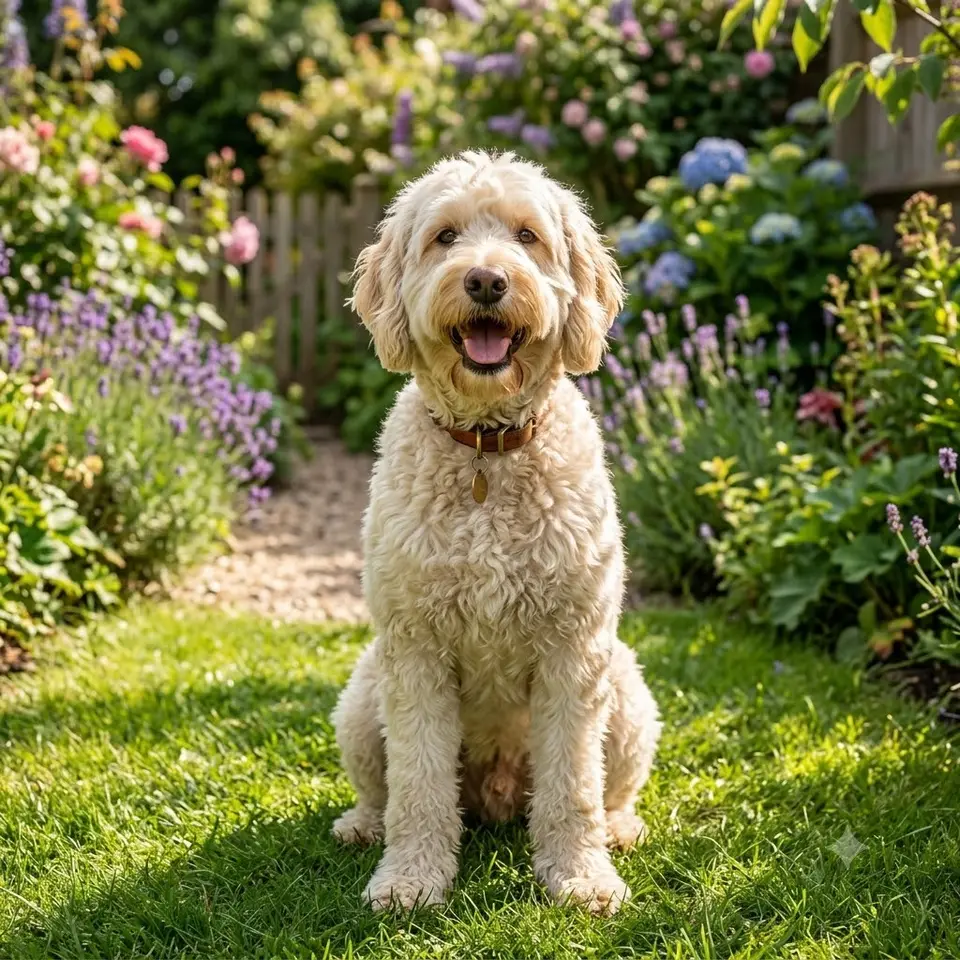 AI illustration
 Overview
The Labradoodle was bred in Australia in 1989 as a lower-shedding guide dog, combining the Labrador's famous friendliness with the Poodle's clever, curly-coated athleticism. Done well it's a superb, social family dog; the caveat of every cross applies: individual pups vary, and no doodle is guaranteed non-shedding.
A designer cross: the Labradoodle is a Labrador Retriever × Poodle mix, not a standardised breed - individuals vary more than purebreds, in coat, size and temperament alike. No study has measured how long this cross lives; for the parent breeds the AKC lists 11-13 years (Labrador Retriever) and 10-18 years (Poodle).
History & Origins
Created by Wally Conron of Australia's Royal Guide Dogs to serve a vision-impaired woman whose husband was allergic. The cross exploded in popularity worldwide - to the point Conron himself lamented the puppy-mill industry it spawned. Buy from health-testing breeders or adopt; doodle mills are everywhere.
ABC News described the first litter in 2019. In 1989 Wally Conron, breeding manager of the Royal Guide Dogs Association of Australia (now Guide Dogs Victoria), mated a Labrador bitch, Brandy, with Harley, a Standard Poodle owned by John Gosling of the same organisation. Of the three pups, only Sultan passed the allergy tests run in Hawaii on coat clippings and saliva, and he went there as a guide dog. The name came from a press appeal when no one wanted the other two. Guide Dogs in the UK still uses the cross: 2% of its working guide dogs are poodle cross Labrador retrievers. A 2020 genetic study of the modern Australian Labradoodle found other breeds in its ancestry and a genome that is mostly Poodle.
Appearance
20-30 kg and 53-63 cm by generation and Poodle parent (standard vs miniature); coats range from Lab-like scruff to full Poodle curl - fleece-wavy is the sought-after middle. Cream, gold, chocolate, black, red. Typical size: Medium-large, 20-30 kg. Coat: Wavy fleece to curly, low-shed (varies!).
Size and coat depend on which Poodle was used. The Royal Kennel Club (UK) standard puts the ideal Labrador at 56-57 cm for dogs and 55-56 cm for bitches, with a short, dense coat "without wave or feathering". It sets the Standard Poodle at over 38 cm and the Miniature between 28 and 38 cm, both with a profuse, dense, curly coat. A Labradoodle can fall anywhere between the two.
Temperament & Character
Friendly, exuberant and people-centred - a social everybody's-friend dog with real energy and a soft mouth-carrying habit from both retrieving parents. Poor guard dog, excellent greeter.
Care
Daily exercise (an hour+, they're two working breeds in one), and the coat is most of the work: wavy/curly coats mat without brushing every other day plus professional grooming every 6-8 weeks. 'Low-shed' never means 'no-groom' - the opposite.
Health & Lifespan
How long the cross lives has not been measured; the overview gives the AKC figures for both parent breeds.
A Royal Veterinary College survey published in 2024 (9,402 dogs aged up to five years) found that Labradoodles had lower odds of hip and/or elbow dysplasia than Labrador Retrievers (odds ratio 0.37) and lower odds of patellar luxation than Poodles, but higher odds of ear infection (otitis externa) than Labradors. Eye screening gives mixed figures: a UK survey from 2008 and 2009 found multifocal retinal dysplasia in 4.6% of the Labradoodles examined, more than in Labradors, while a 2026 Dutch study of 1,182 screened Labradoodles found it in 0.2%. UK primary-care records from 2016 also show raised odds of Addison's disease (hypoadrenocorticism) in the Labradoodle.
For the parents, the AKC lists the breed clubs' recommended tests: hip and elbow evaluations, an eye examination and DNA tests for EIC, CNM and PRA-prcd in the Labrador; hip and eye examinations, a thyroid evaluation and DNA tests for NEwS and von Willebrand disease in the Standard Poodle. We do not give veterinary advice; ask the breeder for the parents' results and talk to your vet.
Feeding & Nutrition
Quality large-breed food measured carefully - both parent breeds are famous gluttons and Labradoodles inherit the appetite. Watch weight from year one.
Pros & Cons
Pros
- Friendly, social, family-proof temperament
- Often (not always) lower-shedding
- Smart and very trainable
- Athletic adventure companion
Cons
- Coat is high-maintenance and unpredictable
- Energy demands real daily exercise
- Doodle-mill breeders are rampant
- No two are quite alike
Best Suited For
- Active families
- Allergy households willing to gamble sensibly (spend time with the dog first)
- First-time owners with time for grooming
- Therapy-dog aspirations
Sources
- ABC News, 2019: the first labradoodle litter, Sultan and the name: abc.net.au
- Guide Dogs (UK), crossbreeds: poodle cross Labrador retrievers, 2% of working guide dogs: guidedogs.org.uk
- Ali et al., PLoS Genetics 2020: genetic analysis of the Australian Labradoodle: doi.org
- Royal Kennel Club, Labrador Retriever breed standard: size and coat: royalkennelclub.com
- Royal Kennel Club, Poodle (Standard) breed standard: size and coat: royalkennelclub.com
- Royal Kennel Club, Poodle (Miniature) breed standard: size: royalkennelclub.com
- Bryson et al., PLOS ONE 2024: health of Cockapoo, Labradoodle and Cavapoo compared with their parent breeds: doi.org
- Oliver and Gould, Veterinary Record 2012: eye abnormalities in UK Labradoodles: doi.org
- Goossens et al., Frontiers in Veterinary Science 2026: hereditary eye disease in Dutch Labradoodles: doi.org
- Schofield et al., Journal of Small Animal Practice 2021: hypoadrenocorticism in UK dogs: doi.org
- AKC, Labrador Retriever: recommended health tests: akc.org
- AKC, Poodle (Standard): recommended health tests: akc.org
Sources opened and checked on 16 October 2026.
Everyday gear for dogs
Links go to Amazon or a partner brand's own store and may earn us a commission at no extra cost to you. As an Amazon Associate we earn from qualifying purchases. An Amazon link leads to a type of gear and you choose the exact product; a card that names a store leads to that partner's own shop.
Labradoodle puppy growth chart
A typical growth curve for a large breed like the Labradoodle, estimated from its adult weight of 20-30 kg. Puppies vary with sex, genetics and diet, so treat this as a guide - for your own puppy, use the puppy weight predictor.
| Age | Typical weight | % of adult |
|---|---|---|
| 2 mo | 4.4-6.6 kg | 22% |
| 3 mo | 6.6-9.9 kg | 33% |
| 4 mo | 8.6-12.9 kg | 43% |
| 6 mo | 12-18 kg | 60% |
| 9 mo | 16-24 kg | 80% |
| 12 mo | 18.4-27.6 kg | 92% |
| Adult | 20-30 kg | 100% |
Labradoodle - frequently asked questions
Are Labradoodles hypoallergenic?
No dog is, and Labradoodle coats vary hugely even within a litter. Meet the individual dog first; allergic households should spend real time with it before committing.
F1, F1b - what do the codes mean?
F1 = Lab × Poodle; F1b = F1 bred back to a Poodle (curlier, more reliably low-shed). Higher Poodle content generally means more curl and more grooming.
Health checks to ask for?
Hip and elbow scores plus eye tests on BOTH parents - Labs and Poodles share hip dysplasia and PRA risks, and a cross inherits from both sides.
Test yourself: guess the dog
Three clues from our quiz bank, each about another of our dogs. Can you name them?
Clue 1.Some individuals of this graceful droving breed carry a gene making them dangerously sensitive to certain common medications.
It's the Collie (Rough) - read the full profile →
Clue 2.Named for the Stuart monarch who adored its ancestors, this gentle toy spaniel has long feathered ears and a sweet melting expression.
It's the Cavalier King Charles Spaniel - read the full profile →
Clue 3.This small, perky Scottish terrier has a pure white double coat and was bred to hunt rats and foxes in the Highlands.
It's the West Highland White Terrier - read the full profile →
Adoptable Labradoodles near you
Real dogs of this breed (and close mixes) waiting in shelters and rescues right now, live from Petfinder. We have no affiliation and earn nothing - if someone catches your eye, the link goes straight to their shelter. New to adopting? Start with our adoption guide.
Widget not loading (some ad-blockers hide it)? Search directly on petfinder.com.