Lakeland Terrier
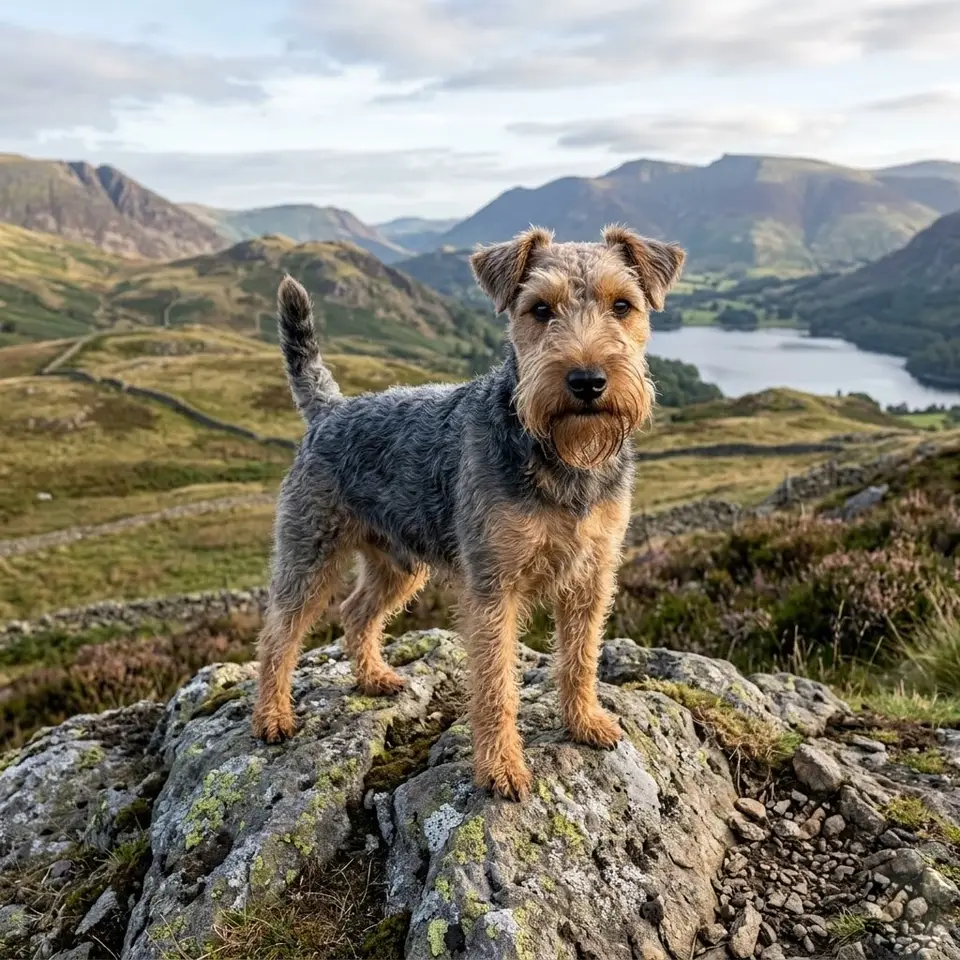
The Lakeland Terrier is a small working terrier from the Lake District in north-west England, bred to run with packs of hounds over steep, rocky fells.
Updated: November 2026
 AI illustration
Overview
The Lakeland Terrier is a small working terrier from the Lake District in north-west England, bred to run with packs of hounds over steep, rocky fells. PDSA gives an average weight of 7-8 kg and an average lifespan of over 12 years (PDSA). The Royal Kennel Club's breed standard gives a height of up to 37 cm at the shoulder (Royal Kennel Club), and the RKC lists the Lakeland as a vulnerable native breed (Royal Kennel Club).
History & Origins
The Royal Kennel Club says that in the counties of Cumberland and Westmorland, the area known as the Lake District, several valleys developed their own type of working terrier, and that the Lakeland Terrier was developed from these (Royal Kennel Club). Behind the breed, according to the RKC, is the Black and Tan Terrier, the root of many English native terrier breeds, perhaps with some input from the Welsh, Border and Fox Terriers, and some suggest Bedlington blood (Royal Kennel Club).
The RKC says the breed was developed to run with packs of hounds and their followers on foot over the steep, rocky fells, so it needed stamina, agility and the courage to bolt or kill fox or badger (Royal Kennel Club). The first breed club was formed in 1912, and The Kennel Club recognised the breed in 1921 (Royal Kennel Club).
Appearance
The Royal Kennel Club's breed standard gives a height not exceeding 37 cm at the shoulder and an average weight of 8 kg for dogs and 7 kg for bitches (Royal Kennel Club). It describes a smart, workmanlike, well-balanced and compact dog (Royal Kennel Club).
Key features in the breed standard (Royal Kennel Club):
- Coat: dense, harsh and weather-resisting, with a good undercoat.
- Colour: black and tan, blue and tan, red, wheaten, red grizzle, liver, blue or black; small tips of white on the feet and chest are tolerated, and mahogany or deep tan is highly undesirable.
- Bearing: a gay, fearless demeanour, keen of expression and quick of movement, "on the tip-toe of expectation".
Temperament & Character
The RKC breed standard describes the Lakeland Terrier's temperament as bold, friendly and self-confident (Royal Kennel Club). The Royal Kennel Club rates it as a small dog that suits a small house and a small to medium garden, in town or country (Royal Kennel Club).
Care
Coat & Grooming
The Royal Kennel Club puts grooming at more than once a week and lists the Lakeland as a breed that does not shed (Royal Kennel Club). The breed standard asks for a dense, harsh, weather-resisting coat with a good undercoat (Royal Kennel Club).
Exercise & Activity Needs
PDSA gives a minimum of one hour of exercise a day (PDSA), and the Royal Kennel Club gives up to one hour (Royal Kennel Club). The RKC history describes a dog bred for stamina and agility on the fells (Royal Kennel Club).
Health & Lifespan
Average lifespan is over 12 years, according to PDSA (PDSA), and the Royal Kennel Club gives the same figure (Royal Kennel Club).
This section lists what the sources report; it is not veterinary advice, so take any health question about your dog to your vet.
What the sources say about the breed's health:
- Genetic diversity - the Royal Kennel Club names prioritising genetic diversity as the minimum it recommends before breeding (Royal Kennel Club).
- Eyes - the RKC lists eye testing with the BVA/KC/ISDS Eye Scheme among its further recommended tests (Royal Kennel Club), and Dogs New Zealand requires a yearly eye certificate from its accredited Lakeland breeders (Dogs NZ).
- Conformation - the Lakeland is in category 1 of the RKC's Breed Watch, which means no points of concern specific to the breed have been identified for special attention by judges (Royal Kennel Club).
Health screening
| Test | Dogs NZ accredited breeders | How often |
|---|---|---|
| Eye certificate | Mandatory | Every year |
| DNA profile | Mandatory | Once, valid for life |
The table follows the health tests that Dogs New Zealand (Dogs NZ) sets for its accredited Lakeland Terrier breeders (Dogs NZ). In the UK, the Royal Kennel Club names prioritising genetic diversity as the minimum before breeding and eye testing as a further test (Royal Kennel Club); the BVA runs the eye scheme (BVA).
Checked: 16 November 2026
Care at a glance
| PDSA | Royal Kennel Club | |
|---|---|---|
| Exercise | At least 1 hour a day (PDSA) | Up to 1 hour a day (Royal Kennel Club) |
| Grooming | Not listed | More than once a week (Royal Kennel Club) |
| Lifespan | Over 12 years (PDSA) | Over 12 years (Royal Kennel Club) |
| Height | 37 cm on average (PDSA) | Not exceeding 37 cm in the standard (Royal Kennel Club) |
| Weight | 7-8 kg on average (PDSA) | Dogs 8 kg, bitches 7 kg on average in the standard (Royal Kennel Club) |
| Minimum cost | £80 a month (PDSA) | Not listed |
Our comparison of the PDSA and Royal Kennel Club breed pages and the RKC breed standard.
Checked: 16 November 2026
Feeding & Nutrition
We do not give feeding amounts: what an adult Lakeland Terrier needs depends on the food and on the dog, so start from the food's label and your vet. WSAVA body condition score charts help the veterinary team assess body condition, a measure of fat stores, at every visit (WSAVA) - ask your vet to score your dog.
Best Suited For
Good fit if:
- You want a small dog: the Royal Kennel Club rates the Lakeland as small and suited to a small house (Royal Kennel Club).
- You prefer a dog that does not shed: the RKC lists the breed as non-shedding (Royal Kennel Club).
- You can walk about an hour a day: PDSA and the RKC both give around one hour (PDSA; Royal Kennel Club).
Think twice if:
- You have little time for grooming: the RKC puts it at more than once a week (Royal Kennel Club).
- You keep small pets: the breed was developed to bolt or kill fox and badger, according to the RKC (Royal Kennel Club).
- You want an easy-to-find breed: the RKC lists the Lakeland as a vulnerable native breed (Royal Kennel Club).
Everyday gear for dogs
Links go to Amazon or a partner brand's own store and may earn us a commission at no extra cost to you. As an Amazon Associate we earn from qualifying purchases. An Amazon link leads to a type of gear and you choose the exact product; a card that names a store leads to that partner's own shop.
Lakeland Terrier puppy growth chart
A computed growth curve for a toy breed like the Lakeland Terrier, worked out from its adult weight of 7-8 kg. The ends of the curve follow the WALTHAM growth-chart study (Salt et al., PLOS ONE 2017); the points in between are our approximation, not a published table. Puppies vary with sex, genetics and diet, so treat this as a guide - for your own puppy, use the puppy weight predictor.
| Age | Computed weight | % of adult |
|---|---|---|
| 2 mo | 2.3-2.6 kg | 33% |
| 3 mo | 3.2-3.6 kg | 45% |
| 4 mo | 3.9-4.4 kg | 55% |
| 6 mo | 5.3-6 kg | 75% |
| 9 mo | 6.7-7.6 kg | 95% |
| 12 mo | 7-8 kg | 100% |
| Adult | 7-8 kg | 100% |
Lakeland Terrier - frequently asked questions
How long do Lakeland Terriers live?
PDSA and the RKC give an average lifespan of over 12 years (PDSA; Royal Kennel Club).
Do Lakeland Terriers shed?
The Royal Kennel Club lists the Lakeland as a breed that does not shed, with grooming more than once a week (Royal Kennel Club).
What colours do Lakeland Terriers come in?
The breed standard lists black and tan, blue and tan, red, wheaten, red grizzle, liver, blue and black (Royal Kennel Club).
When was the breed recognised?
The first breed club was formed in 1912, and The Kennel Club recognised the Lakeland in 1921 (Royal Kennel Club).
Sources
Sources this profile draws on, as linked in the text:
- PDSA(pdsa.org.uk)
- Royal Kennel Club(royalkennelclub.com)
- Royal Kennel Club(royalkennelclub.com)
- Dogs NZ(dogsnz.org.nz)
- BVA(bva.co.uk)
- WSAVA(wsava.org)
- AVSAB(avsab.org)
Breed standard:The Royal Kennel Club (UK). A breed standard describes the ideal for the breed; an individual dog may be larger or smaller.
This page is general information, not veterinary advice. For questions about your pet's health, please talk to your vet.
Test yourself: guess the dog
Three clues from our quiz bank, each about another of our dogs. Can you name them?
Clue 1.This enormous, droopy-jowled mastiff is famed for a calm, affectionate temperament despite its intimidating bulk.
It's the English Mastiff - read the full profile →
Clue 2.Originally a German water retriever, this curly-coated dog comes in standard, miniature, and toy sizes and rarely sheds.
It's the Poodle (Standard, Miniature, Toy) - read the full profile →
Clue 3.This brachycephalic, fawn-or-brindle breed often shows a comically wrinkled forehead and a long, energetic puppyhood.
It's the Boxer - read the full profile →
Adoptable Lakeland Terriers near you
Real dogs of this breed (and close mixes) waiting in shelters and rescues right now, live from Petfinder. We have no affiliation and earn nothing - if someone catches your eye, the link goes straight to their shelter. New to adopting? Start with our adoption guide.
Widget not loading (some ad-blockers hide it)? Search directly on petfinder.com.