Senior Cat Food: What to Compare
What changes for older cats according to the Cornell Feline Health Center - weight gain or loss, dental pain that stops them eating, kidney changes, arthritis - and four 7+ and 11+ cat foods, dry and wet, compared on what their makers publish.
 AI illustration
This is a reading guide to published feline health advice and to what makers state on their own pages. Weight loss, eating less or drinking more in an older cat are reasons to see your vet first: kidney disease, hyperthyroidism and diabetes are common at this age, and some need a prescription diet.
The short answer: there is no single senior diet. What an older cat needs depends on what is happening to it. The Cornell Feline Health Center notes that many cats get heavier or even obese as they age, while others become too thin. Weight loss can come from medical problems such as kidney failure, and special diets may help manage them. Start with a check-up, then choose the food.
What Changes With Age
From Cornell’s overview of the senior cat:
- When it starts. Many cats show age-related changes between seven and ten years, and most by 12.
- Teeth. Dental disease is extremely common in older cats and can make eating painful. Cornell calls dental discomfort a more likely cause of reluctance to eat than a weaker sense of smell.
- Kidneys. Kidney failure is a common disease in older cats.
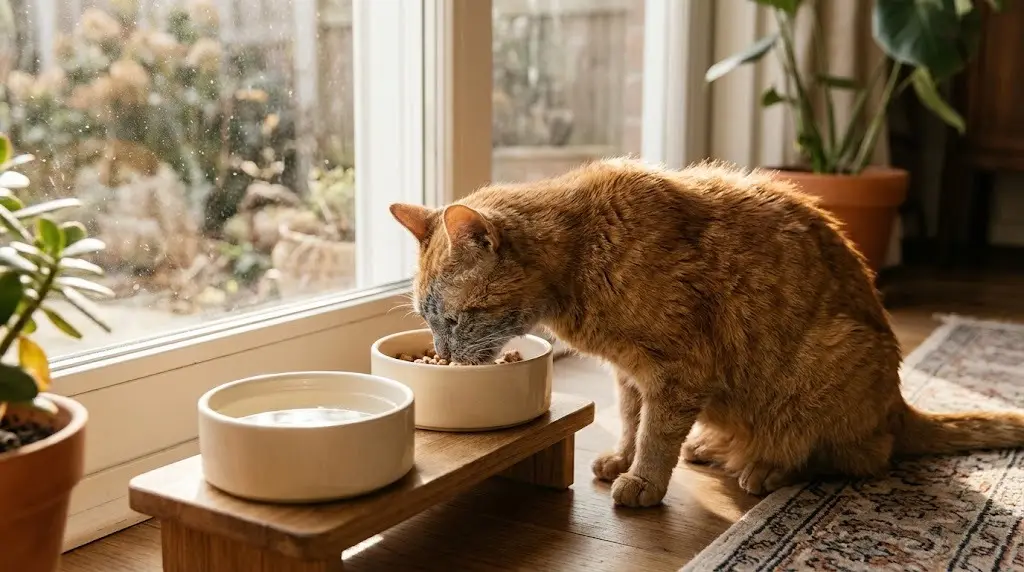
- Joints. Arthritis is common. Most arthritic cats do not limp. They may still struggle to reach food and water bowls that need a jump or a climb.
- Other conditions: hyperthyroidism, high blood pressure and diabetes.
So for an older cat, look at the bowl as well as the bag. Put food and water where the cat can reach them without jumping, and watch whether it chews comfortably.
Four Senior Cat Foods Compared
| Food | Form | First ingredient | What the maker says | Protein | Energy | AAFCO statement | Links |
|---|---|---|---|---|---|---|---|
| Hill’s Science Diet Adult 7+ Indoor, Chicken Recipe | Dry | Chicken | For indoor cats 7 and older; antioxidants and balanced minerals | Hill’s gives dry matter: 34.2% | 324 kcal per cup | Feeding tests, adult maintenance | See on Amazon · Maker’s page |
| Hill’s Science Diet Senior Vitality Adult 7+ Tuna & Vegetable Stew | Wet | Chicken broth, then tuna | For cats 7 and older | Hill’s gives dry matter: 38.9% | Not in the page text we could read | Feeding tests, adult maintenance | See on Amazon · Maker’s page |
| Royal Canin Aging 11+ | Dry | Wheat, then corn, then chicken by-product meal | For older cats; “supports appetite and weight” | 28.0% min, as sold (phosphorus 0.88% max) | 360 kcal per cup | Formulated to meet, adult maintenance | See on Amazon · Maker’s page |
| Royal Canin Aging 11+ Ultra Soft Mousse in Sauce | Wet | Water for processing, then pork by-products | For older cats | 7.5% min, as sold (moisture 82% max) | 125 kcal per can | Formulated to meet, adult maintenance | See on Amazon · Maker’s page |
How we put this together. Four senior foods from two makers, two dry and two wet, compared on what each maker states on its own product page, checked on 26 October 2026. Hill’s gives its nutrients on a dry-matter basis, without water, while Royal Canin gives them for the food as sold, so the protein figures do not line up directly. All four carry an AAFCO statement for adult maintenance, and the “7+” and “11+” are the makers’ own age labels. We have not fed these foods, and none of them is a diet for kidney disease or another illness; those come from your vet. There are no prices here: the Amazon links search for the exact food, and we may earn a commission if you buy through them.
Wet Food for Older Cats
Canned food is at least 75% water, which makes it a good source of water, according to Cornell’s feeding guide. Some cats prefer canned and some dry, and Cornell suggests choosing what works for your cat. If your cat struggles to chew, ask your vet to check its teeth: dental disease can be treated.
Other Care
Cornell stresses that older cats adapt less well to change. If you switch foods, do it gradually. Its senior page also recommends daily tooth brushing with a pet toothpaste, which it calls the single most effective way to prevent dental disease, and vet check-ups that compare weight and body condition with earlier visits. Among the signs it lists as a possible problem: weight loss, and drinking more than one ounce of water per pound of body weight a day.