Cat Vaccines: Core and Optional
Which vaccines cats need, indoor cats included: core and noncore vaccines, the kitten series, boosters for adult cats and the small risks, from the Cornell Feline Health Center and the Merck Veterinary Manual. A reading guide, not veterinary advice.
 AI illustration
This is a reading guide to published vaccine recommendations. Which vaccines your cat needs, and when, depends on its age, health and lifestyle and on local law for rabies; your vet sets the schedule.
The short answer: every cat gets the core vaccines, including cats that never go outside. The Cornell Feline Health Center gives the American Association of Feline Practitioners panel’s core list for all household cats kept indoors at all times. Other vaccines depend on the cat’s risk of exposure.
Core and Noncore Vaccines
| Vaccine | Core or noncore | What the disease does (Cornell) |
|---|---|---|
| Panleukopenia (feline distemper) | Core | Highly contagious and potentially lethal: fever, vomiting, diarrhea, sometimes sudden death. Kittens are most at risk |
| Feline herpesvirus (viral rhinotracheitis) | Core | Upper respiratory infection: fever, sneezing, eye and nose discharge, conjunctivitis |
| Calicivirus | Core | A major cause of upper respiratory infection, mouth sores and lameness. A rare severe strain can kill up to half of affected cats |
| Rabies | Core | Spread mainly by bites. Routinely fatal once signs appear, and a risk to people |
| Feline leukemia virus (FeLV) | Core for cats under one year. Noncore after that for cats with no chance of meeting infected cats or cats of unknown status | The leading cause of virus-related deaths in cats; roughly half of cats diagnosed die within two and a half years |
| Bordetella, Chlamydia | Noncore | Suggested by risk, for example in multi-cat homes (Merck) |
Merck notes that the vaccine for feline infectious peritonitis (FIP) is no longer recommended. Cornell says FIV vaccines are no longer sold in North America.
The Kitten Series
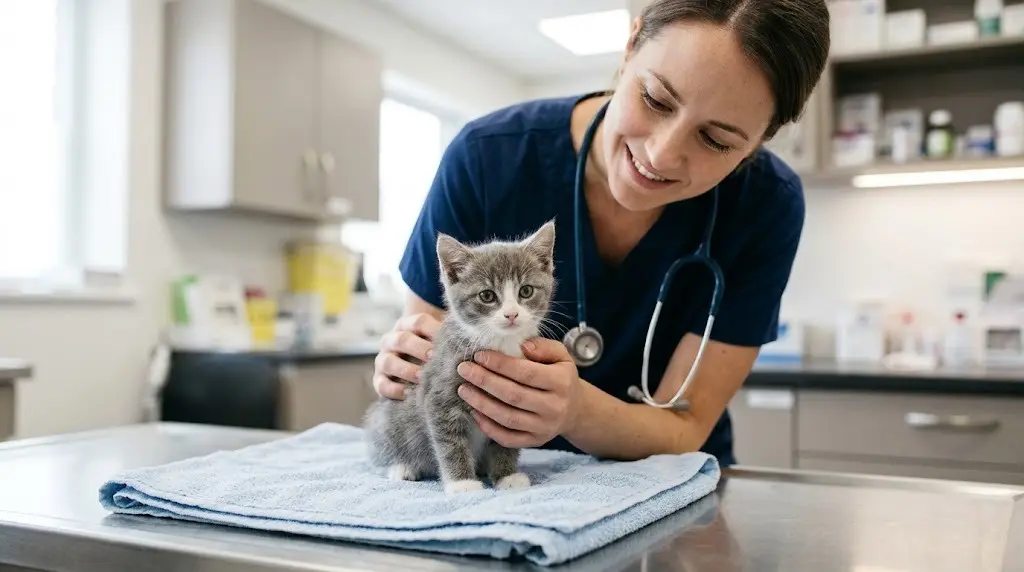
Kittens absorb protective antibodies from their mother’s milk in the first hours after birth. Those antibodies also block vaccines, and they last only a few weeks, so kittens get a series of doses timed to cover the gap (Cornell). Merck’s professional summary of the current guidelines gives this schedule:
- Panleukopenia, herpesvirus and calicivirus: first dose at 6 to 8 weeks, then every 3 to 4 weeks until 16 to 20 weeks old. Another dose follows at 6 months, then one every 3 years.
- Feline leukemia: at 8 to 12 weeks, with a booster 3 to 4 weeks later. After that, yearly for high-risk cats and every 2 to 3 years for lower-risk cats.
- Rabies: timing follows local law.
Merck’s pet owner chapter adds that kittens need a vet visit every 3 to 4 weeks until about 6 months old (Merck).
Adult Cats and Rescues
- Unknown history: Cornell says an adult cat whose vaccine history is unknown should be treated as unvaccinated and given the full kitten series.
- Overdue cats get boosters, however long it has been since the last dose.
- Exposure still matters: no vaccine is 100% effective, so even vaccinated cats should have as little contact with sick cats as you can manage.
The Risks
Cornell calls the risks of vaccination “rather minimal”. In the short term the main one is an allergic reaction. In the long term, a rare tumor can form at the injection site (feline injection site sarcoma). For that reason, Merck notes, the guidelines suggest injecting cats low on a leg rather than on the body, where a tumor would be easier to remove. Cornell’s bottom line: for the average cat, the benefits of an appropriate vaccination program far outweigh the potential risks. It also lists a myth worth knowing, that every cat should get every vaccine available. Tell your vet about any reaction your cat has had to a past vaccine.
For dogs, see dog vaccines. Herpesvirus and calicivirus are the usual cause of cat sneezing.