Boston Terrier
The Boston Terrier - the "American Gentleman" - is one of the few breeds developed entirely in the United States.
🗓️ Last reviewed: September 2026
Should you get a Boston Terrier?
The honest first screen, before you read on: taken from this profile's own cons and health notes, not from a feeling.
Not for you if …
- you live somewhere hot and want an outdoor dog - a flat face and heat do not mix.
- you want a running partner in summer - short, cool-hour walks are the pattern.
- there is frequent rough play in the house - the prominent eyes get injured, and corneal ulcers are the breed's biggest eye problem.
- you cannot live with snoring and wind - both are standard.
Quick check - four questions
- Does the breeder show the club's tests: annual eye exam, patella, BAER hearing test and the juvenile-cataract DNA test?
- Can you keep the dog cool and out of midday heat, every summer?
- Will you protect the eyes - no face-first play, no cat claws?
- Is a mostly-white or blue-eyed puppy tested for deafness before you commit?
What it costs
First year, before the purchase or adoption fee: about 1,100 (the calculator's assumptions for a small-breed dog: setup, food, vet with vaccines and desexing, extras). Later years: roughly 950. The fee comes on top, once: 50-300 from a shelter or 500-3,000 from a breeder. Figures are in your local currency, method disclosed in the first-year cost calculator.
Cheap to feed, but eye emergencies (ulcers) and airway problems are the bills that arrive without warning; insurance with no brachycephalic exclusion is worth reading the small print for.
Compare
Overview
The Boston Terrier - the "American Gentleman" - is one of the few breeds developed entirely in the United States. Small, tuxedo-marked, and bright-eyed, the Boston combines the muscular compactness of its bulldog ancestors with the lively, sociable temperament of a terrier. It is among the friendliest, most adaptable small breeds and a particularly good fit for first-time dog owners willing to manage its brachycephalic limitations.
History & Origins
The breed began in Boston in 1865 when Robert C. Hooper bought a dog named Judge - an English Bulldog-and-White-English-Terrier cross. Judge and his descendants were bred down in size and refined into a smaller, lighter, more elegant companion. Local dog enthusiasts formed the American Bull Terrier Club, later renamed the Boston Terrier Club, and the AKC recognised the breed in 1893 - the first American breed officially admitted.
Early Boston Terriers were larger and heavier, used for pit fighting and ratting. Over the early 20th century the breed shifted entirely to companionship, and modern Boston Terriers retain only the muscular silhouette as a reminder of their fighting ancestry. Boston was named the official state dog of Massachusetts in 1979.
Appearance
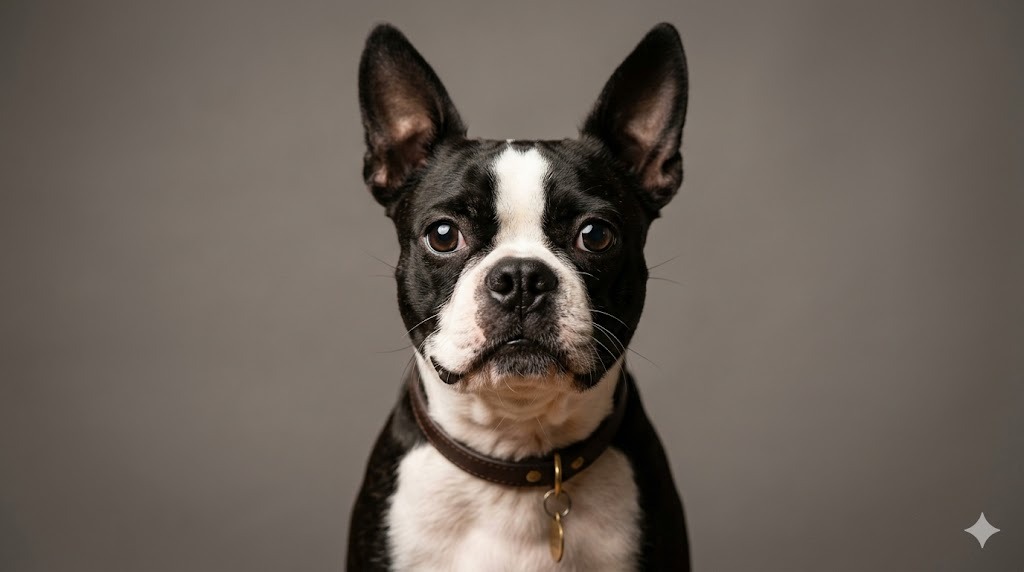
Small, square, compact, with a distinctive tuxedo pattern. Adults stand 25-38 cm (10-15 in) and weigh 5-11 kg (12-25 lb). Three official weight classes exist (under 7 kg, 7-9 kg, 9-11 kg) but the breed is otherwise a single type.
Key features:
- Coat: short, smooth, glossy.
- Colour: brindle, black, or seal (very dark brown that looks almost black), always with required white markings - muzzle band, blaze between the eyes, chest, and forelegs.
- Head: square, flat-topped, brachycephalic with a clean short muzzle.
- Eyes: large, round, dark, prominent, with a soft expression.
- Ears: small, erect, set high; historically cropped (now rare).
- Tail: naturally short - straight or screw, never docked.
Temperament & Character
Friendly, alert, and lively without being hyperactive. The Boston is one of the most adaptable small breeds - sociable with strangers, gentle with children, agreeable with other dogs and cats. Most are excellent in multi-pet homes.
The breed is intelligent and trainable, with a playful streak and a clownish sense of humour. Bostons are not vocal - they bark to alert but are not chronic barkers, making them excellent apartment dogs. Many "snort and snore" charmingly.
Care
Coat & Grooming
The short coat is very low-maintenance: weekly brush with a rubber curry, baths every 6-8 weeks. Sheds moderately year-round.
Wipe facial wrinkles (light folds) and around the eyes daily to prevent infection. The prominent eyes are vulnerable to dryness and corneal injury - gentle saline drops can help in dry climates. Clean ears weekly. Trim nails every 3 weeks. Brush teeth several times weekly.
Exercise & Activity Needs
Moderate. Adults need 45-60 minutes of daily exercise - walks, indoor play, light training. The breed is more athletic than other brachycephalic dogs and many enjoy short jogs, agility, and dock diving.
That said, the short muzzle limits heat tolerance. Avoid midday summer walks; stop activity at the first sign of laboured breathing. Never leave a Boston in a parked car. Most should not swim unsupervised due to top-heavy bodies and breathing limitations.
Health & Lifespan
Average lifespan is 11-13 years; a 2024 UK study found 11.8 years.
Common concerns:
- Brachycephalic issues - variable, generally less severe than French Bulldog or Pug but still significant; some need surgical correction.
- Eye problems - corneal ulcers are, in the breed club's words, the single largest eye problem in Boston Terriers; cataracts (including the inherited juvenile form), glaucoma and cherry eye follow. The prominent eyes are particularly vulnerable.
- Patellar luxation.
- Deafness - unilateral and bilateral congenital deafness occur, particularly in dogs with extensive white; the breed club requires a once-in-a-lifetime BAER hearing test for breeding stock, alongside an annual eye exam, a patella exam and the HSF4 DNA test for early-onset juvenile cataracts.
- Hemivertebrae and spinal disease related to the screw tail.
- Allergies and skin issues.
- Mast cell tumours in older dogs.
- Heart disease.
Feeding & Nutrition
Adults typically eat 1/2 to 1½ cups of quality food per day in two meals, depending on size. The breed is food-motivated; measure portions and limit treats.
Bostons can be prone to flatulence and food sensitivities. Slow-feeder bowls help inhalers. Some do best on a fish or novel-protein diet.
Pros & Cons
Pros
- Friendly, adaptable, family-oriented.
- Good with kids, strangers, dogs, cats.
- Apartment-friendly; modest exercise needs.
- Low grooming requirements.
- Quiet for a small breed.
Cons
- Brachycephalic - heat-intolerant, snoring, occasional breathing issues.
- Eye injuries common.
- Spinal vulnerabilities from screw tail.
- Tendency to flatulence.
- Moderate prevalence of congenital deafness, especially in heavily-white dogs.
Best Suited For
- First-time small-dog owners.
- Apartment dwellers and city families.
- Households with children of any age.
- Multi-pet homes.
- Mild climates or air-conditioned homes.
Not suited for hot-climate outdoor lifestyles, owners wanting a running partner in summer heat, or households with frequent rough play that could injure prominent eyes.
Sources
- AKC, Official Standard of the Boston Terrier - weight classes under 15 lb, 15-20 lb, 20-25 lb: images.akc.org
- Boston Terrier Club of America, health statement - CHIC tests (annual eye exam, patella, BAER) plus HSF4 juvenile cataract DNA test: cdn.akc.org
- Boston Terrier Club of America, Health Certification Program: bostonterrierclubofamerica.org
- OFA / CHIC - breed-specific health testing requirements: ofa.org
- McMillan et al., Scientific Reports 2024 - UK life expectancy by breed (584,734 dogs): nature.com
- Wikipedia, Boston Terrier - brachycephalic airway, dystocia and caesarean rates, with primary references: en.wikipedia.org
Facts on this page were checked against these sources on 25 September 2026.
🐾 Everyday gear for dogs
Links go to Amazon or a partner brand's own store and may earn us a commission at no extra cost to you. As an Amazon Associate we earn from qualifying purchases. We link gear types, not sponsors' picks: you choose the exact product.
Boston Terrier puppy growth chart
A typical growth curve for a toy breed like the Boston Terrier, estimated from its adult weight of 5-11 kg. Puppies vary with sex, genetics and diet, so treat this as a guide - for your own puppy, use the puppy weight predictor.
| Age | Typical weight | % of adult |
|---|---|---|
| 2 mo | 1.7-3.6 kg | 33% |
| 3 mo | 2.3-5 kg | 45% |
| 4 mo | 2.8-6.1 kg | 55% |
| 6 mo | 3.8-8.3 kg | 75% |
| 9 mo | 4.8-10.5 kg | 95% |
| 12 mo | 5-11 kg | 100% |
| Adult | 5-11 kg | 100% |
Boston Terrier - frequently asked questions
Are Boston Terriers good with kids?
Excellent - sociable, gentle, and tolerant. Supervise toddlers; the prominent eyes are vulnerable to accidental injury.
Do Boston Terriers shed?
Moderately. The short coat sheds steadily year-round but is easy to manage with weekly brushing.
Are they easy to train?
Yes - bright, eager to please, and quick learners. Reward-based methods work beautifully.
How is heat tolerance?
Limited. Avoid midday summer activity. Better than French Bulldog or Pug; worse than non-brachycephalic small breeds.
Are Bostons hypoallergenic?
No - they shed and produce dander.
🧠 Test yourself: guess the dog
Three clues from our quiz bank, each about another of our dogs. Can you name them?
Clue 1.Once called the 'bobtail,' this drovers' dog has a loud, distinctive 'pot-casse' or cracked-bell bark.
It's the Old English Sheepdog - read the full profile →
Clue 2.With a broad head, rust-colored markings, and a muscular frame, this driving dog is among the oldest herding breeds.
It's the Rottweiler - read the full profile →
Clue 3.An all-purpose Irish farm dog whose flowing, silky coat lacks the harsh wiry texture typical of most terriers.
It's the Soft Coated Wheaten Terrier - read the full profile →
💛 Adoptable Boston Terriers near you
Real dogs of this breed (and close mixes) waiting in shelters and rescues right now, live from Petfinder. We have no affiliation and earn nothing - if someone catches your eye, the link goes straight to their shelter. New to adopting? Start with our adoption guide.
Widget not loading (some ad-blockers hide it)? Search directly on petfinder.com.